










Jullundur Motor Agency shifts buyback tax to capital gains
Key highlights
- Jullundur Motor Agency says no company-level tax applies to buyback distributions undertaken on or after April 1, 2026.
- Qualifying non-promoter long-term gains above Rs 1.25 lakh are stated at 12.5%, plus applicable surcharge and cess.
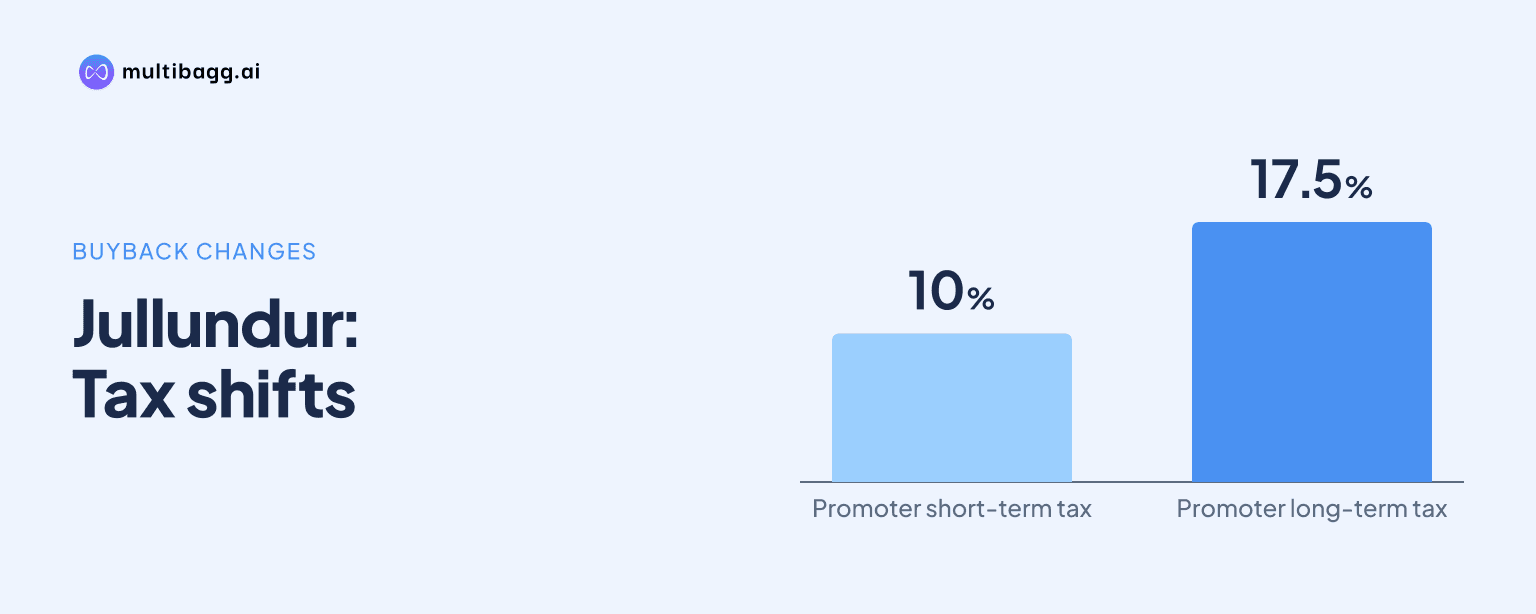
- Promoters other than domestic companies face additional tax of 10% on short-term gains and 17.5% on long-term gains.
- Jullundur Motor Agency says resident shareholders will have no tax deducted at source on buyback consideration.
powered by IRIS
Jullundur Motor Agency (Delhi) Limited says its buyback consideration will be taxable as shareholder capital gains for buybacks undertaken on or after April 1, 2026, rather than attracting company-level buyback tax. Its tax note sets a 12.5% rate on qualifying non-promoter long-term gains above Rs 1.25 lakh, before applicable surcharge and health and education cess.
Know Jullundur Motor Agency (Delhi) inside out
Results, valuation, peers and who's buying, in one view.
How will Jullundur Motor Agency's buyback be taxed?
Jullundur Motor Agency says it will not pay tax on the amount distributed in this buyback because the revised regime applies from April 1, 2026. Instead, a shareholder's capital gain is generally the difference between buyback consideration and the cost of acquiring the accepted shares, taxable in the year the company purchases them.
The treatment has changed twice since July 2019. Before October 1, 2024, listed companies undertaking qualifying buybacks paid 20% additional income tax on distributed income under Section 115QA of the Income-tax Act, 1961, plus surcharge and cess. From October 1, 2024 to March 31, 2026, the company levy was withdrawn and buyback consideration was taxed as deemed dividend in shareholders' hands.
The current position follows amendments made by the Finance Act, 2026 to the Income-tax Act, 2025, including changes to Section 69. Shares listed on a recognised Indian stock exchange are long-term capital assets when held for more than 12 months immediately before transfer; shares held for 12 months or less are short-term assets.
What capital-gains rates apply to Jullundur Motor Agency holders?
Jullundur Motor Agency states that non-promoter shareholders face 12.5% tax on qualifying long-term capital gains above Rs 1.25 lakh in the relevant tax year, or 20% tax on short-term capital gains. Both rates are subject to applicable surcharge and health and education cess, while the Rs 1.25 lakh threshold applies only to long-term gains covered by Section 198.
Promoters are subject to the ordinary capital-gains rates and an additional income tax under Section 69(2)(b), unlike non-promoter holders. Promoters other than domestic companies, including non-residents, have additional tax of 10% on short-term gains and 17.5% on long-term gains. Domestic-company promoters have additional rates of 2% and 9.5%, respectively.
Jullundur Motor Agency says the additional promoter tax carries a flat 12% surcharge, plus health and education cess, while the normal capital-gains tax remains subject to otherwise applicable surcharge rates. A capital loss arises where acquisition cost exceeds consideration and is subject to the Income-tax Act's set-off and carry-forward provisions. For shares acquired before February 1, 2018, the tax note cites grandfathering rules in Sections 90(7) and 90(8).
Got a follow-up? Ask IRIS
Will Jullundur Motor Agency deduct tax from shareholders?
Jullundur Motor Agency says it is not required to deduct tax at source for resident shareholders. For non-residents, it must withhold tax when a payment is chargeable in India, at the earlier of payment or credit, using stated rates of 20% for short-term gains and 12.5% for long-term gains, plus relevant surcharge, cess and promoter-specific tax.
Foreign institutional investors and foreign portfolio investors, referred to as FIIs and FPIs, have a separate mechanism under Section 393. Jullundur Motor Agency says no tax is to be deducted from buyback consideration payable to FIIs or FPIs for capital gains on securities covered by Section 210; those investors must discharge their tax liability directly.
For other non-residents, withholding will be calculated using documentary evidence supporting acquisition cost. Without that evidence, Jullundur Motor Agency may deduct tax from the whole consideration payable. A holder seeking Double Tax Avoidance Agreement relief must submit a Tax Residency Certificate for tax year 2026-27, Form 41 under Rule 75, PAN details or the prescribed alternative, and treaty-related declarations.
How qualified is Jullundur Motor Agency's tax summary?
Jullundur Motor Agency says its tax disclosure is based on an opinion from Adeesh Mehra & Co., Chartered Accountants, dated November 19, 2026. The opinion is based on the Income-tax Act, 2025, Income-tax Rules, 2026, and prevailing judicial and administrative interpretations, each of which may change through later legislative, regulatory, administrative or judicial decisions.
The tax note says shareholders should consult their own advisers because the outcome can depend on residence status, holding period, acquisition-cost evidence, promoter status and treaty eligibility. It also notes that non-residents may face tax in their country of residence and need to assess availability of credit for Indian taxes. Securities Transaction Tax applies because the buyback will settle through the stock-exchange mechanism.
Conclusion
Jullundur Motor Agency's disclosure moves the central buyback tax calculation from the company to shareholders for transactions from April 1, 2026. The distinction is particularly relevant for promoters, who face ordinary capital-gains tax plus additional tax of up to 17.5% on long-term gains, before the stated 12% surcharge on that additional levy and cess.
The next item to watch is documentation from non-resident holders for tax year 2026-27, since absent acquisition-cost evidence may lead to withholding on the entire consideration. Shareholders holding physical shares also face a December 1, 2026, 5:00 p.m. IST deadline for the tender documents specified in the offer.