










Jullundur Motor Agency (Delhi) Q2 Profit Rises 14.5% YoY
Key highlights
- JMA reported Q2 FY27 revenue of ₹155.37 crore, up 9.69% year-on-year.
- JMA's Q2 FY27 net profit rose 14.55% year-on-year to ₹6.85 crore.
- Operating profit margin declined to 4.68% in Q2 FY27 from 5.45% in Q1 FY27.
- JMA approved a buyback of up to 20 lakh shares at ₹112 each, with a maximum value of ₹22.4 crore.
powered by IRIS
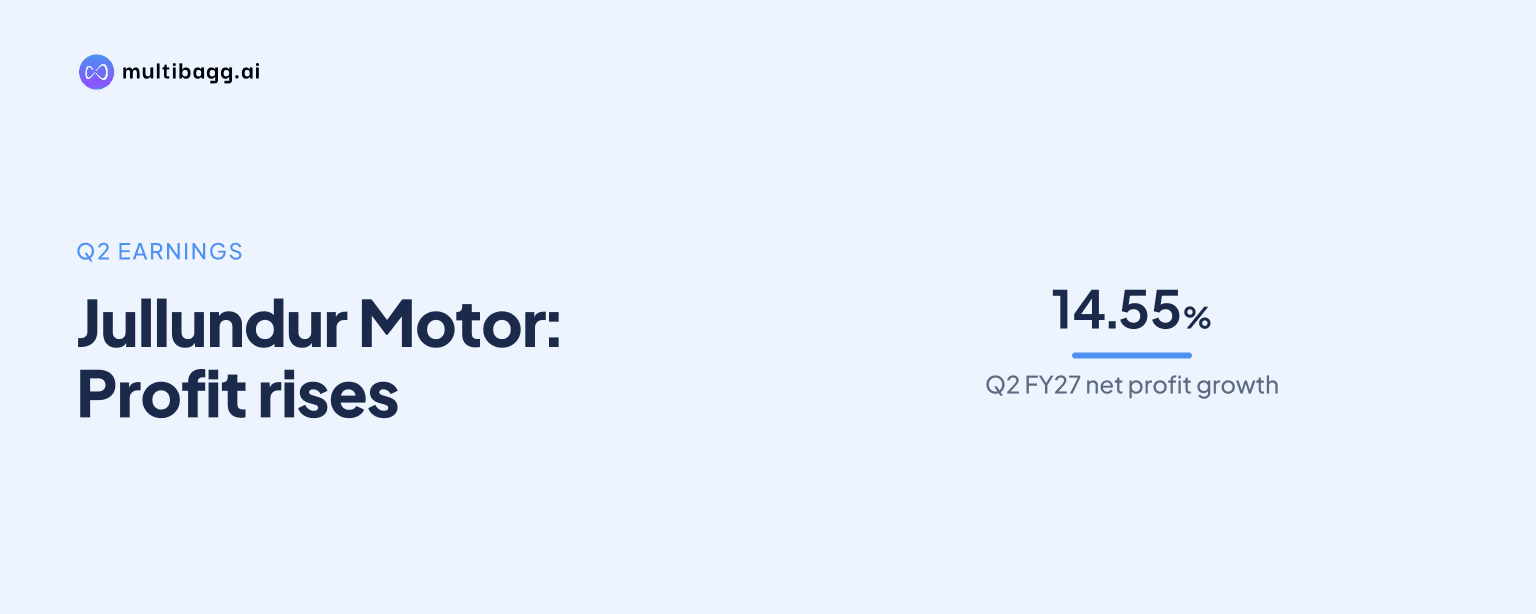
Jullundur Motor Agency (Delhi) Limited reported consolidated net profit of ₹6.85 crore for Q2 FY27, up 14.5% year-on-year, as revenue from operations increased 9.7% to ₹155.37 crore. The September 2026 quarter also showed a sequential decline in revenue, operating profit and margins compared with the June quarter.
Know Jullundur Motor Agency (Delhi) inside out
Results, valuation, peers and who's buying, in one view.
What did Jullundur Motor Agency (Delhi) report for Q2 FY27?
Jullundur Motor Agency (Delhi) Limited, referred to as JMA, reported consolidated revenue from operations of ₹155.37 crore for the quarter ended September 30, 2026. Revenue was higher than ₹141.65 crore in Q2 FY26, representing growth of 9.69% year-on-year. The company announced the results for the July-September quarter on November 12, 2026.
Consolidated profit after tax stood at ₹6.85 crore, compared with ₹5.98 crore in the corresponding quarter of the previous financial year. This translated into year-on-year growth of 14.55%. Earnings per share were ₹2.95 in Q2 FY27, against ₹2.57 in Q2 FY26.
The results show that JMA maintained year-on-year growth across revenue, operating profit and net profit. However, the quarter-on-quarter comparison was weaker, with the June 2026 quarter having benefited from higher revenue and operating profitability.
How did JMA perform compared with the June 2026 quarter?
JMA's revenue declined 3.18% sequentially from ₹160.47 crore in Q1 FY27 to ₹155.37 crore in Q2 FY27. Expenses fell 2.4% quarter-on-quarter to ₹148.10 crore, but the reduction was not enough to prevent a decline in operating profit.
Operating profit decreased to ₹7.27 crore from ₹8.75 crore in the June quarter. The resulting operating profit margin declined to 4.68% from 5.45%, a contraction of about 77 basis points. The margin movement is relevant because it indicates that operating costs remained a significant factor even as sales stayed above the year-ago level.
Net profit fell from ₹7.96 crore in Q1 FY27 to ₹6.85 crore in Q2 FY27, a sequential decline of about 13.9%. Profit after tax margin also moved down to 4.41% from 4.96% in the preceding quarter. Profit before tax was ₹9.26 crore in Q2 FY27, compared with ₹10.66 crore in Q1 FY27.
Why did margins decline despite year-on-year growth?
JMA's operating profit grew 15.19% year-on-year, faster than the 9.69% rise in revenue, and operating margin improved from 4.46% in Q2 FY26 to 4.68% in Q2 FY27. This indicates that the company delivered better profitability than in the year-ago quarter.
But the sequential trend was different. Revenue declined by ₹5.10 crore from Q1 FY27, while operating profit declined by about ₹1.48 crore. The reported quarterly figures therefore point to margin pressure in comparison with the immediately preceding quarter, rather than a year-on-year deterioration.
Other income was ₹2.24 crore in Q2 FY27, marginally higher than ₹2.13 crore in Q1 FY27. Depreciation was ₹0.25 crore, compared with ₹0.22 crore in the June quarter. The company reported no interest expense in the quarterly financial data provided.
Got a follow-up? Ask IRIS
What did JMA's board approve with the September-quarter results?
JMA's board approved the unaudited financial results for the quarter and half year ended September 30, 2026, along with the limited review reports, at its meeting on November 12, 2026. The company subsequently submitted the results to the exchange.
The board also approved a share buyback of up to 20 lakh equity shares with a face value of ₹2 each at ₹112 per share. The maximum buyback size is ₹22.4 crore. The disclosed record date for the buyback is November 18, 2026.
The buyback approval is a separate capital-allocation decision from the quarterly operating performance. Its terms specify the maximum number of shares, the buyback price and the overall amount, while the reported results provide the financial context at the end of the September quarter.
What do the results mean for investors and the automobile spares business?
For investors, the key point is the contrast between year-on-year growth and quarter-on-quarter moderation. JMA's revenue and profit were above the comparable period last year, while the sequential fall in revenue, operating profit and margins highlights the importance of monitoring whether the June-quarter margin level can be sustained.
JMA operates in India's automobile spares and components industry, where sales performance and profitability are important operating measures. In Q2 FY27, revenue remained above ₹155 crore and expenses were ₹148.10 crore, leaving a relatively narrow operating profit margin of 4.68%. This makes changes in costs and sales volumes material to quarterly profitability.
The company's recent quarterly record also shows variation in margins. Operating profit margin was 7.21% in March 2025, 4.46% in September 2025, 6.29% in March 2026, 5.45% in June 2026 and 4.68% in September 2026. These reported figures provide context for the September-quarter sequential decline without establishing a future trend.
Conclusion
JMA delivered a 14.55% year-on-year increase in Q2 FY27 net profit to ₹6.85 crore and a 9.69% rise in revenue to ₹155.37 crore. The result was tempered by a sequential decline in sales, operating profit, net profit and operating margins from the June 2026 quarter.
Investors will next watch the implementation of the approved buyback, for which November 18, 2026 is the record date, and the company's subsequent quarterly disclosures for changes in revenue growth, costs and operating margin.