










Envirotech Systems Limited Declares Rs 1 Interim Dividend for FY27
Key highlights
- Envirotech Systems declared a Rs 1 per equity share interim dividend for FY2026-27.
- The dividend record date is November 20, 2026.
- Standalone revenue fell 5.5% year on year to Rs 24.62 crore in the half year ended September 2026.
- Standalone profit after tax declined to Rs 10.20 lakh from Rs 597.57 lakh a year earlier.
powered by IRIS
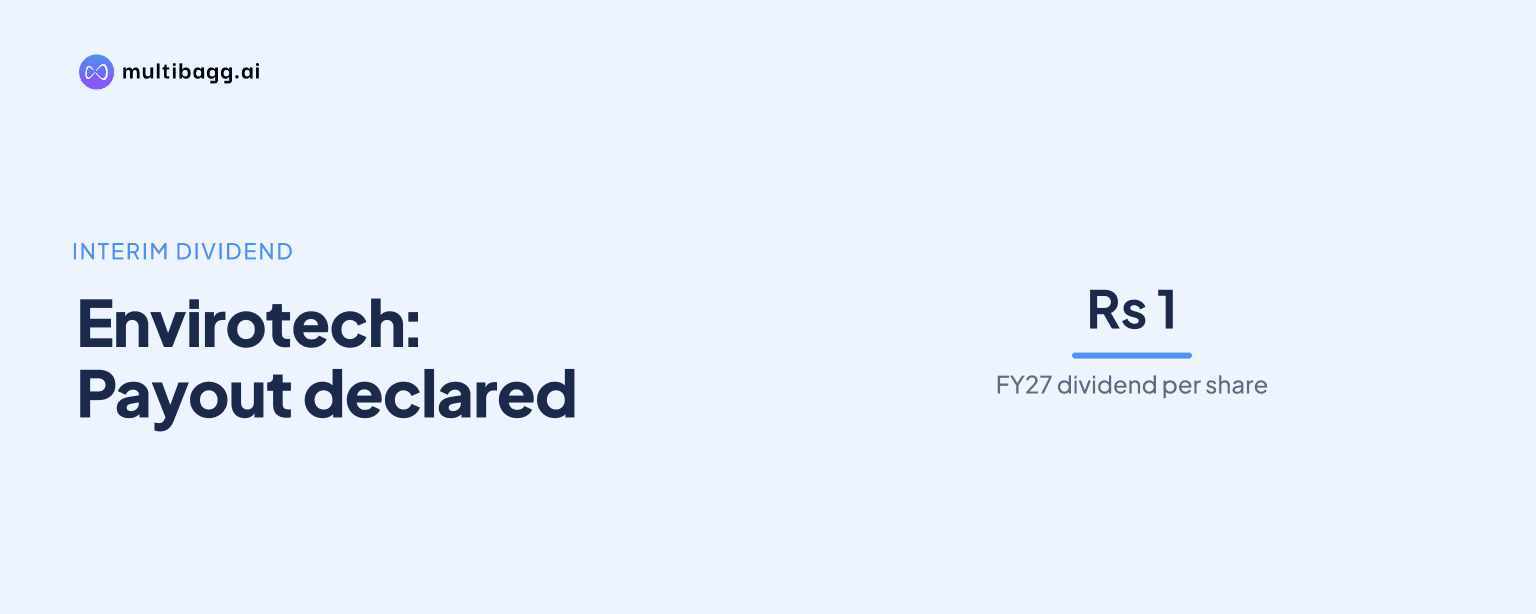
Envirotech Systems Limited declared a Rs 1 per equity share interim dividend for FY2026-27 despite standalone half-year profit falling to Rs 10.20 lakh from Rs 597.57 lakh a year earlier. The company fixed November 20, 2026, as the record date, while its promoter group voluntarily waived its dividend entitlement.
Know Envirotech Systems inside out
Results, valuation, peers and who's buying, in one view.
What dividend has Envirotech Systems declared?
Envirotech Systems declared its first interim dividend of Rs 1 per equity share for FY2026-27 at a board meeting held on November 14, 2026. The dividend represents 10% of the Rs 10 face value of each equity share, according to the company announcement.
The record date for determining eligible shareholders is November 20, 2026. Investors whose names appear in the company records or depository records on that date will be eligible, subject to the usual settlement and holding requirements applicable to listed shares.
The company stated that the promoter group has voluntarily waived its entitlement to the interim dividend. This means the dividend distribution will not be paid on the promoter group's eligible shareholding, reducing the company's overall cash outgo compared with a distribution paid across all qualifying equity shares.
Why did Envirotech Systems announce the dividend now?
Envirotech Systems announced the interim dividend alongside approval of its unaudited standalone financial results for the half year ended September 30, 2026. The filing does not state a specific reason for the board's decision beyond the declaration and the promoter group's waiver.
The waiver was described as a measure to retain funds for expansion. It allows the company to make a dividend payment to eligible non-promoter shareholders while preserving a portion of cash that would otherwise have been distributed to promoters.
The announcement came during a period when several listed companies disclosed interim dividend decisions and record dates. However, each company's dividend policy, cash position, shareholder structure and capital requirements differ, so the Envirotech Systems declaration should be assessed alongside its own standalone financial results.
How did Envirotech Systems perform in the September half year?
Envirotech Systems reported standalone revenue from operations of Rs 24.62 crore for the half year ended September 30, 2026, compared with Rs 26.04 crore in the corresponding previous-year period. Revenue was therefore lower by about 5.5% year on year.
Standalone profit after tax declined sharply to Rs 10.20 lakh, or Rs 0.10 crore, from Rs 597.57 lakh, or Rs 5.98 crore, in the previous-year half year. The reported figures indicate a substantial reduction in profitability despite the relatively modest decline in revenue.
Operating cash flow was negative at Rs 47.56 lakh during the reported half year, compared with positive operating cash flow of Rs 430.28 lakh in the prior-year period. This movement is relevant because operating cash flow indicates the cash generated or used by core business operations during the period.
Got a follow-up? Ask IRIS
What does the promoter waiver mean for shareholders and investors?
The promoter waiver means eligible public shareholders can receive the declared Rs 1 per share interim dividend, while the promoter group will not receive its corresponding dividend amount. The direct effect is a lower total distribution from the company than would have occurred without the waiver.
For investors, the dividend provides a defined per-share cash entitlement, but it does not change the reported decline in half-year profit or the negative operating cash flow. The market update did not provide an immediate share-price reaction to the filing, so the announcement itself does not establish a confirmed effect on the stock.
The financial results and dividend should be considered together. The profit decline and cash-flow movement are material operating data points, while the promoter waiver indicates that promoters have chosen not to participate in this particular payout in order to leave more funds within the business for expansion.
Why are the record date and financial results important?
The November 20 record date is important because it sets the date used to identify shareholders entitled to the interim dividend. A shareholder's eligibility is based on shares held in accordance with the applicable settlement process by the record date, rather than on the date the dividend was announced.
The half-year results provide the financial context for the distribution. Revenue, profit after tax and operating cash flow are separate measures: revenue records business income, profit reflects earnings after expenses and taxes, and operating cash flow tracks cash generated or consumed by operations.
For Envirotech Systems, the available data show lower revenue, a steep reduction in standalone profit and negative operating cash flow for the September half year. The company has nevertheless declared a Rs 1 interim dividend, with promoters foregoing their share of the payout.
Conclusion
Envirotech Systems has declared a Rs 1 per share interim dividend for FY2026-27, with November 20, 2026 as the record date. The decision follows a half year in which standalone revenue declined to Rs 24.62 crore, profit after tax fell to Rs 10.20 lakh and operating cash flow turned negative at Rs 47.56 lakh.
Investors can watch the dividend payment process after the record date and future disclosures on expansion, working-capital trends and operating performance. The promoter group's waiver remains a notable part of the announced distribution because it retains funds that would otherwise have been paid out to that shareholder category.