










Juniper sees BESS arbitrage persist as battery costs ease
Key highlights
- Juniper said first-half power demand grew more than 10%, net of increased rooftop-solar generation.
- Juniper expects battery-container prices to ease to about 66-68 from around 68-70.
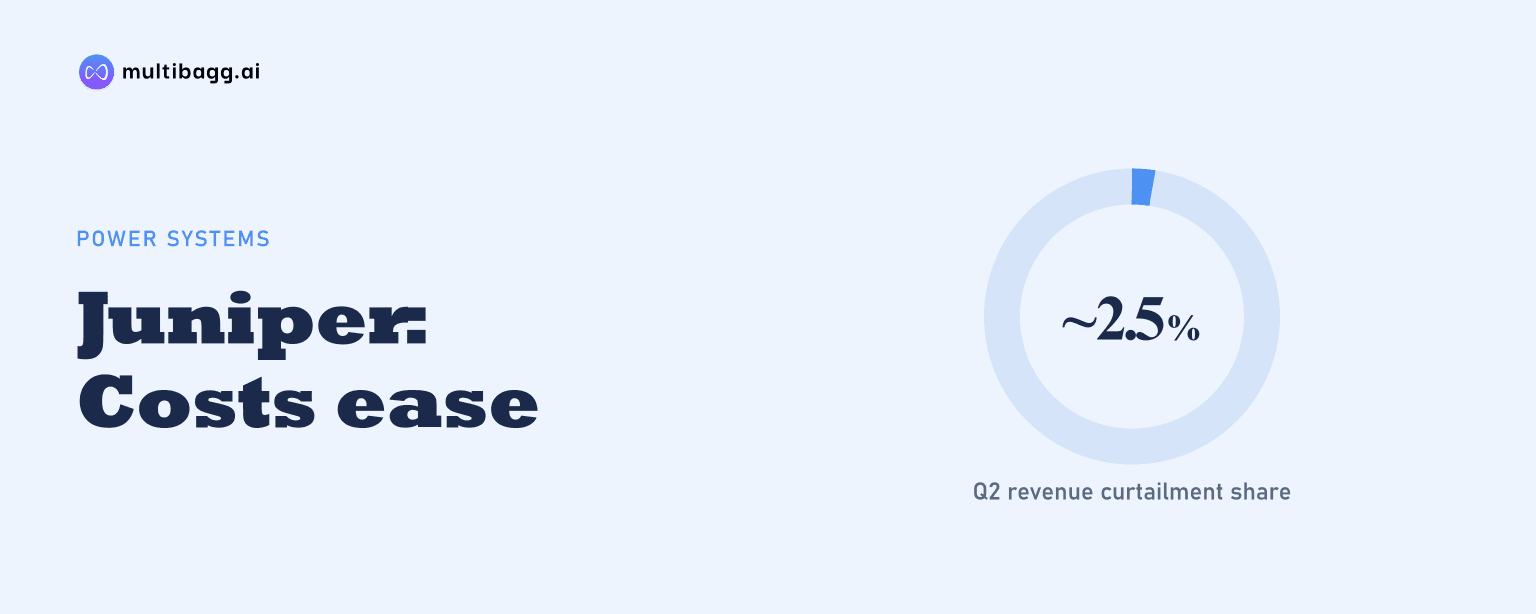
- Juniper reported second-quarter curtailment of around 2.5% of overall revenue, mainly in July and August.
- Juniper expects close to half of its 1,300 megawatt-hour Beta battery to operate by March 2027.
powered by IRIS
In the first half, Juniper said merchant battery energy storage system, or BESS, arbitrage should persist because power demand grew more than 10% while expected standalone-storage supply has been delayed, even as battery-container prices may decline to about 66-68 from 68-70. Management intends to give each battery a long-term contractual destination.
Know Juniper Green Energy inside out
Results, valuation, peers and who's buying, in one view.
Why does Juniper expect merchant BESS arbitrage to persist?
Juniper expects merchant BESS arbitrage to continue because standalone storage that had been expected from competitive tenders has not come online, while power demand rose by more than 10% in the first half. Management said this demand growth was net of additional rooftop-solar generation, which it said had also increased.
Management did not provide a deadline for the opportunity, a realised trading spread or an FY28 merchant-storage revenue forecast. Its explanation was that awarded standalone BESS capacity must still be replaced and that this takes time, whereas higher electricity demand increases the need to shift power between lower-demand charging periods and higher-demand discharge periods.
Juniper attributed the delayed standalone additions to tariffs that management described as ultra-aggressive and to some bidders having limited electricity-sector experience. The company said it was assessing storage step by step rather than assuming a permanent market condition, but it expects the present supply-demand imbalance to support merchant activity.
How will Juniper limit long-term merchant battery exposure?
Juniper plans to use merchant operation in the near term but move batteries into long-term firm and dispatchable renewable energy, or FDRE, contracts over time. Management said every battery being installed has a long-term solution, although some are completely merchant today and have not been assigned to a specific power purchase agreement, or PPA.
At Bhadla, Juniper said one merchant battery is separate from its FDRE project and is not yet allocated to a PPA. It will mostly charge from the grid before it is placed in a future long-term PPA, while curtailed renewable output can also be used for charging when available.
Juniper is also participating in shorter contracts with distribution companies, or DISCOMs. Management said DISCOM contracts have commonly run for one or three months, with tenders now extending to six to nine months as buyers become more cautious about prices on the power exchange. Juniper said it would enter those contracts if rates are attractive, without treating a medium-term PPA as its principal solution.
How much could Juniper’s battery-container prices decline?
Juniper expects battery-container prices to soften to roughly 66-68 from around 68-70, a decline management estimated at about 1-2%. The transcript did not specify the currency, measurement unit, supplier or delivery period for those container-price figures.
Management linked the projected movement to lithium carbonate, which it said had risen from 60,000-70,000 yuan per tonne to about 170,000 yuan per tonne before falling to 100,000 yuan per tonne. It said the commodity decline would otherwise imply a 7-8% battery-price reduction, but the removal of a 6% Chinese export incentive from January would offset much of that reduction.
The lower battery-cost expectation matters for projects bid in different periods. Management said FDRE projects bid in 2023-24 could produce returns close to 20% after battery prices declined, while hybrid projects were expected to deliver high-teen returns. It described the return range for its recently won thermal-mimicking project as mid to high teens, without disclosing a project-specific percentage.
Got a follow-up? Ask IRIS
What operating role do Juniper’s batteries have at Beta and Stellar?
Juniper said its batteries can manage curtailment as well as conduct merchant trading. At Beta, it has installed a 1,300 megawatt-hour merchant battery and expects close to half of that capacity to be operational by March 2027. Management said the battery should cover potential curtailment even if the related project slips by a couple of months.
The company reported curtailment of around 2.5% of overall revenue in the second quarter, primarily during July and August. Management said transmission lines at the Stellar project were completed in late August and early September, and Juniper had not seen curtailment from September and October after those additions.
Juniper said its existing batteries can absorb remaining central transmission utility, or CTU, constraints, and management described available storage as more than sufficient for that purpose. This operational use differs from the Bhadla merchant model because a battery can preserve renewable output that might otherwise be constrained as well as charge from the grid for later discharge.
What capacity and transmission milestones support Juniper’s plan?
Juniper expects the transmission associated with its FY28 projects to be available in time for capacity commissioning. Management said the relevant transmission dates were no later than June 2027, despite being six to nine months behind original schedules that in some cases had targeted December 2026 or earlier.
Management said state transmission utility capacity supported first-half growth because it is not affected by the same constraints as CTU-linked capacity. Juniper did not say that transmission delays had ended, but it expressed confidence that FY28 capacity would come online based on the currently scheduled transmission dates.
Juniper put the earnings before interest, tax, depreciation and amortisation, or EBITDA, run rate at Rs 1,900 crore for 2.8 gigawatts commissioned to date. Management expects an EBITDA run rate of Rs 2,750 crore for nearly 3.9 gigawatts peak by March 2027, representing an expected Rs 850 crore increase alongside roughly 1.1 gigawatts of additional capacity.
Conclusion
Juniper’s storage position combines a near-term merchant-arbitrage expectation with a longer-term plan to place batteries under FDRE contracts. Management cited first-half power-demand growth above 10%, delayed standalone BESS additions and an expected battery-container price range of 66-68 as the key economics, while batteries reduced the effect of second-quarter curtailment of around 2.5% of revenue.
The next disclosed milestones are close to half of the 1,300 megawatt-hour Beta battery becoming operational by March 2027 and transmission dates no later than June 2027 for FY28 projects. Management’s assumptions will also be tested by whether container prices reach 66-68 after January and whether merchant batteries secure the long-term PPAs Juniper has identified as their eventual destination.