










Juniper Green says battery buffer limits Beta delay risk
Key highlights
- Juniper Green has a 1,300 MWh merchant battery at Bhadla, with about half expected to operate by March 2027.
- Juniper Green reported Q2 FY27 curtailment of about 2.5% of overall revenue, mainly during July and August at Stellar.
- Juniper Green commissioned about 500 MWh of battery capacity in the first seven months of FY27 across 11 sites.
- Juniper Green maintained FY27 guidance to commission 2 GW of generation capacity and 1.7 GWh of battery capacity.
powered by IRIS
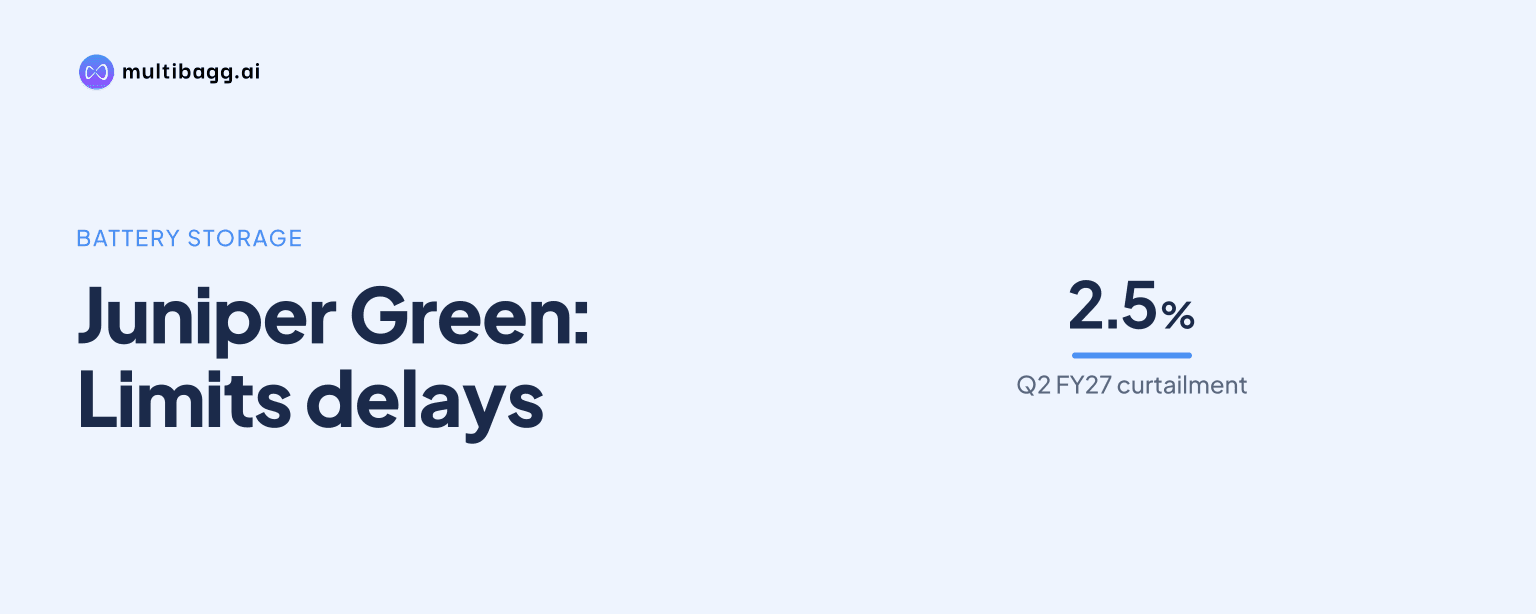
Juniper Green Energy Limited says its 1,300 MWh merchant battery at Bhadla should prevent curtailment even if the Beta transmission project slips a couple of months beyond its expected March 2027 completion, with roughly half of the battery expected to be operational by March.
Know Juniper Green Energy inside out
Results, valuation, peers and who's buying, in one view.
Can Juniper Green prevent curtailment if Beta transmission slips?
Juniper Green says it can cover potential curtailment from a short Beta delay because it has a 1,300 MWh battery at the location. Management said Beta should, in all probability, be completed by March 2027, but added that about half of the merchant battery should be operational by then. Its stated expectation is that this storage capacity would absorb power that could otherwise be curtailed during a delay of a couple of months.
The protection is important because the 1,300 MWh battery is not tied to a specific long-term contract at present. Juniper Green described it as a merchant battery at Bhadla that can charge from the grid and, where required, charge using renewable power affected by curtailment. Management said the battery could later be assigned to one of the company’s power-purchase agreements that has yet to be signed, providing a potential route from merchant operations to longer-term use.
How will the Bhadla battery operate before its long-term use is decided?
Juniper Green plans to use the 1,300 MWh Bhadla battery principally for grid charging while it remains merchant capacity, while using curtailed renewable power for charging if that is required. Management said it remains active in short-term opportunities ranging from one-month and three-month arrangements to tenders of six to nine months, rather than seeking a medium-term contract as a priority.
The company’s approach differs between merchant capacity and its firm dispatchable renewable energy, or FDRE, projects. For its FDRE projects, management said batteries are already part of the project structure and are being installed early. During the initial temporary general network access period, those batteries can charge from the grid and discharge back to the grid. This front-ending is intended to make storage available before all transmission infrastructure is complete.
What does Juniper Green’s recent curtailment experience show?
Juniper Green reported curtailment of about 2.5% of overall revenue in Q2 FY27, concentrated in July and August at the Stellar project. Management said several transmission lines were completed in late August and early September, and that it had not seen curtailment at Stellar during September and October after those additions. This provides the company’s immediate operating context for its confidence on Beta.
At Stellar, one remaining transmission element was the Fatehgarh 3-Bhadla 3 line, which management said was being built by Apraava and was expected in December. The Stellar plant was operating under temporary general network access, and management said the project’s battery, combined with other completed elements, meant it was not facing curtailment at the time of the call. The earlier 2.5% impact therefore reflects a period before the late-August and early-September line completions.
Got a follow-up? Ask IRIS
How much transmission risk does Juniper Green see for FY28 projects?
Juniper Green says its FY28 commissioning projects are supported by transmission elements whose currently stated dates are no later than June 2027, despite delays from original dates in some cases. Management said those original transmission dates were at least one year earlier for the relevant projects, with certain cases delayed by six to nine months. It nevertheless said it remained confident that the FY28 capacity would come online.
The company also pointed to state-transmission capacity as a mitigating factor because it said this capacity is not hampered in the same way as central-transmission projects. Juniper Green said this channel contributed materially to its growth in the first half of FY27. In the first seven months of FY27, it commissioned more than 1 GW of capacity across 11 sites in three states, including 494 MW of solar and 542 MW of wind.
What operating capacity supports Juniper Green’s storage strategy?
Juniper Green had 2.8 GW of operational generation capacity and 600 MWh of operational battery capacity at the time of the call, after commissioning about 316 MW of renewable capacity and 100 MWh of batteries in Q2 FY27. It maintained full-year FY27 commissioning guidance of 2 GW of generation capacity and 1.7 GWh of battery capacity. Management also said its operating batteries had state of health above 99% and round-trip efficiency close to 90%.
The wider portfolio stood at about 11.2 GW plus 9 GWh of batteries, of which 6.1 GW was operational or had signed power-purchase agreements. Juniper Green said 84% of its portfolio was in FDRE and hybrid formats. It also cited connectivity of more than 20 GWh for batteries and surplus generation connectivity of more than 5 GW for future bids, resources that management presented as supporting its construction and storage rollout.
Conclusion
Juniper Green’s position is that installed and front-ended batteries reduce the immediate revenue risk from delayed transmission, rather than eliminating the importance of grid completion. The evidence it offered is the 1,300 MWh Bhadla merchant battery for Beta, the removal of Stellar’s curtailment after late-summer line additions, and the 500 MWh of battery capacity commissioned in the first seven months of FY27.
The next test is March 2027, when management expects roughly half of the Bhadla battery to be operating and Beta to be completed in all probability. Investors will also be watching the company’s plan to spend a further Rs 5,000 crore in the final six months of FY27, taking cumulative capex to Rs 24,000 crore, alongside the expected conversion of more than 1 GW to 1.3 GW of awarded capacity into contracts over the next one to one-and-a-half months.