










Jyothy Labs liquid detergents grow 50% but lag powder margins
Key highlights
- Jyothy Labs said liquid detergents are growing at upwards of 50% every quarter.
- Liquid detergents currently earn lower margins than powders, according to Jyothy Labs management.
- Raw-material and packaging inflation contributed close to 18% to year-on-year gross-margin erosion in Q2.
- Jyothy Labs said 60% to 65% of its cost base is linked to crude derivatives.
powered by IRIS
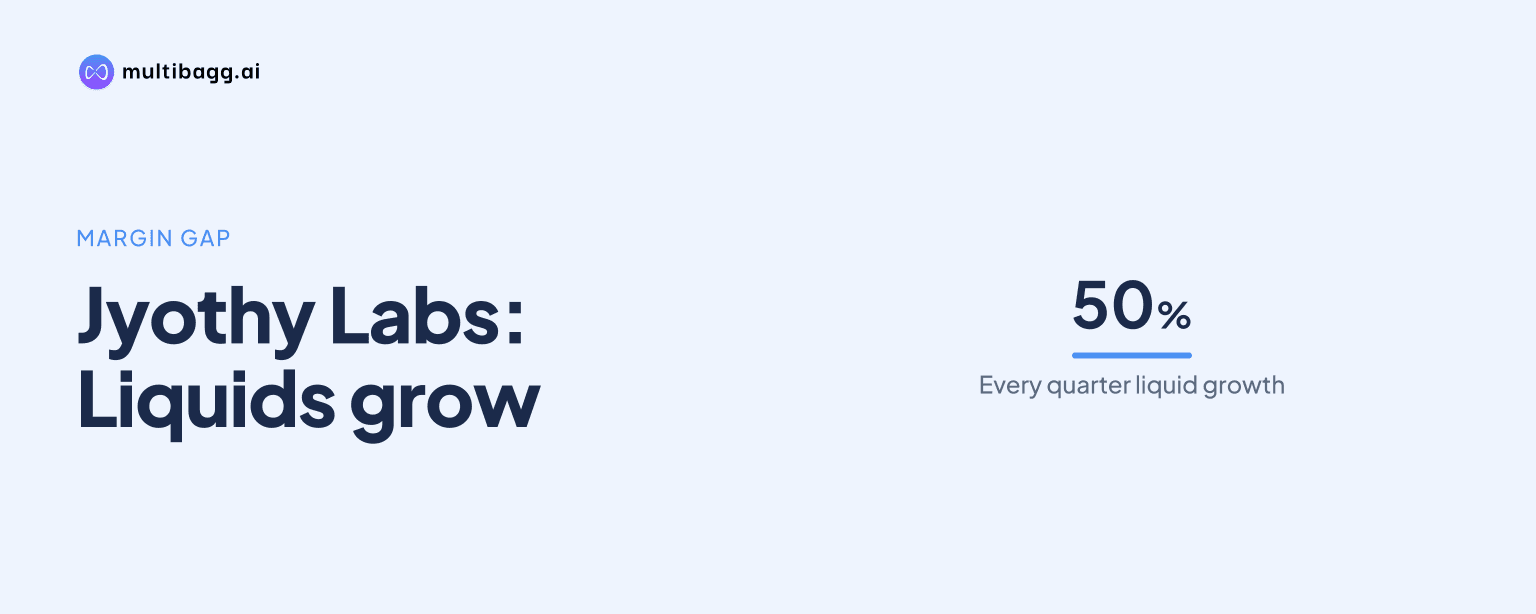
Jyothy Labs said in Q2 that its liquid-detergent category was growing at upwards of 50% every quarter but currently earned lower margins than powders, because the format is still scaling and needs consumer-conversion investment. Management said higher raw-material and packaging costs, rather than liquid mix alone, were the main cause of Fabric Care margin pressure.
Know Jyothy Labs inside out
Results, valuation, peers and who's buying, in one view.
Why do Jyothy Labs liquid detergents earn lower margins than powders?
Jyothy Labs said liquid detergents earn lower margins than powders because the category remains at a scale-building stage and requires investment to convert consumers to the format. Management described current liquid economics as different from powder economics, rather than as evidence of a structural deterioration in the business. It expects higher penetration, scale benefits, procurement efficiency and a richer product mix to improve liquid-detergent unit economics progressively.
The company is accepting this current margin gap because management sees significant strategic opportunity in the format. Jyothy Labs said that, at a growth rate above 50% every quarter, not participating aggressively in liquid detergents would pose a substantially greater strategic risk. This means the Fabric Care portfolio is carrying a faster-growing but currently lower-margin format while management seeks to increase its scale.
How fast are Jyothy Labs liquid detergents growing?
Jyothy Labs said liquid detergents are growing at upwards of 50% every quarter. Management also named liquid detergents and fabric conditioners as priorities for sustained Fabric Care growth in Q3, placing both formats within its near-term category plan. It did not disclose liquid-detergent revenue, volume, market share or the format's share of Fabric Care sales.
The comparison between growth and profitability is clear: liquid detergents are expanding faster than the established powder format but currently earn lower margins. Management said Exo liquid was “shaping up really well” when asked about the departure of Pril and Fa from the distribution basket. It also said that those exits had not led to changes in general-trade or modern-trade terms, including distributor return or credit.
What is driving Jyothy Labs Fabric Care margin pressure?
Jyothy Labs said the larger cause of Fabric Care margin pressure is input-cost inflation. Management estimated that raw-material and packaging-material costs contributed close to 18% to year-on-year gross-margin erosion in Q2. About 4% of sales-price increases and a small benefit from mix partly offset that effect, leaving a net gross-margin impact of about 13% to 13.5% for the quarter.
The cost pressure spans several materials because 60% to 65% of Jyothy Labs' cost base is linked to crude derivatives, management said. It cited inflation in linear alkylbenzene sulphonic acid, sodium lauryl ether sulphate, soap noodles, neem oil, chemicals and packaging materials. While the lower-margin liquid mix has “some bearing” on Fabric Care profitability, management said the impact visible in the segment was largely due to input costs.
Got a follow-up? Ask IRIS
Why is Jyothy Labs using calibrated price increases?
Jyothy Labs said it used calibrated pricing to avoid jeopardising consumer affordability or market share through a large increase in one or two quarters. Management said it had taken about 4% price increases across the portfolio in Q2, with the extent differing by segment, brand, stock-keeping unit and geography. A stock-keeping unit is an individual product variation sold separately.
Management said pricing alone cannot close the full 13% to 14% inflation gap. Its recovery plan includes additional price actions, procurement measures, value engineering, product mix and operating leverage. Low-unit packs are part of the broader portfolio consideration because their fixed selling prices can make cost increases more difficult to absorb, according to management's comments on product mix and affordability.
How does Jyothy Labs expect liquid-detergent economics to improve?
Jyothy Labs expects liquid-detergent economics to improve as household penetration rises, volumes scale, procurement becomes more efficient and the mix becomes richer. These are management expectations rather than a quantified target. The company did not provide a date by which liquid-detergent margins could match powder margins, nor did it quantify the investment being made in consumer conversion.
For the broader business, management said FY27 should be treated as an aberration year because of external conditions, geopolitical developments and input inflation. Jyothy Labs maintained an internal aspiration to deliver double-digit growth, but gave no margin guidance for the second half. It said margin recovery should begin if commodity prices stabilise, while also warning that a full recovery in H2 cannot be assumed unless those prices moderate and remain stable.
What does this mix trade-off mean for Jyothy Labs' wider plans?
Jyothy Labs is pursuing category growth and margin recovery simultaneously, rather than relying on liquid detergents to repair profitability. Management said new-product developments with better margin profiles are one lever alongside pricing, procurement and value engineering. The company also said it continues to evaluate acquisition opportunities, but only where they meet its long-term criteria and fit its checklist.
The company retained its aim of reaching Rs 5,000 crore of revenue, which management discussed as a three-to-four-year objective in response to an analyst's question. Management said new-product developments will form part of that journey, and that launches from the past two or three years had met with reasonable success. It did not identify the categories for its next line of launches or provide a year-by-year revenue path to the Rs 5,000 crore aim.
Conclusion
Jyothy Labs has identified a clear product-mix trade-off in Fabric Care: liquid detergents are growing at upwards of 50% every quarter but currently trail powders on margin. Management nevertheless considers participation necessary while the category develops. The immediate profitability issue is broader, with close to 18% of Q2 year-on-year gross-margin erosion attributed to raw-material and packaging inflation.
The next disclosures to watch are commodity-price movement in H2, the effect of further pricing and procurement actions on the estimated 13% to 14% inflation gap, and whether liquid-detergent scale improves unit economics. Management has also pointed to Q3 growth led by Fabric Care, new-product developments and its continuing Rs 5,000 crore revenue aim as the relevant operating milestones.