










Jyothy Labs EBITDA margin falls to 2.5% in Q2 FY27
Key highlights
- Jyothy Labs’ Q2 FY27 operating EBITDA margin fell to 2.5% from 16.1% a year earlier.
- Q2 FY27 gross margin declined to 34.8% from 48.1%, with RMPM inflation contributing roughly 18%.
- Revenue rose 3.3% to Rs 760 crore, while sales excluding Pril and Fa grew 12.4% by value.
- Jyothy Labs held approximately Rs 846 crore in cash and had zero debt at September 2026.
powered by IRIS
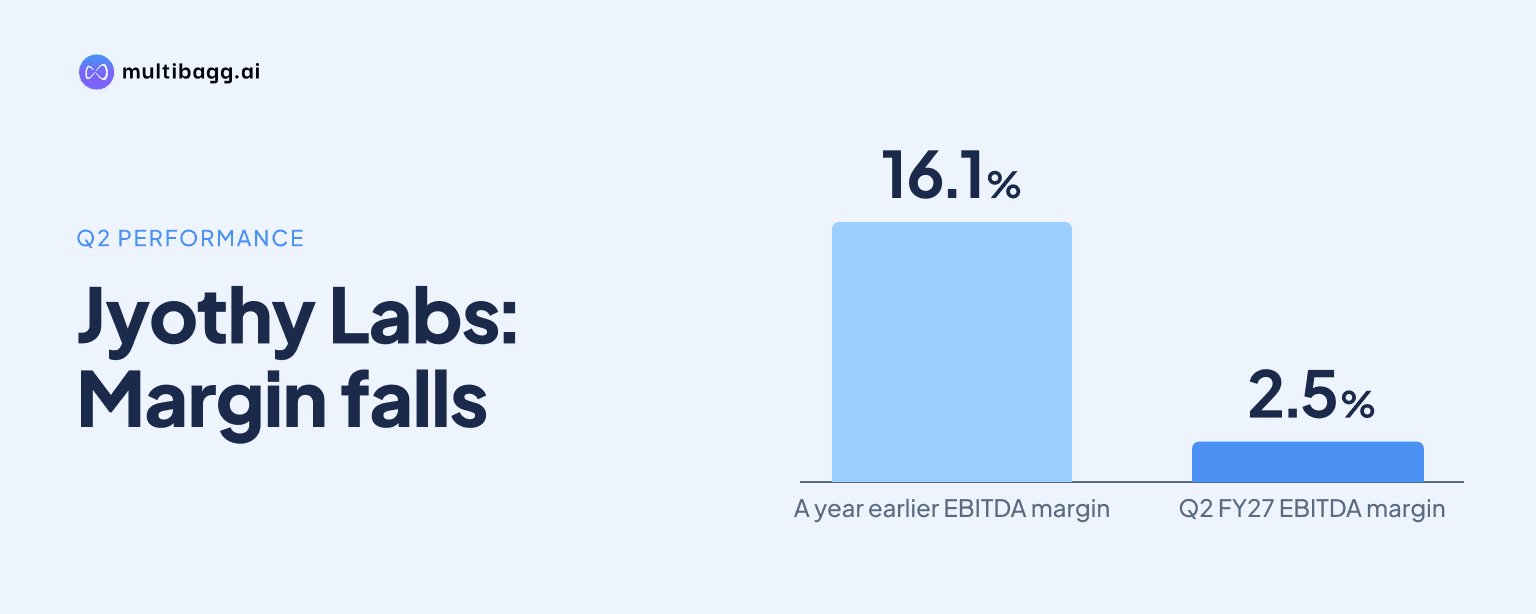
Jyothy Labs Limited’s operating EBITDA margin fell to 2.5% in Q2 FY27, ended September 30, 2026, from 16.1% a year earlier, as roughly 18% raw-material-and-packaging inflation exceeded pricing actions of around 4%. Operating EBITDA was Rs 19 crore, while profit after tax was Rs 10.6 crore.
Know Jyothy Labs inside out
Results, valuation, peers and who's buying, in one view.
Why did Jyothy Labs’ EBITDA margin fall to 2.5%?
Jyothy Labs’ EBITDA margin fell because gross margin contracted to 34.8% in Q2 FY27 from 48.1% in Q2 FY26 and 38.5% in the preceding quarter. Management said raw material and packaging material, or RMPM, inflation contributed close to 18% of the year-on-year cost increase, partly offset by about 4% pricing and a small benefit from product mix. The resulting gross-margin impact was about 13% to 13.5% in the quarter.
The cost increase covered crude derivatives, linear alkylbenzene sulfonic acid, or LABSA, sodium laureth sulfate, or SLES, soap noodles, palm oil and packaging materials. High-density polyethylene, or HDPE, and polypropylene prices were approximately 55% to 60% above levels before the West Asia conflict. Packaging represented around 18% to 20% of the cost base, while crude-linked inputs accounted for nearly 60% to 65% of Jyothy Labs’ consumption basket.
High-cost finished goods held in inventory also continued to affect Q2 FY27 margins. Management said commodity prices softened during July and early August but inflation renewed in October, adding uncertainty. Employee costs rose about 5.7% year on year to nearly 12% of revenue, advertising and promotion spending reached 7.4% of revenue, around 100 basis points higher sequentially, and other expenses increased to about 13% from 12.1% on freight, logistics and export-shipping costs.
How much did pricing offset Jyothy Labs’ input inflation?
Jyothy Labs said pricing actions of around 4% were reflected in Q2 FY27, substantially below the roughly 18% RMPM inflation identified by management. The company is evaluating further selective pricing and grammage adjustments, particularly in lower-unit packs, while considering consumer affordability. Its stated response also includes procurement efficiencies, value engineering, product-mix changes and cost discipline without compromising product quality.
The gap between pricing and costs was evident in Personal Care, where Margo price increases of approximately 10% to 12% did not fully absorb higher palm oil, neem oil and other ingredient costs. Personal Care delivered a little over 11% value growth, supported by Margo pricing and a favourable base after the previous year’s goods and services tax transition. Management said progressively restoring category margins remains a priority.
Management told an analyst that lower-unit packs are important to traditional-trade distribution but have fixed price points that can magnify the effect of material inflation. It identified new product developments with better margin profiles, portfolio-mix changes and back-end efficiencies as margin-recovery measures. Management did not specify the additional pricing required to restore margins to earlier levels.
Got a follow-up? Ask IRIS
Which Jyothy Labs businesses are growing despite margin pressure?
Jyothy Labs’ sales growth was stronger after excluding Pril and Fa, whose brand licence agreement expired in May 2026. Reported Q2 FY27 revenue from operations increased 3.3% to Rs 760 crore from Rs 736 crore, while reported volume declined marginally. Excluding Pril and Fa, value growth was 12.4% and volume growth was 8.1%, supported by core brands, selective pricing, new launches and distribution expansion.
Fabric Care led category growth with 10.4% value growth, while liquid detergents expanded by more than 50% year on year through Henko, Ujala, MoreLight and Mr. White. Ujala Young & Fresh fabric conditioner also performed well, according to management. These liquid-detergent and conditioner formats form part of Jyothy Labs’ product-mix plan as management said detergent margins face greater pressure during material-cost inflation.
Home Care, excluding Pril, grew 15.3%, driven largely by volume, and Exo delivered 23% growth through new variants, liquids, wider distribution and brand investment. In Household Insecticides, or HI, coil contribution fell to 30% to 35% of the portfolio from 43% to 45% a year earlier as Jyothy Labs expanded liquid vaporizers, aerosols and other formats. The company introduced Maxo Agarbatti during Q2 FY27 as part of this expansion.
What does Jyothy Labs expect for margins and working capital?
Jyothy Labs expects underlying business growth to remain healthy in Q3 FY27, led by Fabric Care and new products, but management said gross margins are likely to remain under pressure. It said a full recovery in H2 FY27 cannot be assumed unless commodity prices moderate and remain stable. Its recovery plan is calibrated pricing, procurement savings, value engineering, disciplined cost management and a more favourable product mix.
For H1 FY27, revenue from operations was Rs 1,533 crore, up 3.1% on a reported basis, while reported volume declined marginally. Excluding Pril and Fa, H1 value growth was 10.2% and volume growth was 6.2%. Gross margin was 36.7%, compared with 48.0% a year earlier, while operating EBITDA margin was 5.5% against 16.3%, showing that the Q2 decline followed a broader first-half compression.
Net working capital increased to 23 days at September 2026 from 15 days in March, mainly because input inflation raised inventory values even though inventory volumes remained broadly consistent. Management expects working capital to return gradually to its medium-term range of 18 to 20 days as conditions stabilise. Jyothy Labs held approximately Rs 846 crore in cash and had zero debt, while management expects the full-year effective tax rate to be around 25% to 26%, after 28.4% in H1 FY27.
Conclusion
Jyothy Labs’ Q2 FY27 performance shows that growth in its core categories did not offset an exceptional input-cost shock. Reported revenue rose 3.3% to Rs 760 crore and sales excluding Pril and Fa increased 12.4% by value, but gross margin fell to 34.8% and operating EBITDA margin declined to 2.5%. The divergence reflects crude-linked material, packaging and operating-cost inflation that pricing did not fully recover.
The next indicators are commodity-price stability, the impact of selective price and grammage actions, and the contribution from liquid detergents, fabric conditioners, Exo and newer HI formats. Management’s disclosed Q3 FY27 plan is to sustain underlying growth while progressively restoring profitability, but it has said that full H2 FY27 margin recovery depends on commodity prices moderating and remaining stable.