








Kalind Limited Approves Draft Offer for ₹500 Crore Rights Issue
MAX Plan at ₹4,999/yr

Find your next multibaggerBe a Pro Investor
Research stocks and track your picks on the go. Download the app.
Key highlights
- Kalind’s Rights Issue Committee approved the Draft Letter of Offer for partly paid-up equity shares on 24 November 2026.
- Kalind’s proposed rights issue is capped at ₹500 crore.
- The proposed equity shares have a face value of ₹2 each.
- The record date, issue price and rights entitlement ratio have not been disclosed.
powered by IRIS
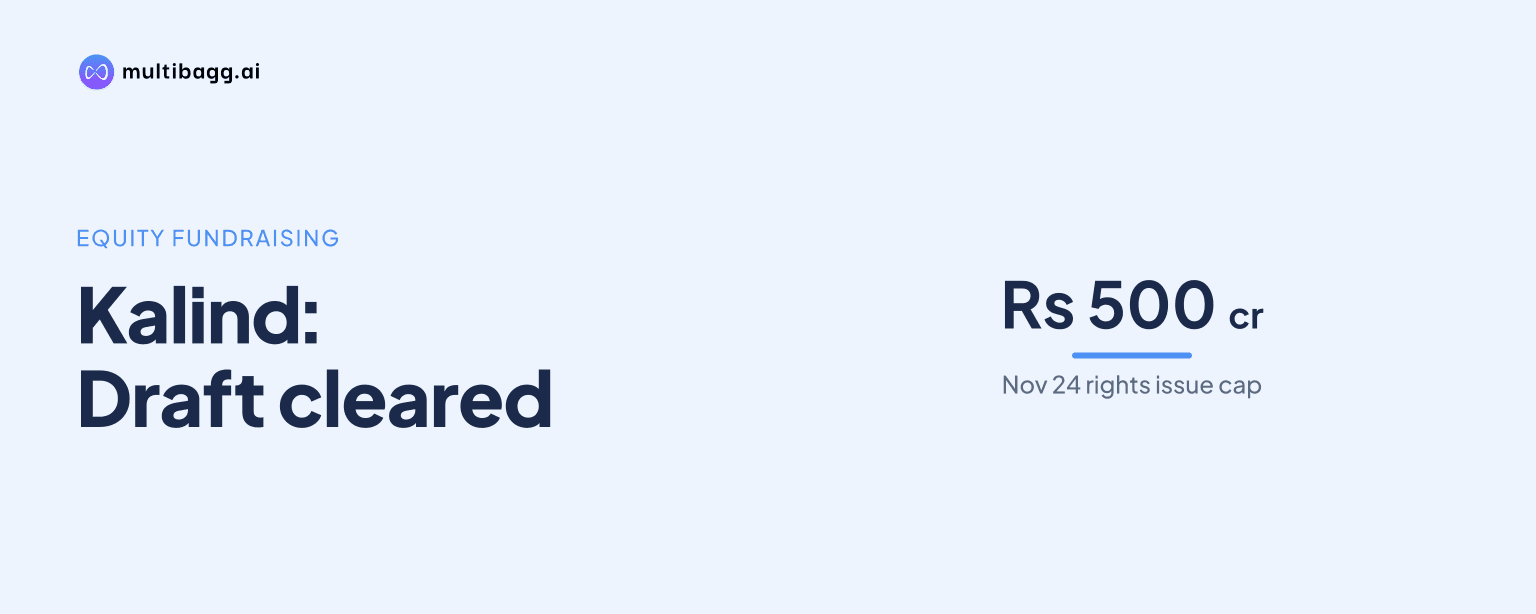
Kalind Limited’s Rights Issue Committee has approved the Draft Letter of Offer for a rights issue of partly paid-up equity shares, taking forward the company’s proposed capital raising of up to ₹500 crore. The filing matters because key commercial terms, including the record date, issue price and entitlement ratio, have not yet been disclosed.
Know Kalind inside out
Results, valuation, peers and who's buying, in one view.
What did Kalind Limited approve in its latest filing?
Kalind Limited approved the Draft Letter of Offer for its proposed rights issue through its Rights Issue Committee. The draft offer relates to partly paid-up equity shares and follows the board’s earlier approval to raise funds through a rights issue of equity shares for an aggregate amount not exceeding ₹500 crore.
Kalind had stated on 18 November 2026 that the shares proposed under the rights issue would carry a face value of ₹2 each. The board had also constituted the Rights Issue Committee to decide and implement detailed terms of the offer. Approval of the draft document is the latest disclosed step in that process.
The filing does not provide the final issue price, rights entitlement ratio, number of shares, payment schedule, issue opening and closing dates, or the final amount to be raised. It also does not state the proposed use of proceeds. The ₹500 crore figure remains the maximum approved size rather than a confirmed final issue amount.
How did Kalind’s proposed rights issue develop?
Kalind’s proposed rights issue developed from its broader fund-raising plans during 2026. On 31 October 2026, the board had approved, in principle, a proposal to raise up to ₹500 crore through one or more permissible modes, including a rights issue, preferential issue, warrants or other securities, subject to required approvals.
The board subsequently approved a rights issue on 18 November 2026, specifically covering equity shares with a face value of ₹2 each and an aggregate value not exceeding ₹500 crore. It empowered the Rights Issue Committee to determine the issue’s quantum, pricing, entitlement ratio, record date, payment terms and other conditions.
The company had earlier disclosed a change in its fund-raising approach in September 2026. On 17 September, the board withdrew an earlier proposed issue of warrants and approved a fresh proposal for a preferential issue of equity shares. The later decisions in October and November show that Kalind considered multiple equity-linked fund-raising routes before proceeding with the rights issue framework.
Got a follow-up? Ask IRIS
What does a pending record date mean for existing shareholders?
A pending record date means Kalind has not yet identified the date on which shareholders must hold its equity shares to qualify for rights entitlements. Only shareholders recorded as eligible on the eventual record date can receive the offer, subject to the terms disclosed in the final offer documents.
The draft offer approval does not itself establish the number of rights that shareholders will receive or the amount they may need to pay. Those outcomes depend on the entitlement ratio, issue price and payment schedule, all of which remain to be determined or announced by Kalind’s authorised committee.
The partly paid-up structure is also relevant because shareholders may be required to pay the issue price in instalments rather than in full at the time of application. However, the filing does not state the amount payable on application, any later call amounts, or their timing. Investors therefore do not yet have the information needed to calculate their potential cash commitment.
Why does the ₹500 crore ceiling matter for Kalind investors?
The ₹500 crore ceiling defines the outer limit of the capital that Kalind’s board has authorised for the rights issue. It does not confirm that the company will raise the full amount. The final fund-raise will depend on terms that have not been disclosed, including the issue size, price and the number of shares offered.
For current shareholders, the final structure will determine potential dilution if they do not subscribe to their entitlement. It will also determine the amount of additional equity capital that may be added to Kalind’s share capital. No dilution estimate can be made from the current filing because the issue price and entitlement ratio are unavailable.
The company’s decision to use a rights issue offers eligible shareholders an opportunity to participate in the proposed equity raising once the record date and terms are announced. The filing, however, does not disclose whether the offer will be fully underwritten, whether promoters will participate, or the final regulatory timetable. Those details remain material for evaluating the transaction.
Conclusion
The approval of the Draft Letter of Offer moves Kalind’s proposed rights issue beyond the board-level framework approved on 18 November. The proposed issue involves partly paid-up equity shares and remains capped at ₹500 crore, while its commercial structure has not been disclosed.
The next disclosures to watch are the record date, issue price, rights entitlement ratio, payment mechanism, final issue size and subscription schedule. These decisions are expected to be determined through the Rights Issue Committee under the authority granted by Kalind’s board.

