










Kalyani Forge auditors again cannot conclude on results
Key highlights
- Auditors could not conclude on Kalyani Forge’s September 30, 2026 results because four evidence areas remained unresolved.
- Kalyani Forge reported trade receivables of Rs 141.21 crore at September 30, 2026, up from Rs 102.65 crore at March 31, 2026.
- Inventories declined to Rs 14.41 crore at September 30, 2026 from Rs 35.49 crore at March 31, 2026.
- Management targets confirmation coverage of 80% of vendors and customers by value in the next quarter.
powered by IRIS
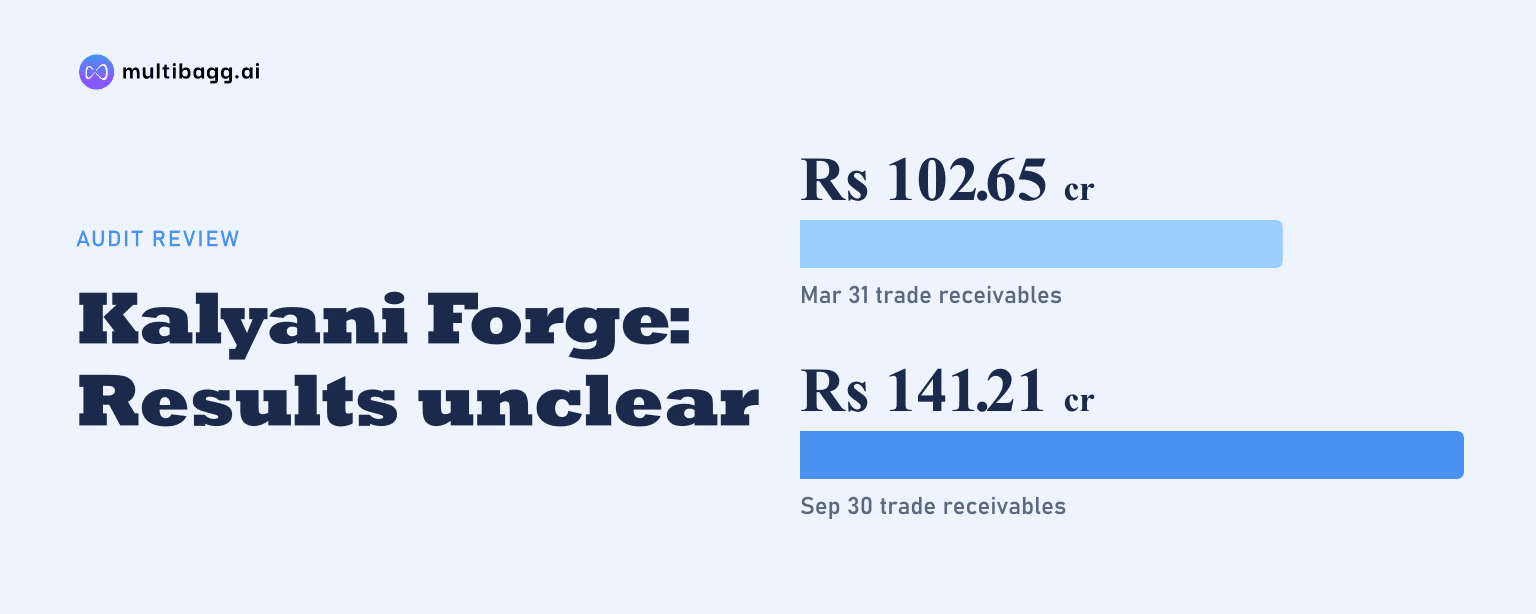
Kalyani Forge Limited’s reviewers again could not conclude on its unaudited standalone results for September 30, 2026 because four evidence areas remained unresolved, including inventory valuation and financial controls. Kalyani Forge reported trade receivables of Rs 141.21 crore at September 30, while the reviewer said it lacked sufficient appropriate evidence for a conclusion.
Know Kalyani Forge inside out
Results, valuation, peers and who's buying, in one view.
Why could Kalyani Forge auditors not conclude on results?
Kalyani Forge’s auditors could not conclude on the September 30, 2026 results because they could not obtain sufficient appropriate evidence across four matters: inventory valuation, confirmations of counterparty balances, asset and Goods and Services Tax, or GST, reconciliations, and internal-financial-control documentation. M. P. Chitale & Co. reviewed the quarter ended September 30, 2026 and the six-month period from April 1, 2026 to September 30, 2026.
The reviewer said the matters were substantive and significant enough that it could not provide a conclusion on whether the unaudited results were prepared under applicable Indian Accounting Standards. The review was performed under Standard on Review Engagements 2410, which provides moderate assurance and is narrower than an audit. The firm said its May 25, 2026 and August 11, 2026 reports had also been disclaimed in respect of the same matters.
Which Kalyani Forge balances remain unresolved?
Kalyani Forge’s trade receivables, trade payables and stock with vendors remained subject to confirmations, reconciliations and consequential adjustments, if any, at September 30, 2026. The reviewer said it could not satisfy itself on these balances even after applying alternative procedures. This issue affects reported trade receivables of Rs 141.21 crore, up from Rs 102.65 crore at March 31, 2026.
The reported current-asset mix changed between March 31, 2026 and September 30, 2026, with receivables increasing and inventories declining. Management said it received additional confirmations from customers and vendors in the second quarter and would provide reconciliations using standard reason codes. It aims to obtain confirmations covering 80% of vendors and customers by value in the next quarter.
What is Kalyani Forge doing on inventory valuation?
Kalyani Forge said it had corrected rates for all live-parts inventory to support consistency and compliance with Indian Accounting Standard 2, or Ind AS 2, which covers inventories. However, the reviewer said the company’s process of refining standard rates for material, labour and overheads had remained incomplete since prior financial years. As a result, inventory quantities, valuation and the related effects on consumption and inventory movements were unascertainable to the reviewer.
Management said it received further auditor input on the underlying inventory calculations and plans to incorporate it in the next iteration during the third quarter of FY27. The filing does not quantify any possible adjustment. Its cash-flow statement showed a Rs 21.08 crore decrease in inventories in the half year ended September 30, 2026, compared with a Rs 6.49 crore increase in the half year ended September 30, 2025.
Got a follow-up? Ask IRIS
Which asset and GST gaps remain at Kalyani Forge?
Kalyani Forge’s property, plant and equipment, other assets, GST input tax credit and sales reported in GSTR-1 remained subject to reconciliation at September 30, 2026. GSTR-1 is the GST return for outward supplies. The reviewer said it could not satisfy itself on these balances through alternative means and that consequential adjustments could be required.
Management attributed missing tags in the asset register to an SAP configuration error and said asset master data would be updated, with corrective entries made if required. It also said it shared GST reconciliation data for the second quarter of 2026 and would reconcile differences after auditor input. Capital work-in-progress was Rs 12.56 crore at September 30, 2026, compared with Rs 10.28 crore at March 31, while intangible assets were Rs 3.95 crore compared with Rs 3.16 crore.
Has Kalyani Forge documented its financial controls?
Kalyani Forge had not provided the documentation necessary for the reviewer to determine whether internal financial controls over financial reporting were adequate or operating effectively as at September 30, 2026. The reviewer said it understood that the company was updating relevant documentation. This was one of the four matters preventing a review conclusion for the six months ended September 30, 2026.
Management said new policy and process documents had been prepared for finance and other critical departments, incorporating risk control matrix, or RCM, controls. Management’s opinion is that Kalyani Forge has adequate financial controls and is updating and testing them in line with current requirements. The company reported equity of Rs 100.73 crore at September 30, 2026, compared with Rs 95.54 crore at March 31, while current borrowings rose to Rs 85.63 crore from Rs 70.72 crore.
Conclusion
Kalyani Forge’s September 2026 review repeats the limitations cited in the May 25 and August 11, 2026 reports: unresolved inventory measurement, counterparty balances, asset and GST reconciliation, and control documentation. The reported financial position also changed over the six months, with receivables rising by Rs 38.56 crore and inventories falling by Rs 21.08 crore from March 31, 2026.
The next disclosed checkpoints are management’s planned third-quarter FY27 inventory-rate iteration and its next-quarter target for confirmation coverage of 80% of vendors and customers by value. The filing also identifies pending SAP asset-master updates, GST reconciliations and financial-control documentation as matters that must be addressed for the reviewer to assess the September 30, 2026 control framework.