










Kanpur Plastipack Limited Delays 12,000-Tonne Non-Woven Start
Key highlights
- Kanpur Plastipack Limited expects to commission its 12,000-tonne annual non-woven facility by mid-November 2026.
- The greenfield needle-punch non-woven project has an investment allocation of ₹58.04 crore.
- Management has guided for ₹100-120 crore of non-woven revenue in FY28 with margins of 14-15%.
- Kanpur Plastipack Limited expects FIBC manufacturing volume growth of about 20% in the following year after a 5-10% increase in the current year.
powered by IRIS
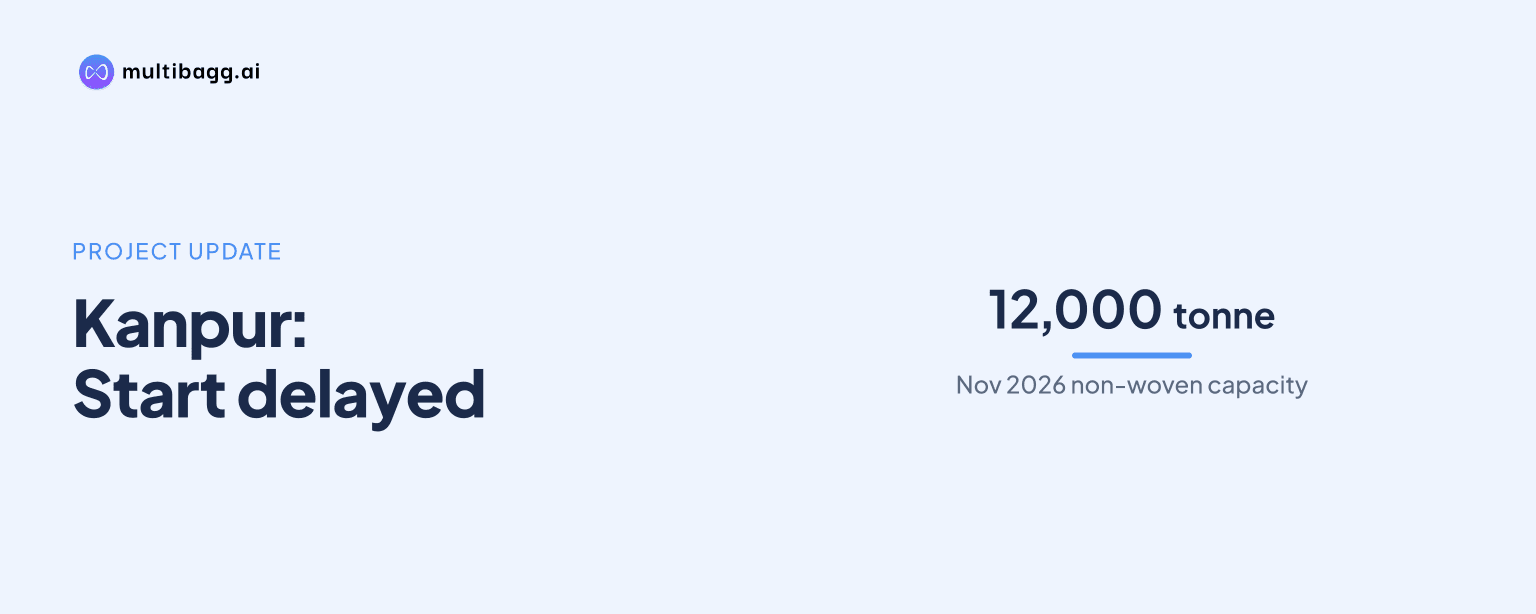
Kanpur Plastipack Limited has delayed commissioning of its 12,000-tonne annual needle-punch non-woven facility to mid-November 2026, from an earlier September 2026 commercial-production target, after heavy rains and overseas-engineer visa issues affected the project schedule.
Know Kanpur Plastipack inside out
Results, valuation, peers and who's buying, in one view.
Why has Kanpur Plastipack delayed the non-woven plant?
Kanpur Plastipack said heavy rains and visa-related issues involving overseas engineers caused a slight delay in commissioning its non-woven fabrics facility. The company had earlier indicated that commercial production at the greenfield project would begin by September 2026. Its subsequent earnings-call commentary put commissioning in mid-November, with one reported target date of 15 November 2026.
The facility is being built as a greenfield needle-punch manufacturing project rather than through an acquisition. Needle-punch technology is used to make non-woven fabrics for industrial and consumer-linked applications, including automotive interiors, geotextiles, artificial leather, exhibition carpets, shoe insoles and home-furnishing products.
Management has indicated that the project will be brought up in stages. Around half of the planned capacity is expected to come up in the current quarter, while the remaining half is expected by the end of the following quarter. The revenue contribution is therefore expected to become visible only in the next financial year.
The delayed startup comes alongside capacity additions in the company’s FIBC operations. The ground floor of the FIBC expansion has already been commissioned, while the first and second floors were expected to be commissioned by the end of November 2026. Management said utilisation of the additional FIBC capacity would depend on demand conditions.
What capacity and revenue does the project target?
Kanpur Plastipack plans annual non-woven capacity of about 12,000 tonnes and has guided for ₹100 crore to ₹120 crore of non-woven revenue in FY28. Management expects margins from the business to be in the 14% to 15% range once operations begin contributing.
The non-woven project has been allocated ₹58.04 crore under the company’s broader ₹105.26 crore expansion programme. The balance of the announced programme includes ₹47.22 crore for FIBC capacity enhancement and infrastructure upgrades. The company has said the new facility will be funded through internal accruals and term loans.
Got a follow-up? Ask IRIS
How does non-woven fabric fit Kanpur Plastipack’s strategy?
The non-woven project expands Kanpur Plastipack beyond its established flexible intermediate bulk container, or FIBC, and woven polypropylene packaging operations. While the core packaging and yarn businesses use polypropylene, the non-woven facility will use polyester fibre, creating a separate raw-material chain and customer base.
The company is targeting five technical-textile categories: geotextiles for infrastructure, filtration media, automotive interior textiles, footwear materials and flooring or interior-textile applications. This broadens its addressable markets while retaining an operational link to its existing textile-manufacturing capabilities.
Kanpur Plastipack is also building a premium yarn platform through a 50:50 joint venture with Italy-based Essegomma S.p.A. The joint venture is intended to produce and distribute high-performance polypropylene Taslan yarn, with stated capacity of 1,000 metric tonnes a year. Together, the yarn venture and non-woven plant represent diversification away from a business mix centred on bulk packaging.
What does the delay mean for investors and operations?
The revised commissioning schedule shifts the expected operational milestone by a limited period, but it also means the new business is unlikely to make a meaningful revenue contribution in the current financial year. Management has explicitly said that the non-woven capacity and its financial impact should become visible in the following year as the phased rollout progresses.
For investors, the project matters because management has attached a higher-margin profile to the non-woven operation than to a purely volume-led capacity expansion. The ₹100 crore to ₹120 crore FY28 revenue guidance and 14% to 15% margin expectation provide measurable operating benchmarks once production stabilises. These remain management targets rather than reported financial results.
The FIBC business continues to be relevant to the near-term operating picture. Kanpur Plastipack has said manufacturing volumes may rise only 5% to 10% in the current year because of demand conditions, while it expects about 20% growth in FIBC manufacturing volume in the following year. The usefulness of newly commissioned FIBC floors will consequently depend on a recovery in customer demand.
The broader industry context is also important. Non-woven technical textiles serve infrastructure, automotive, footwear and furnishing uses, but the company has noted that per-person consumption in India remains low. Kanpur Plastipack’s plan is therefore an entry into a relatively under-penetrated domestic segment rather than an immediate replacement for its packaging business.
Conclusion
Kanpur Plastipack Limited’s non-woven facility has moved from a September 2026 commercial-production expectation to a mid-November 2026 commissioning schedule because of rain-related disruption and overseas-engineer visa issues. The project is material because it adds a distinct polyester-based technical-textile business with planned capacity of 12,000 tonnes a year and management guidance of ₹100 crore to ₹120 crore of FY28 revenue.
The next disclosures to watch are the confirmed commissioning date, progress on the two-phase capacity rollout and the first reported revenue contribution from non-woven fabrics. Investors can also track FIBC demand and utilisation after the remaining floors of the FIBC expansion are commissioned.