










Kansai Nerolac Paints reports ₹2,268.77 crore Q2 revenue
Key highlights
- Kansai Nerolac reported Q2 FY27 standalone revenue of ₹2,268.77 crore, up 18.9% year on year.
- Standalone EBITDA was ₹223.23 crore, with an EBITDA margin of 9.8% in Q2 FY27.
- Standalone net profit rose 8.8% year on year to ₹148.64 crore.
- Consolidated revenue was ₹2,317.38 crore and consolidated net profit was ₹143.99 crore.
powered by IRIS
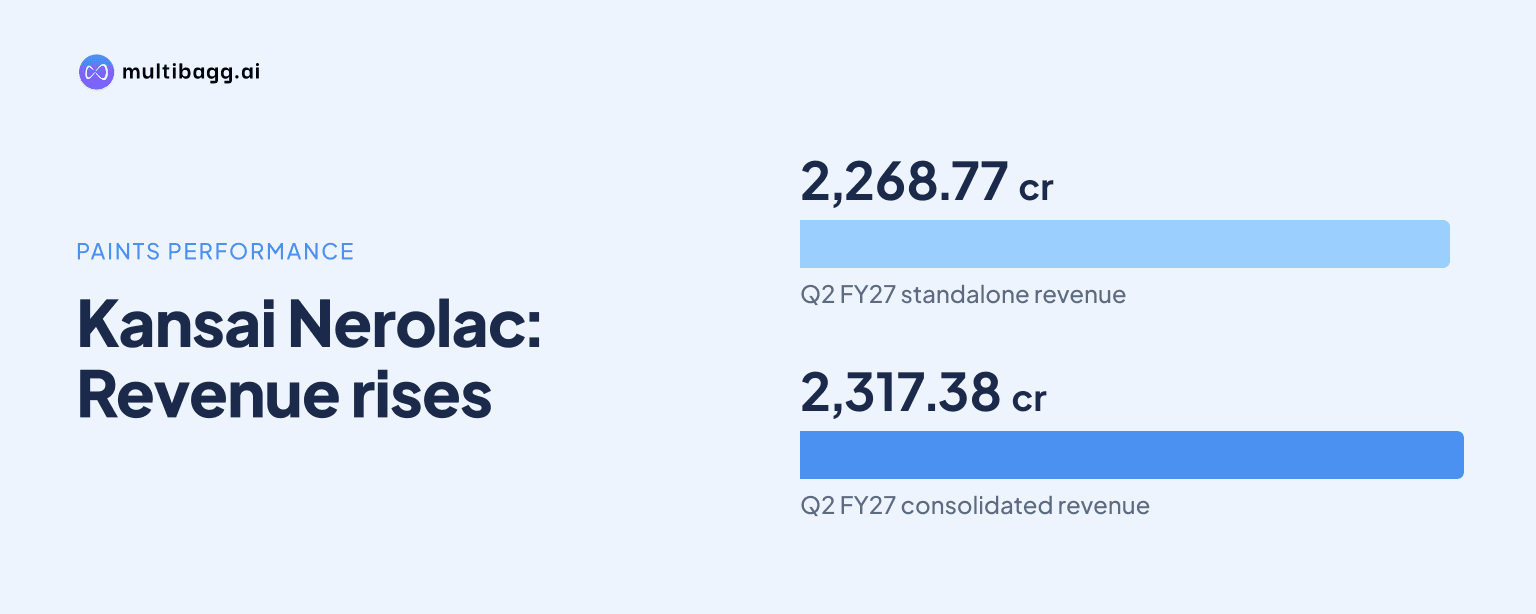
Kansai Nerolac Paints Ltd reported standalone revenue of ₹2,268.77 crore for Q2 FY27, an 18.9% year-on-year increase, while standalone net profit rose 8.8% to ₹148.64 crore. The results for the quarter ended 30 September 2026 also reflected retrospective accounting for the Nerofix amalgamation from 1 April 2025.
Know Kansai Nerolac Paints inside out
Results, valuation, peers and who's buying, in one view.
What did Kansai Nerolac report for Q2 FY27?
Kansai Nerolac reported a 18.9% year-on-year rise in standalone revenue to ₹2,268.77 crore in Q2 FY27. Standalone EBITDA stood at ₹223.23 crore, translating into an EBITDA margin of 9.8%, while standalone profit after tax was ₹148.64 crore.
The company’s standalone net profit was 8.8% higher than the corresponding period a year earlier. The difference between revenue growth and profit growth indicates that the reported quarter saw a slower rate of expansion in profit than in the top line, based on the figures disclosed.
On a consolidated basis, Kansai Nerolac reported revenue of ₹2,317.38 crore and net profit of ₹143.99 crore. The consolidated figures include the financial impact of the Nerofix amalgamation as accounted for under the approved scheme.
How were the Q2 FY27 results approved and reviewed?
Kansai Nerolac’s board approved the unaudited standalone and consolidated financial results on 4 November 2026 for the quarter and six months ended 30 September 2026. The company had earlier informed exchanges that the board would consider these results at its scheduled meeting.
The statutory auditors issued unqualified limited-review conclusions on the reported financial statements. An unqualified conclusion means the auditors did not identify a material issue requiring modification to their review conclusion, based on the information provided for the limited review.
Kansai Nerolac has also scheduled an earnings conference call for 5 November 2026 at 4:00 pm India time. Managing Director Pravin Chaudhari, Chief Financial Officer Yash Ahuja and Director Jason Gonsalves were named as participants for the discussion with analysts and investors.
The call provides the next formal opportunity for management to discuss quarterly performance, operating conditions and the accounting effect of the merger. No further management commentary on demand, margins or future financial targets was included in the supplied results information.
Got a follow-up? Ask IRIS
What is the impact of the Nerofix amalgamation?
The reported results include the scheme of amalgamation involving Nerofix, approved by the National Company Law Tribunal. Kansai Nerolac has accounted for the transaction retrospectively from 1 April 2025 under common-control accounting.
Retrospective accounting means comparative prior-period financial information has been restated to reflect the amalgamation from the stated effective date. This treatment is important when comparing current numbers with earlier reported periods because the prior figures may no longer be presented on the same basis as before the scheme was implemented.
The merger accounting affects both standalone and consolidated presentation as disclosed by the company. Investors reviewing year-on-year changes should therefore consider the restated basis of the financial statements alongside the reported growth rates.
The supplied information does not quantify a separate revenue, cost, profit or asset contribution from Nerofix. It also does not provide standalone details of the acquired entity. As a result, the available disclosures support the stated retrospective treatment but do not allow the financial effect of the amalgamation to be isolated.
How do the results matter to investors and the paint sector?
Kansai Nerolac’s 18.9% standalone revenue growth is the principal operating metric in the Q2 FY27 disclosure, while net profit growth was 8.8%. EBITDA of ₹223.23 crore and the 9.8% margin provide the reported measure of operating profitability for the standalone business.
For investors, the results bring attention to the relationship between sales growth, operating margin and profit growth. The figures show higher revenue and profit on a year-on-year basis, but the supplied material does not provide a breakup of raw-material costs, employee costs, other expenses or segment-level performance to explain the margin movement.
The company operates in the paints industry, where quarterly performance is typically assessed through revenue trends, profitability and management commentary on demand conditions. The supplied data does not include a share-price movement, volume growth figure or market-share data, so no conclusion can be drawn from these results alone about the stock’s market reaction or competitive position.
Kansai Nerolac had closed its trading window for designated insiders from 1 October to 6 November 2026 under SEBI’s Prohibition of Insider Trading regulations. The closure covered the period around the board meeting and the release of the quarterly financial results.
Conclusion
Kansai Nerolac reported Q2 FY27 standalone revenue of ₹2,268.77 crore, EBITDA of ₹223.23 crore and net profit of ₹148.64 crore. Revenue increased 18.9% year on year and net profit increased 8.8%, while consolidated revenue and profit were ₹2,317.38 crore and ₹143.99 crore, respectively. The financial statements incorporate the Nerofix amalgamation retrospectively from 1 April 2025, with prior periods restated.
The immediate item to watch is the management discussion scheduled for the 5 November 2026 earnings call. Investors may look for further detail on quarterly demand, operating margins, the effect of the Nerofix amalgamation and the factors behind the difference between revenue growth and net-profit growth.