








KDDL advances Eigen capacity after nearly 50% H1 revenue rise

Find your next multibaggerBe a Pro Investor
Research stocks and track your picks on the go. Download the app.
Key highlights
- KDDL said Eigen delivered close to 50% year-on-year revenue growth in H1 FY '27.
- KDDL raised FY '27 capital-expenditure spending to around Rs 70 crore to Rs 75 crore from an earlier plan of around Rs 50 crore.
- Eigen Unit 2B is expected to become operational in the middle of the next financial year.
- KDDL reported H1 FY '27 consolidated income of Rs 1,345.8 crore, up 33.5% year on year.
powered by IRIS
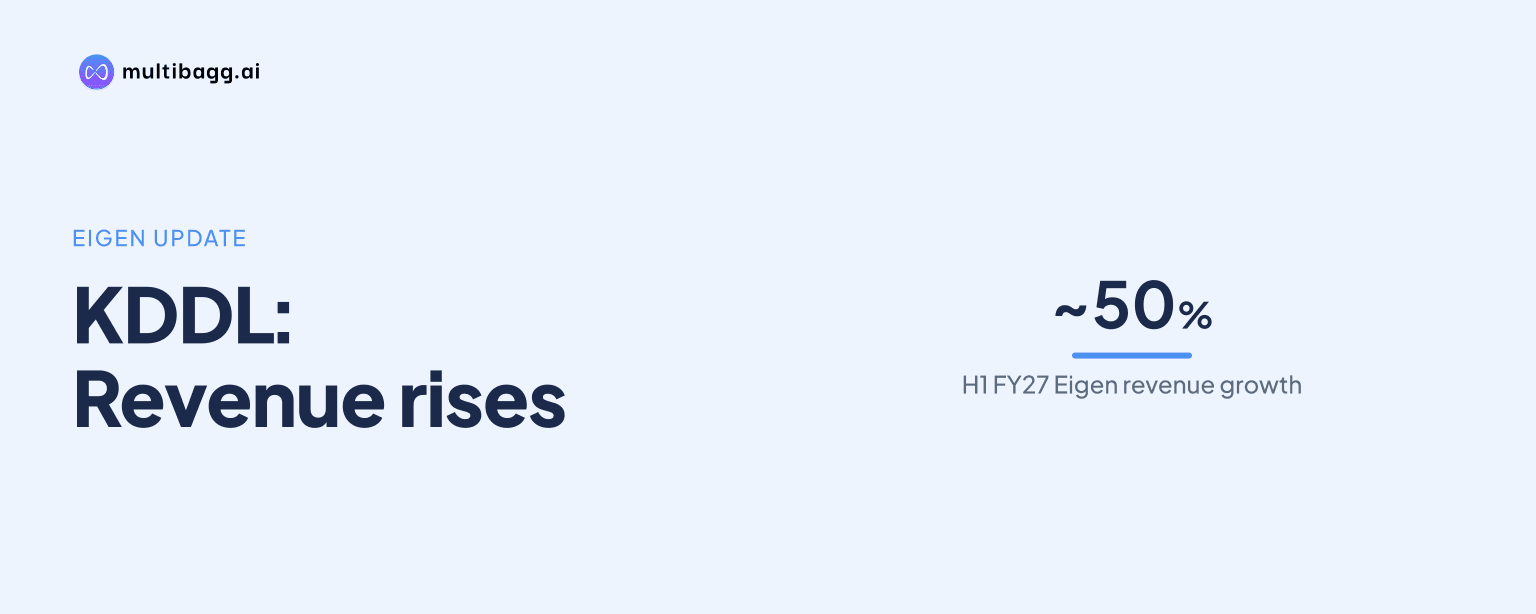
KDDL Limited is accelerating Eigen capacity expansion after its precision-engineering business delivered nearly 50% year-on-year revenue growth in H1 FY '27, as customer projects converted earlier and at larger scale than management expected. KDDL has lifted FY '27 capital-expenditure spending to about Rs 70 crore to Rs 75 crore.
Know KDDL inside out
Results, valuation, peers and who's buying, in one view.
Why is KDDL accelerating Eigen capacity expansion?
KDDL is bringing forward Eigen expansion because the business is converting existing project opportunities faster than management expected. Chairman and Managing Director Yashovardhan Saboo said the H1 FY '27 performance had taken the company “a little bit by surprise,” though he described it as a positive development rather than a demand backlog being cleared.
The company said the growth came from stronger responsiveness by both existing and new customers. Projects already in the sales funnel fructified sooner than expected and at a larger-than-expected scale, prompting KDDL to expand facilities faster so it does not miss opportunities. Management retained its medium-term revenue growth objective of 20% to 25% compound annual growth rate, or CAGR, despite the exceptional H1 pace.
KDDL’s decision differs from a capacity plan built around a single end market. Management described Eigen’s demand as spread across electric vehicles, battery energy storage systems, electronics, aerospace and defence, with customer activity coming from the Americas and Europe. It said the company has limited focus on China and Asia for this business.
What drove Eigen's nearly 50% H1 FY '27 growth?
Eigen’s nearly 50% H1 FY '27 revenue growth was primarily volume-led demand from export customers and additional business from new customers. KDDL said there was little currency movement versus the previous year, meaning foreign-exchange changes were not a material driver of the reported increase.
Management did not attribute the rise to an accumulated backlog or to a normalisation in United States tariff conditions. Instead, it said customer projects already under discussion converted earlier and more substantially than expected. KDDL also said its ability to make customised components to client-specific designs and technical requirements supports deeper customer relationships.
The company reported that its overall export sales account for almost 75% of revenue, while Eigen’s export share is slightly higher. KDDL is strengthening export-market coverage through managers based outside India, organised by geography rather than product group, as it seeks to address customers across its range of manufacturing capabilities.
The pace at Eigen exceeded that of KDDL’s other manufacturing lines in H1 FY '27. Watch-component dials and hands grew about 30% year on year, and premium-packaging business Ornapac grew more than 30%, while the bracelet business faced subdued demand in its export market. This faster Eigen growth also changed the group’s sales mix.
What capacity is KDDL adding at Eigen?
KDDL is expanding manufacturing space at Eigen Unit 1, has installed a rack-plating line at Unit 2A, and has secured an adjacent plot for Unit 2B. Unit 2A is a new facility about 6 kilometres from the existing plant, where the company has also shifted a set of machines.
The rack-plating line is a backward-integration measure, meaning KDDL is bringing a production process into its own operations. Management said the line had been commissioned, trials completed and samples sent to customers for approval. It expected commercial supplies to begin in the next one or two months, subject to those approvals.
Unit 2B is intended to provide additional manufacturing space and is expected to become operational in the middle of the next financial year. KDDL did not disclose the square footage, machine count or output capacity for Unit 1, Unit 2A or Unit 2B, so the precise production increase cannot yet be quantified from the call.
Alongside space, KDDL is adding capabilities that can support customer-specific product development. Management identified rack plating, different forms of welding, blanking and machining as incremental capabilities. It said the company develops products jointly with customers after building relevant manufacturing capability, rather than making standard products first and seeking demand later.
Got a follow-up? Ask IRIS
How much is KDDL spending on accelerated FY '27 capex?
KDDL expects FY '27 capital expenditure of around Rs 70 crore to Rs 75 crore, including the accelerated plans. Chief Financial Officer and Executive Director Sanjeev Masown said the earlier spending plan was about Rs 50 crore, implying an additional Rs 15 crore to Rs 20 crore under the revised plan.
KDDL did not split the Rs 70 crore to Rs 75 crore budget between Eigen, watch components, bracelets or other operations. Management also said it is difficult to quantify exactly how much revenue the new spending will generate, although it referred to a typical capital-expenditure-to-revenue norm of 3:1.
The broader financial base expanded in H1 FY '27. Consolidated total income was Rs 1,345.8 crore, up 33.5% year on year, while consolidated earnings before interest, tax, depreciation and amortisation, or EBITDA, were Rs 220.5 crore, up 32.3%. The EBITDA margin was 16.4%, compared with a 16.0% margin in Q2 FY '27.
How is faster Eigen growth affecting KDDL's margins and outlook?
KDDL said faster Eigen growth has contributed to a slight decline in blended gross margin because Eigen inherently has a slightly lower gross margin than the watch-components business. Management said the difference was not significant and did not expect a large movement solely from this mix shift.
A second mix effect came from watch components, where domestic sales grew faster than export sales. KDDL said domestic sales within that business generally carry slightly lower gross margin than exports. These two changes, rather than raw-material cost inflation, were cited as the main explanation for the gross-margin movement raised by an analyst.
At the group level, consolidated profit after tax, or PAT, was Rs 92.9 crore in H1 FY '27, with a PAT margin of 6.9%. Standalone H1 FY '27 income was Rs 329 crore, up 36.2% year on year, and standalone EBITDA was Rs 75.2 crore, up 38.4%, with a 22.9% margin.
Management said the number of requests for quotation, or RFQs, was broadly stable rather than rising materially. It noted that United States RFQs slowed after the tariff issue, but European RFQs compensated for that decline. KDDL said it sees sufficient projects in the pipeline to support its stated growth objectives, while not disclosing the value of those RFQs.
Conclusion
KDDL’s accelerated Eigen expansion follows an unusually rapid H1 FY '27 increase in precision-engineering revenue, driven mainly by volume and by earlier conversion of customer projects rather than exchange rates or a backlog release. The company is responding with added manufacturing space, in-house plating and a higher Rs 70 crore to Rs 75 crore FY '27 capital-expenditure plan, while group income rose 33.5% year on year.
The next milestones are customer approval and commercial production from the Unit 2A rack-plating line, which management expected within one or two months, and Unit 2B becoming operational in the middle of the next financial year. Whether demand from the Americas and Europe continues to support Eigen’s stated 20% to 25% medium-term CAGR objective will also be relevant as RFQs remain broadly stable.

