








KDDL Limited dials and hands rise 30% as bracelets lag

Find your next multibaggerBe a Pro Investor
Research stocks and track your picks on the go. Download the app.
Key highlights
- KDDL’s dials and hands business grew about 30% year-on-year in H1 FY27, led by domestic and export volumes.
- KDDL said bracelet growth trailed dials and hands because its 100% export unit faced weaker Swiss-watch-sector demand.
- KDDL increased planned FY27 capital expenditure to around Rs 70 crore to Rs 75 crore from an earlier Rs 50 crore plan.
- KDDL reported consolidated H1 FY27 total income of Rs 1,345.80 crore, up 33.5% year-on-year.
powered by IRIS
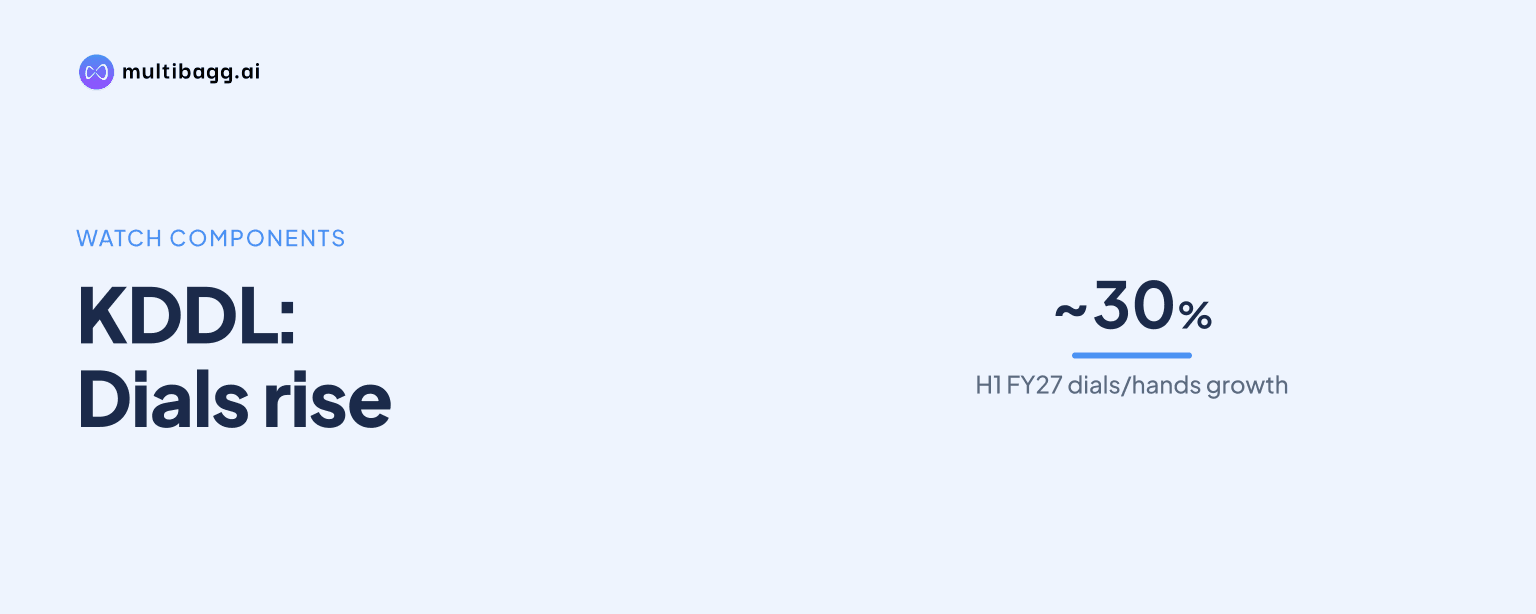
KDDL Limited’s dials and hands business grew about 30% year-on-year in H1 FY27 on domestic and export volume growth, while its 100% export bracelet unit saw slower offtake amid Swiss watch industry weakness. Management began dials-and-hands capacity expansion in FY27, ahead of its original FY28 plan.
Know KDDL inside out
Results, valuation, peers and who's buying, in one view.
Why did KDDL’s dials and hands business grow 30% in H1 FY27?
KDDL said dials and hands revenue rose about 30% year-on-year in H1 FY27 because volumes increased with both domestic and export customers. Management said the growth was driven by underlying volumes rather than merely by higher realisations, indicating that demand increased across both customer sets.
The H1 performance was ahead of KDDL’s original full-year revenue-growth expectation of about 12% to 14% for the business. Management therefore said full-year FY27 revenue growth should be higher than that range, but it did not disclose a revised percentage or separate revenue for dials and hands.
Domestic sales also changed the mix within watch components. Management said domestic watch-component sales rose faster than exports, while domestic sales typically have a somewhat lower gross margin than exports. Combined with faster growth at precision-engineering business Eigen, that mix shift caused a slight decline in blended gross margin.
What held back KDDL’s bracelet business?
KDDL’s bracelet business was slower in H1 FY27 because it is a 100% export unit exposed to subdued demand in the Swiss watch industry. Management said this environment reduced customer offtake, leaving bracelet growth below the about 30% reported for dials and hands.
The company said it had started expanding the bracelet customer base several months earlier. Because bracelets are made to order, new accounts need to progress through sampling, quality evaluation, homologation and trial orders before regular supplies can begin. KDDL did not disclose bracelet revenue, the number of prospective customers or an order-book value.
Management said it had received responses from customers in other geographies and expected bracelet sales to return to a growth path quite soon. In a later response, it said the results of customer-base expansion were expected to start becoming visible from the next quarter onwards, though that was a management expectation rather than a quantified recovery target.
How is KDDL expanding its watch-component capacity?
KDDL has started work on dials-and-hands capacity expansion in FY27 rather than waiting until FY28, following the about 30% H1 growth rate. Management said it would provide more details at its next interaction, but did not disclose the project cost, added capacity or completion date for the watch-component project.
The expansion includes investment in skills as well as machinery. Management described watch components as dependent on specialised skills and experience, making training and capability-enhancement infrastructure important alongside manufacturing investment.
KDDL expects FY27 capital expenditure of around Rs 70 crore to Rs 75 crore, including the advanced plans. The earlier plan was around Rs 50 crore, representing an increase of around Rs 15 crore to Rs 20 crore. Management said it typically uses a three-to-one revenue-to-capex norm, while cautioning that a specific project’s revenue contribution cannot be quantified precisely.
Got a follow-up? Ask IRIS
How are bracelets and Eigen capacity plans progressing?
KDDL said bracelet and Eigen capital expenditure are independent decisions, rather than competing uses of capacity. For bracelets, management said customer development had already begun, but made-to-order production means each new account progresses at its own pace through approval and trial stages.
At Eigen, KDDL installed a rack-plating line at Unit 2A, a facility about 6 kilometres from its existing plant. The company had completed trials and sent samples to customers for approval, with management expecting commercial supplies to start within one or two months of the November 17, 2026 call.
KDDL has also finalised an agreement for an adjacent plot for Eigen Unit 2B. Management said Unit 2B is intended to add manufacturing space and is expected to become operational in the middle of the next financial year. The expansion follows close to 50% H1 FY27 revenue growth at Eigen, compared with about 30% at dials and hands.
How did KDDL’s other businesses and financial results compare?
KDDL’s dials-and-hands growth lagged Eigen’s close to 50% H1 FY27 revenue growth, while packaging business Ornapac grew by more than 30%. Management attributed Eigen’s growth to export demand and additional opportunities from new customers across electric vehicles, battery energy storage systems, electronics, aerospace and defence.
Management said volume was the principal driver of both Eigen’s close to 50% growth and dials-and-hands growth of about 30%, with little currency change from the previous year. Exports accounted for almost 75% of KDDL’s overall sales, while Eigen’s export share was slightly higher, according to management.
Ornapac recorded positive profit before tax, or PBT, in Q2 FY27 after growing revenue by more than 30% in H1 FY27. Management expects the positive profitability trend to continue in the remaining FY27 quarters, supported by further revenue growth and better use of its existing operating base.
KDDL reported consolidated total income of Rs 1,345.80 crore in H1 FY27, up 33.5% year-on-year, while earnings before interest, tax, depreciation and amortisation, or EBITDA, rose 32.3% to Rs 220.50 crore. Consolidated EBITDA margin was 16.4% in H1 FY27, compared with 16.0% in Q2 FY27.
Consolidated profit after tax, or PAT, was Rs 92.90 crore for H1 FY27, at a 6.9% margin, compared with Rs 48.20 crore in Q2 FY27, also at a 6.9% margin. These consolidated figures include businesses beyond watch components and do not establish the individual profitability of dials, hands or bracelets.
Conclusion
KDDL’s H1 FY27 watch-components performance was uneven. Dials and hands grew about 30% through domestic and export volumes, but the export-only bracelet business faced lower offtake in a subdued Swiss-watch market. Eigen’s close to 50% growth and Ornapac’s more than 30% growth contributed to consolidated income growth of 33.5%.
The next update should show whether bracelet customer-development work begins producing results from the next quarter, as management expects. Investors can also watch for details of the accelerated dials-and-hands expansion, commercial rack-plating supplies expected within one or two months of the November 17, 2026 call, and Eigen Unit 2B’s planned opening in the middle of the next financial year.

