








KEC order book reaches Rs 39,946 crore amid execution delays

Find your next multibaggerBe a Pro Investor
Research stocks and track your picks on the go. Download the app.
Key highlights
- KEC reported a consolidated order book of Rs 39,946 crore in YTD FY27.
- T&D and SAE Towers together account for 65% of KEC’s order book.
- KEC reported Rs 7,793 crore of net debt including acceptances on 30 September 2026.
- H1 FY27 consolidated net sales declined 6% year on year to Rs 10,491 crore.
powered by IRIS
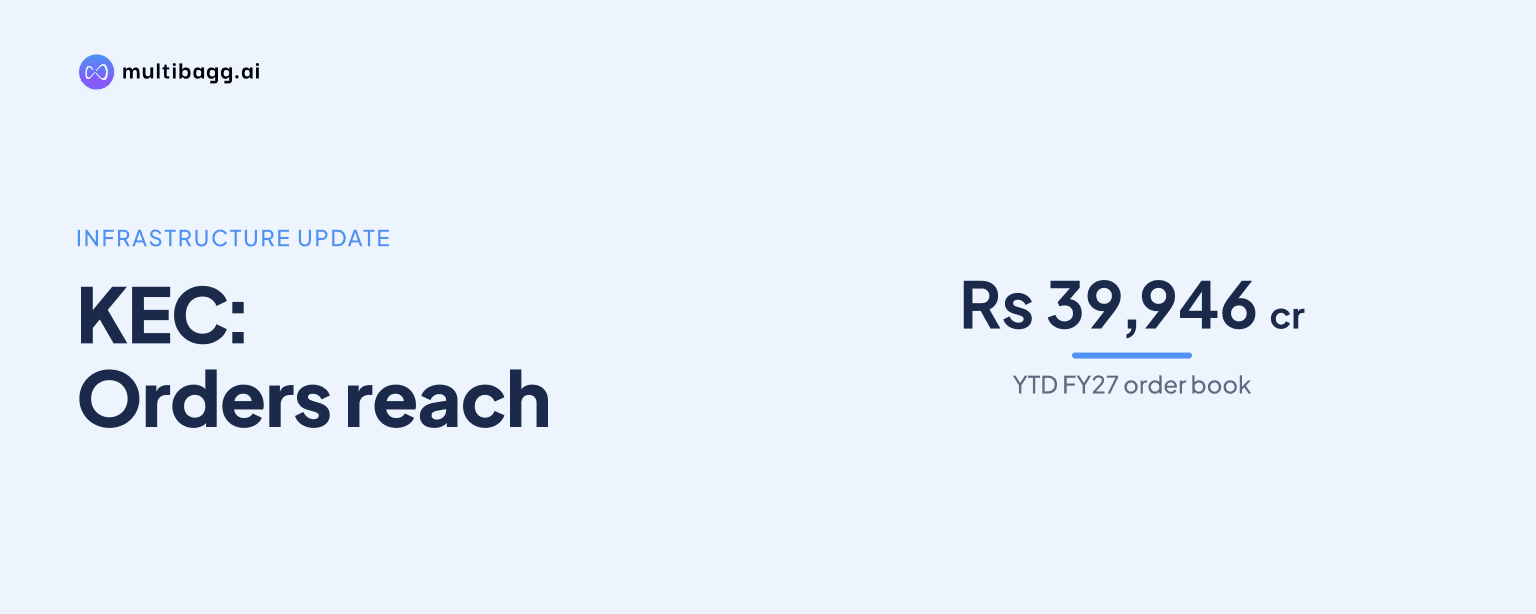
KEC reported a Rs 39,946 crore consolidated order book in year-to-date FY27, providing revenue visibility but leaving execution timing exposed to Middle East disruption, delayed Indian Water-project payments and elevated working capital. KEC also reported an L1 position of about Rs 43,500 crore and a tender pipeline above Rs 2,00,000 crore.
Know KEC International inside out
Results, valuation, peers and who's buying, in one view.
What makes up KEC’s Rs 39,946 crore order book?
KEC’s Rs 39,946 crore order book is led by transmission and distribution, or T&D, at 56%, followed by Civil at 23% and SAE Towers at 9%. Transportation represents 5%, while Cables & Conductors and Renewables each account for 3%; Oil & Gas contributes the remaining 1%. This composition puts grid-related work, including T&D and SAE Towers, at 65% of the YTD FY27 backlog.
Domestic projects account for 58% of the order book and international projects account for 42%, making overseas delivery material to backlog conversion. The mix differs from order intake of Rs 13,528 crore in YTD FY27, where domestic orders contributed 71% and international orders 29%. T&D comprised 56% of intake and SAE Towers 14%, meaning the combined grid businesses accounted for 70% of orders received during the period.
KEC also cited an L1 position of about Rs 43,500 crore, with L1 referring to the lowest-bidder position, alongside tenders under evaluation and in the pipeline exceeding Rs 2,00,000 crore. These are opportunities rather than booked orders because the presentation distinguishes the L1 position and tender pipeline from the Rs 39,946 crore order book. Management described the order book, L1 position and tender pipeline as providing revenue visibility.
Which risks could delay KEC’s order-book conversion?
KEC identifies geopolitical and supply-chain uncertainty in the Middle East as a direct risk to revenue and margin timing. KEC cites logistics disruption, elevated costs and extended lead times, as well as delays in project finalisation and awards in the region. Management says the timing effect on revenue and margins will be offset in coming quarters, but the presentation provides no quantified value or date for that offset.
The international share of the order book was 42% in YTD FY27, compared with a 29% international share of order intake, so delivery conditions outside India remain relevant to a sizeable portion of booked work. KEC’s outlook nevertheless identifies a healthy international T&D pipeline across the Middle East, Africa, the Americas, the Commonwealth of Independent States and South Asian Association for Regional Cooperation markets. KEC also points to a multi-year global T&D investment cycle and renewable-energy grid evacuation as demand tailwinds.
Within India, KEC flags prolonged resolution of legal claims and disputes in Transportation and Metro projects, continuing right-of-way issues in India T&D, and delays in Water-project payments. The payment delays are described as slowing work progress and affecting working capital and profitability. These matters are separate from the Rs 39,946 crore order-book total because they concern the pace at which existing projects can be executed, billed and converted into cash.
Got a follow-up? Ask IRIS
How does KEC’s order pipeline compare with revenue performance?
KEC’s large backlog follows a first-half period in which consolidated net sales declined 6% year on year to Rs 10,491 crore in H1 FY27 from Rs 11,114 crore in H1 FY26. In Q2 FY27, consolidated net sales declined 10% to Rs 5,468 crore from Rs 6,092 crore a year earlier. The lower reported revenue shows that a high order book does not by itself establish the pace of current-period execution.
T&D remained KEC’s largest operating business, representing 66% of H1 FY27 net sales of Rs 10,491 crore, compared with 65% in H1 FY26. Its revenue fell 5% to Rs 6,903 crore, while SAE Towers, included within T&D, increased 20% to Rs 943 crore. The core KEC T&D business declined 8% to Rs 5,960 crore, showing different performance within the broader T&D category.
Among non-T&D operations, Cables & Conductors rose 34% to Rs 1,214 crore and Oil & Gas Pipelines rose 86% to Rs 209 crore in H1 FY27. Civil revenue increased 2% to Rs 1,951 crore. In contrast, Transportation fell 46% to Rs 483 crore and Renewables declined 79% to Rs 69 crore. The reported decline in Transportation coincides with management’s disclosure of prolonged claims and dispute resolution in Transportation and Metro projects.
Why are payments and working capital material for KEC?
KEC reported consolidated net debt, including interest-bearing acceptances, of Rs 7,793 crore on 30 September 2026, up Rs 1,071 crore from Rs 6,722 crore on 31 March 2026. Net working capital, or NWC, stood at 155 days on 30 September 2026. KEC attributes the elevated debt and NWC partly to a collection spillover of about Rs 600 crore, primarily in the Middle East and Afghanistan, which it says was realised in October 2026.
Additional strategic inventory of about Rs 150 crore was accumulated to manage commodity-price volatility, according to KEC. KEC also cites lower-than-expected realisation in Water and Metro projects as a factor behind elevated debt and working capital. These disclosures connect payment and project-progress issues to funding requirements, rather than treating the Rs 39,946 crore order book solely as a sales measure.
KEC expects net debt, including acceptances, to decline to about Rs 6,000 crore by the end of FY27. That is management’s expectation rather than a reported result, and it depends on collections, project realisation and the working-capital factors set out in the presentation. On a standalone basis, H1 FY27 interest expense rose 9% year on year to Rs 292 crore, while interest as a percentage of sales increased to 3.6% from 3.0% in H1 FY26.
Conclusion
KEC enters the remainder of FY27 with a Rs 39,946 crore order book spanning domestic and international markets, supported by a further Rs 43,500 crore L1 position. The backlog is concentrated in T&D and SAE Towers, while reported H1 FY27 revenue was lower than the prior year, led by declines in T&D, Transportation and Renewables. The presentation therefore indicates substantial booked work alongside execution and cash-conversion constraints.
The next matters to watch are management’s stated expectation that Middle East revenue and margin timing impacts will be offset in coming quarters, the pace of Water and Metro project realisation, and progress toward net debt of about Rs 6,000 crore by the end of FY27. Resolution of Transportation and Metro disputes, right-of-way issues in India T&D, and delayed Middle East awards could also affect conversion of the order pipeline into revenue.

