










Kennametal India Limited hard metal drove nearly all Q1 growth
Key highlights
- Hard metal and hard metal products generated Rs 519.8 crore of Q1 FY27 revenue, versus Rs 31.9 crore for machining solutions.
- Hard-metal revenue rose Rs 72.4 crore sequentially, accounting for most of KIL’s Rs 74.1 crore revenue increase.
- Hard metal reported Rs 163 crore of segment profit, while machining solutions recorded a Rs 5.5 crore loss.
- KIL’s Q1 FY27 profit before tax rose to Rs 142.7 crore from Rs 43.4 crore a year earlier.
powered by IRIS
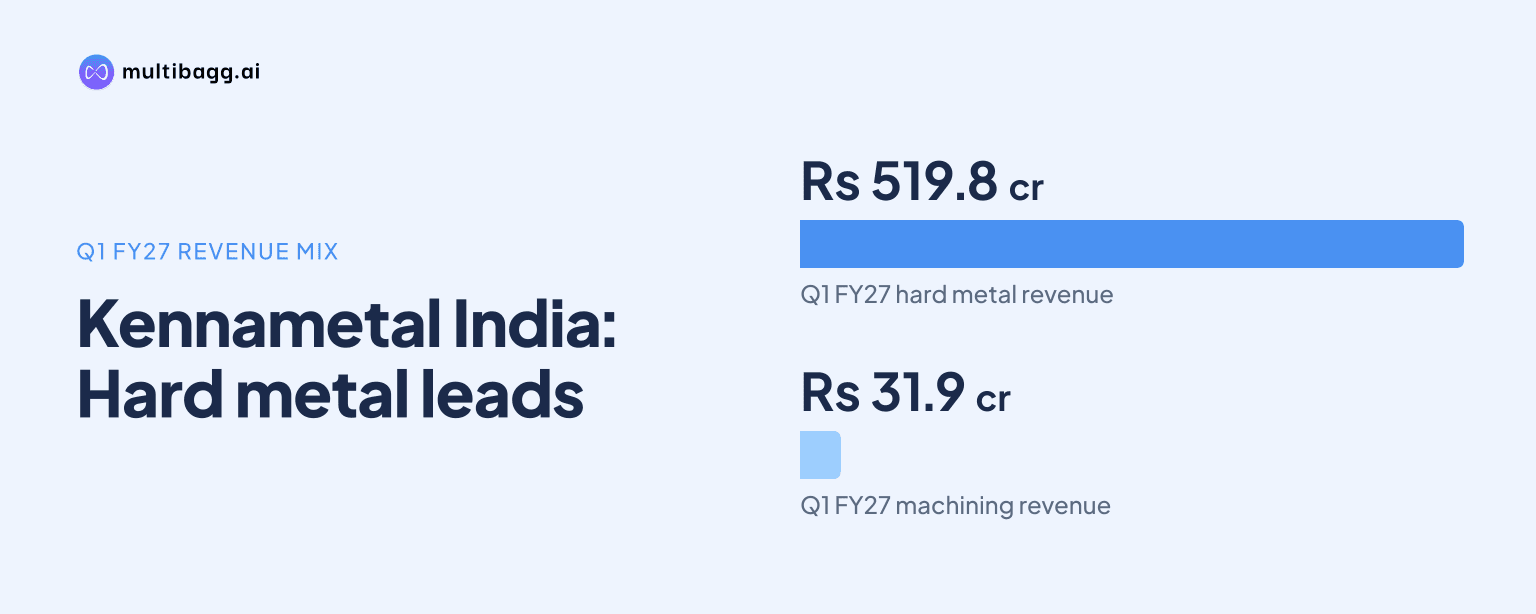
Kennametal India Limited’s hard metal and hard metal products segment generated Rs 519.8 crore of revenue in the quarter ended September 30, 2026, supplying Rs 72.4 crore of KIL’s Rs 74.1 crore sequential revenue increase and Rs 163 crore of segment profit, while machining solutions recorded a Rs 5.5 crore loss.
Know Kennametal India inside out
Results, valuation, peers and who's buying, in one view.
How much did hard metal contribute to KIL’s Q1 revenue growth?
Hard metal contributed Rs 72.4 crore of KIL’s Rs 74.1 crore revenue increase from the quarter ended June 30, 2026 to the quarter ended September 30, 2026. Segment revenue rose to Rs 519.8 crore from Rs 447.4 crore, while machining solutions added Rs 1.7 crore, rising to Rs 31.9 crore from Rs 30.2 crore. Together, the two segments produced reported revenue from operations of Rs 551.7 crore, compared with Rs 477.6 crore in the preceding quarter.
The year-on-year comparison shows an even more concentrated shift. Hard metal revenue increased by Rs 255.9 crore from Rs 263.9 crore in the quarter ended September 30, 2025, exceeding KIL’s company-wide revenue increase of Rs 255.7 crore. Machining solutions revenue declined by Rs 0.2 crore from Rs 32.1 crore a year earlier, meaning the hard metal business offset that reduction and supplied the full net expansion in reported revenue.
Hard metal represented about 94% of KIL’s Rs 551.7 crore revenue from operations in the September 2026 quarter, based on the disclosed segment amounts, compared with about 89% of Rs 296 crore a year earlier. Machining solutions accounted for the remaining Rs 31.9 crore in the latest quarter, down from Rs 32.1 crore in the comparable prior-year period.
KIL’s revenue from operations was 86.4% higher year on year, according to its November 12, 2026 release. Management attributed the increase to favourable raw-material pricing dynamics and stronger volume growth in the hard-metal business. The financial-results notes likewise state that quarterly performance was primarily driven by favourable timing of raw-material-related pricing compared with costs.
Did machining solutions remain loss-making in Q1 FY27?
Yes, machining solutions recorded a Rs 5.5 crore segment loss in the quarter ended September 30, 2026. That was an improvement from a Rs 9.2 crore segment loss in the June 2026 quarter, but it was weaker than the Rs 1.5 crore segment profit reported in the September 2025 quarter. Revenue of Rs 31.9 crore was also a small portion of KIL’s Rs 551.7 crore operating revenue.
Hard metal and hard metal products reported Rs 163 crore of segment profit, up Rs 24.5 crore sequentially from Rs 138.5 crore and Rs 113.2 crore year on year from Rs 49.8 crore. Total segment results increased to Rs 157.5 crore from Rs 129.3 crore in the prior quarter. The machining loss reduced the segment-result total by Rs 5.5 crore in Q1 FY27, rather than adding to it.
The gap between the businesses is also visible in their reported annual figures. For the year ended June 30, 2026, hard metal delivered Rs 316.1 crore of segment profit on Rs 1,363.6 crore of revenue, whereas machining solutions recorded a Rs 12.3 crore loss on Rs 147.1 crore of revenue. The September quarter did not reverse machining solutions’ loss-making position, despite its Rs 3.7 crore quarter-on-quarter reduction in loss.
The filing identifies two reportable segments, and the Rs 157.5 crore combined segment result in the September quarter came from Rs 163 crore earned by hard metal less the Rs 5.5 crore machining solutions loss. In the June 2026 quarter, the corresponding total of Rs 129.3 crore consisted of Rs 138.5 crore from hard metal and a Rs 9.2 crore loss in machining solutions.
Got a follow-up? Ask IRIS
What did segment results mean for KIL’s quarterly profit?
KIL’s profit before tax was Rs 142.7 crore for Q1 FY27, up from Rs 118.4 crore in the June 2026 quarter and Rs 43.4 crore in the September 2025 quarter. The Rs 28.2 crore sequential increase in total segment results was partly offset by changes in unallocable items, interest and other income, resulting in a Rs 24.3 crore rise in profit before tax.
Other unallocable expenditure was Rs 14.5 crore in the September quarter, compared with Rs 12.2 crore in the June quarter and Rs 10.5 crore a year earlier. Interest expense rose to Rs 1.3 crore from Rs 0.2 crore sequentially, while interest income was nil versus Rs 0.2 crore. Other unallocable income was Rs 1 crore, compared with Rs 1.3 crore in the preceding quarter.
Net profit reached Rs 106.7 crore, compared with Rs 88.8 crore in the June 2026 quarter and Rs 31.4 crore a year earlier. Total tax expense was Rs 36 crore, versus Rs 29.6 crore sequentially and Rs 12 crore year on year. Basic and diluted earnings per share, not annualised, were Rs 48.54, up from Rs 40.39 in the June quarter and Rs 14.30 in the comparable prior-year quarter.
Total income was Rs 552.6 crore in the September 2026 quarter, including Rs 0.9 crore of other income, while total expenses were Rs 409.9 crore. In the June 2026 quarter, total income was Rs 479.1 crore and total expenses were Rs 360.7 crore, producing the disclosed rise in profit before tax to Rs 142.7 crore from Rs 118.4 crore.
How did assets and liabilities change across KIL’s segments?
Hard metal assets increased to Rs 1,410.6 crore at September 30, 2026 from Rs 1,057.4 crore at June 30, 2026 and Rs 660.4 crore a year earlier. Machining solutions assets were Rs 94.7 crore, compared with Rs 92.2 crore at June 30 but Rs 128.5 crore at September 30, 2025. Total assets rose to Rs 1,599.9 crore from Rs 1,264.9 crore at the June year-end.
Hard metal liabilities declined to Rs 277.8 crore from Rs 335.4 crore at June 30, while machining solutions liabilities increased to Rs 58.6 crore from Rs 51.2 crore. Other unallocable liabilities rose to Rs 303.1 crore from Rs 24.6 crore, taking total liabilities to Rs 639.5 crore from Rs 411.2 crore. The filing does not provide a segment-level explanation for the movement in other unallocable liabilities.
The September quarter’s cost structure also moved with the higher revenue base. Cost of materials consumed was Rs 319.5 crore, against Rs 228.2 crore in the June quarter, while purchases of stock-in-trade were Rs 178.3 crore versus Rs 148 crore. Inventory changes were negative Rs 213.5 crore, compared with negative Rs 141.5 crore, and employee-benefit expense declined to Rs 45.1 crore from Rs 49.3 crore.
At September 30, 2026, hard metal accounted for Rs 1,410.6 crore of KIL’s Rs 1,599.9 crore total assets, while its Rs 277.8 crore liabilities were below the Rs 335.4 crore recorded at June 30, 2026. By contrast, machining solutions had Rs 94.7 crore of assets and Rs 58.6 crore of liabilities at the September reporting date.
Conclusion
KIL’s Q1 FY27 segment disclosures show that hard metal and hard metal products were the principal source of both revenue growth and segment profitability. The division’s Rs 519.8 crore revenue was more than 16 times the Rs 31.9 crore generated by machining solutions, and its Rs 163 crore segment profit contrasted with the latter’s Rs 5.5 crore loss. Consolidated profit before tax rose to Rs 142.7 crore as the increase in segment results exceeded the increase in unallocable expenditure.
The next disclosed issues to watch are raw-material pricing timing, tungsten prices and demand across end-use segments, all cited by management in discussing the September 2026 quarter. KIL also said geopolitical uncertainties continue to shape the operating environment. Separately, the company said it will monitor finalisation of Central and State rules and further government clarification under the Labour Code, recording any additional accounting impact if required.