










Kerala Ayurveda Q2 FY27 Net Loss Narrows to ₹6.1 Crore
Key highlights
- Kerala Ayurveda reported Q2 FY27 revenue from operations of ₹35.7 crore, up 2.6% year on year.
- Kerala Ayurveda's Q2 FY27 consolidated net loss narrowed to ₹6.1 crore from ₹8.1 crore in Q1 FY27.
- Operating margin improved to negative 17.5% from negative 24.5% in the preceding quarter.
- Kerala Ayurveda acquired the remaining 26% stake in Ayurvedagram Heritage Wellness Centre.
powered by IRIS
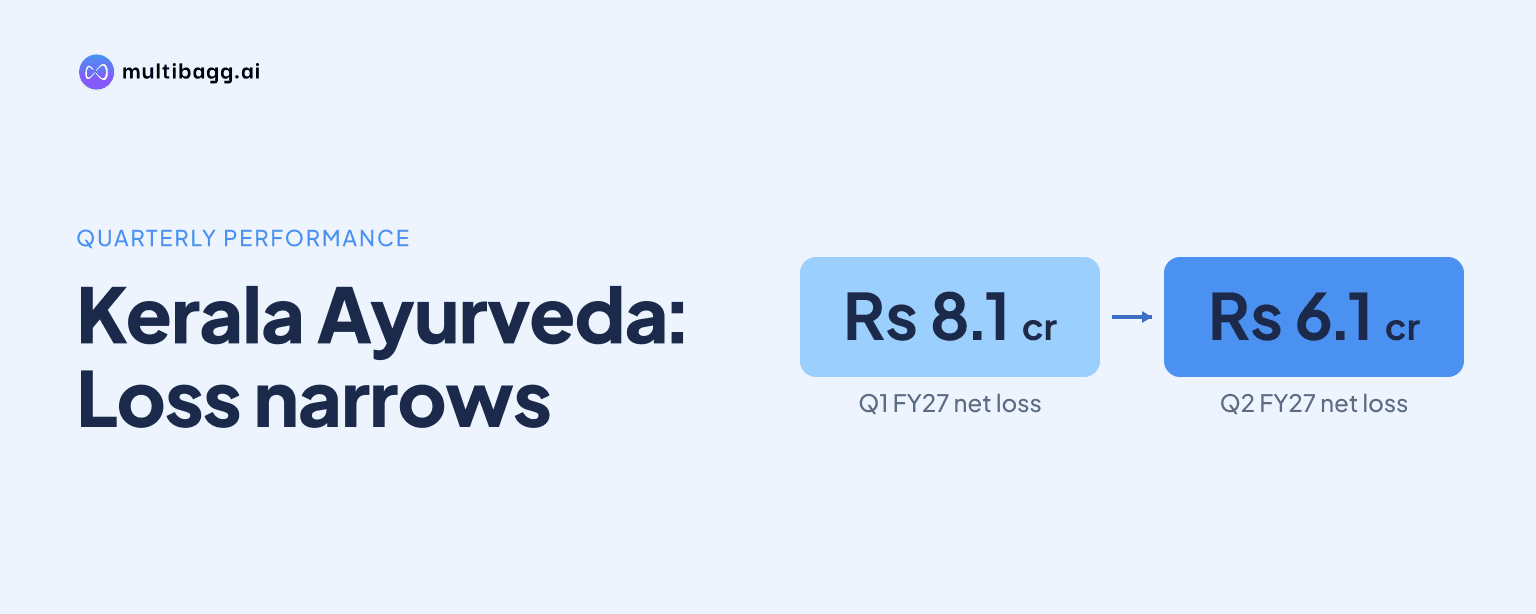
Kerala Ayurveda Ltd reported a consolidated net loss of ₹6.1 crore in Q2 FY27, narrowing from ₹6.4 crore a year earlier as revenue from operations rose 2.6% year on year to ₹35.7 crore. The result matters because operating losses remained substantial despite a sequential improvement in revenue and operating margin.
Know Kerala Ayurveda inside out
Results, valuation, peers and who's buying, in one view.
What did Kerala Ayurveda report for Q2 FY27?
Kerala Ayurveda reported consolidated revenue from operations of ₹35.7 crore for the quarter ended September 30, 2026, compared with ₹34.8 crore in Q2 FY26 and ₹33.2 crore in Q1 FY27. Revenue therefore increased both year on year and quarter on quarter.
Other income was ₹0.7 crore, lower than ₹1.7 crore in the year-ago quarter but above ₹0.3 crore in the preceding quarter. Total income remained unchanged year on year at ₹36.5 crore, while rising from ₹33.5 crore in Q1 FY27.
The company recorded a net loss of ₹6.1 crore, compared with a loss of ₹6.4 crore in Q2 FY26 and ₹8.1 crore in Q1 FY27. Profit before exceptional items and tax was a loss of ₹6.4 crore, improving from losses of ₹6.8 crore a year earlier and ₹8.2 crore in the preceding quarter.
How did Kerala Ayurveda's operating performance change?
Kerala Ayurveda's operating margin improved to negative 17.5% in Q2 FY27 from negative 24.5% in Q1 FY27 and negative 18.6% in Q2 FY26. This indicates that the operating loss narrowed as a proportion of revenue compared with both reference periods.
The source reported operating profit growth of 16.5% year on year and 16.5% quarter on quarter. However, the operating margin remained negative, and the company continued to post losses before tax and at the net-profit level.
The sequential movement in revenue was also positive. Revenue from operations rose by ₹2.5 crore from Q1 FY27, while total income rose by ₹3.0 crore. Net loss narrowed by ₹2.0 crore sequentially, showing improvement from the preceding quarter's loss, though profitability was not restored.
The year-on-year comparison presents a narrower net loss of ₹0.3 crore. Revenue increased by ₹0.9 crore, but lower other income meant that total income did not rise from the Q2 FY26 level. The figures underline the importance of operating performance rather than revenue growth alone for the company's financial position.
What did the board approve on November 12, 2026?
Kerala Ayurveda's Board of Directors approved the unaudited standalone and consolidated financial results for Q2 and the first half of FY27 at its meeting on November 12, 2026. The reporting period ended September 30, 2026.
The results were subject to a Limited Review by the statutory auditors. The company stated that its unaudited financial results were available on its website following the board approval.
The board also approved the acquisition of the remaining 26% stake in Ayurvedagram Heritage Wellness Centre. Following the transaction, Ayurvedagram became a wholly owned subsidiary of Kerala Ayurveda.
The acquisition was completed through a share swap, according to the information provided. Full ownership brings Ayurvedagram under Kerala Ayurveda's complete subsidiary structure, while the reported quarterly financial data still showed a consolidated loss.
Got a follow-up? Ask IRIS
Why does the Ayurvedagram acquisition matter?
The acquisition matters because Kerala Ayurveda has completed the integration of Ayurvedagram Heritage Wellness Centre by acquiring the outstanding 26% interest. The transaction changes the ownership structure by making the wellness-centre business a wholly owned subsidiary.
The company did not disclose a separate financial contribution from Ayurvedagram in the supplied results summary. As a result, the available information does not establish the acquisition's immediate impact on revenue, margins, cash flows, or consolidated profitability.
For investors, the transaction is relevant alongside the quarterly loss. Kerala Ayurveda improved its operating margin and narrowed its net loss during the quarter, but its operating margin of negative 17.5% shows that the core business remained loss-making.
The company had also reported a consolidated net loss of ₹8.08 crore in Q1 FY27, against a profit of ₹2.03 crore in Q1 FY26, according to the provided prior-quarter data. Q2 FY27 therefore shows sequential improvement, although the business remained in a loss position.
How could Q2 FY27 results affect Kerala Ayurveda investors?
Kerala Ayurveda investors received a mixed financial update: revenue rose 2.6% year on year and the net loss narrowed to ₹6.1 crore, but the company remained loss-making. The improvement in operating margin from negative 24.5% in Q1 FY27 to negative 17.5% in Q2 FY27 is a measurable positive in the quarterly comparison.
The results also follow a period of share-price weakness cited in the supplied information. Kerala Ayurveda's share price was reported to have reached a 52-week low of ₹136.2 on October 23, 2026, after a sequence of lower closes earlier in the month.
The financial data provides no basis for assuming a return to profit. Revenue growth was modest on a year-on-year basis, total income was flat at ₹36.5 crore, and both profit before tax and net profit remained negative.
The complete ownership of Ayurvedagram adds an operational development for shareholders to monitor. Future filings may provide clearer evidence on whether the wholly owned subsidiary affects the company's revenue mix, expenses, margins, or overall consolidated performance.
Conclusion
Kerala Ayurveda's Q2 FY27 result showed a narrower consolidated net loss of ₹6.1 crore, supported by revenue from operations of ₹35.7 crore and a better operating margin than in Q1 FY27. Yet the company continued to report negative operating margins and losses at every reported profit level, keeping profitability pressure central to the quarterly assessment.
Investors will next watch Kerala Ayurveda's subsequent financial disclosures for sustained revenue growth, further changes in operating margin and the financial effects of Ayurvedagram becoming a wholly owned subsidiary. The company has completed the acquisition of the remaining 26% stake, but the supplied information does not quantify its future contribution.