










Kinetic Engineering Limited returns to Rs 44 lakh Q2 profit
Key highlights
- Kinetic Engineering reported a standalone Rs 44 lakh profit for the quarter ended September 30, 2026, versus a Rs 2.86 crore loss in June 2026.
- Kinetic Engineering's standalone revenue from operations rose to Rs 45.80 crore in Q2 from Rs 35.76 crore in the preceding quarter.
- Kinetic Engineering recorded a standalone Rs 2.42 crore loss for the half year ended September 30, 2026, versus a Rs 1.27 crore profit a year earlier.
- Kinetic Engineering invested Rs 20 crore in Kinetic Watts and Volts Ltd during the half year ended September 30, 2026.
powered by IRIS
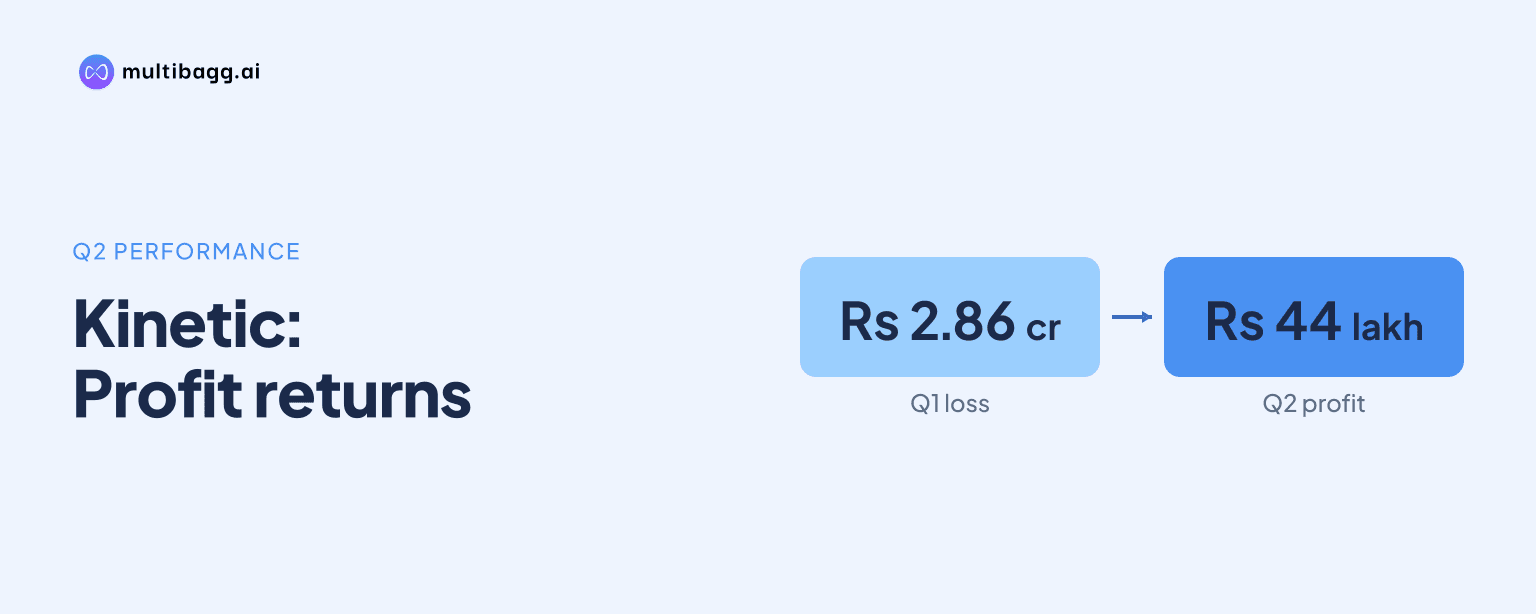
Kinetic Engineering Limited reported a standalone profit after tax of Rs 44 lakh for the quarter ended September 30, 2026, reversing a Rs 2.86 crore loss in the June 2026 quarter as revenue from operations rose to Rs 45.80 crore from Rs 35.76 crore. Its first-half standalone result remained a Rs 2.42 crore loss.
Know Kinetic Engineering inside out
Results, valuation, peers and who's buying, in one view.
How did Kinetic Engineering return to profit in Q2?
Kinetic Engineering made a Rs 44 lakh standalone profit after tax in the September 2026 quarter, compared with a Rs 2.86 crore loss after tax in the preceding June 2026 quarter. The quarterly profit was also Rs 11 lakh above the Rs 33 lakh recorded in the quarter ended September 30, 2025. No current or deferred tax expense was reported for those comparison periods, leaving profit before tax and profit after tax at the same amounts.
The September-quarter total income was Rs 47.47 crore, up from Rs 37.65 crore in June 2026, while total expenses rose to Rs 47.03 crore from Rs 40.51 crore. The resulting Rs 44 lakh surplus was reported as profit before exceptional items and profit before tax. The September 2026 quarterly statement did not show an exceptional item.
What drove Kinetic Engineering's September-quarter revenue growth?
Kinetic Engineering's revenue from operations rose by Rs 10.04 crore sequentially to Rs 45.80 crore in the September 2026 quarter and was Rs 6.50 crore above the Rs 39.30 crore reported a year earlier. Net sales and income from operations accounted for Rs 45.72 crore, with other operating income contributing Rs 8 lakh. The company reported that it operates in a single segment, so the filing provides no business-line revenue or profit split.
Cost of materials consumed increased to Rs 30.02 crore from Rs 22.06 crore in June 2026 and Rs 20.82 crore a year earlier. Other expenses increased to Rs 12.72 crore from Rs 9.70 crore sequentially, while employee-benefit expense fell to Rs 6.08 crore from Rs 6.27 crore. Finance costs were Rs 1.75 crore, compared with Rs 1.63 crore in June and Rs 1.61 crore in the September 2025 quarter.
The change in inventories was negative Rs 4.75 crore in the September quarter, compared with negative Rs 34 lakh in June 2026. Depreciation and amortisation expense was Rs 1.21 crore, versus Rs 1.19 crore in June and Rs 1.21 crore a year earlier. These reported cost movements left total expenses Rs 44 lakh below total income in the September quarter.
Why was Kinetic Engineering still loss-making in the first half?
Kinetic Engineering recorded a standalone loss after tax of Rs 2.42 crore for the half year ended September 30, 2026, compared with a profit after tax of Rs 1.27 crore in the corresponding 2025 half year. The Rs 44 lakh September-quarter profit did not offset the Rs 2.86 crore loss recorded in the June quarter. Basic earnings per share were negative Rs 0.77 for the first half, compared with positive Rs 0.54 a year earlier.
Revenue from operations rose to Rs 81.56 crore in the 2026 half year from Rs 74.64 crore in the prior-year period, while total income increased to Rs 85.12 crore from Rs 81.17 crore. Total expenses, however, rose to Rs 87.54 crore from Rs 79.90 crore, producing the Rs 2.42 crore loss. Materials consumed increased by Rs 10.32 crore year on year to Rs 52.08 crore, and other expenses increased by Rs 1.28 crore to Rs 22.42 crore.
Kinetic Engineering said it made no current-tax provision because carried-forward business losses and unabsorbed depreciation meant there was no taxable income. It also said deferred-tax assets relating to carried-forward losses are recognised only to the extent of deferred-tax liabilities. Those notes coincide with no tax expense against either the Rs 44 lakh quarterly profit or the Rs 2.42 crore first-half loss.
Got a follow-up? Ask IRIS
What do Kinetic Engineering's cash flow and balance sheet show?
Kinetic Engineering reported cash generated from operations of negative Rs 4.53 crore for the half year ended September 30, 2026, after working-capital movements. Operating profit before working-capital changes was Rs 2.32 crore, but trade and other receivables used Rs 6.99 crore and inventories used Rs 4.74 crore. Trade and other payables supplied Rs 4.88 crore, partly offsetting those outflows.
Cash and cash equivalents increased to Rs 58.33 crore at September 30, 2026 from Rs 27.19 crore at March 31, 2026, with the cash-flow statement reporting a Rs 31.14 crore net increase. Financing activities included Rs 57.08 crore from issue of equity shares or convertible warrants, Rs 4.47 crore of net long-term borrowings and Rs 1.61 crore of short-term borrowings. Investing activity included Rs 5.29 crore spent on property, plant, equipment and intangible assets, plus Rs 20 crore of net investment purchases.
Total standalone assets were Rs 336 crore at September 30, 2026, compared with Rs 270.25 crore at March 31, 2026. Equity increased to Rs 205.52 crore from Rs 150.86 crore, while combined current and non-current borrowings rose to Rs 76.57 crore from Rs 70.58 crore. Trade receivables rose to Rs 42.53 crore from Rs 35.38 crore, consistent with the receivables cash outflow reported for the half year.
What capital actions did Kinetic Engineering disclose?
Kinetic Engineering invested Rs 20 crore in the equity share capital of its subsidiary, Kinetic Watts and Volts Ltd, during the quarter and half year ended September 30, 2026. The standalone cash-flow statement separately recorded Rs 20 crore of net purchases of investments. On November 13, 2026, its board also approved an investment of Rs 42 crore in a subsidiary company, although the supplied filing does not identify that subsidiary in the board-meeting announcement.
On September 24, 2026, Kinetic Engineering converted the final tranche of 44.51 lakh outstanding warrants into an equal number of fully paid equity shares. Another 6.36 lakh warrants lapsed because their holders did not exercise their conversion option within the stipulated period. Paid-up equity share capital rose to Rs 31.36 crore at September 30, 2026 from Rs 26.91 crore at June 30, 2026 and Rs 23.81 crore a year earlier.
The audit committee reviewed, and the board approved, the unaudited standalone results on November 13, 2026. The statutory auditor carried out a limited review and said nothing had come to its attention indicating that the standalone statement was materially misstated under applicable requirements. The auditor stated that a review provides less assurance than an audit and does not express an audit opinion.
Conclusion
Kinetic Engineering's Rs 44 lakh September-quarter standalone profit reversed the Rs 2.86 crore June-quarter loss as revenue from operations increased by Rs 10.04 crore sequentially. Yet the company remained at a Rs 2.42 crore standalone loss for the first half, while cash generated from operations was negative Rs 4.53 crore and receivables rose by Rs 7.15 crore from March 31, 2026.
The disclosed points to watch are the use of warrant and equity proceeds, which contributed Rs 57.08 crore in financing cash inflows during the half year, and the subsidiary capital deployment. Kinetic Engineering has reported a Rs 20 crore investment in Kinetic Watts and Volts Ltd and said its board approved a further Rs 42 crore subsidiary investment, alongside a revised plan for using funds received from the warrant issue.