










Edelweiss insurance loss narrows as Zuno reports Rs 5 crore
Key highlights
- Zuno reported Rs 5 crore of profit after tax in the quarter ended September 30, 2026.
- Edelweiss’s insurance segment pre-tax loss narrowed to Rs 17.10 crore from Rs 67.35 crore a year earlier.
- Zuno’s GDPI grew 41% year-on-year, compared with the cited industry growth rate of 7%.
- Edelweiss Life Insurance reported Rs 558 crore of gross premium and Rs 11,067 crore of AUM in the quarter.
powered by IRIS
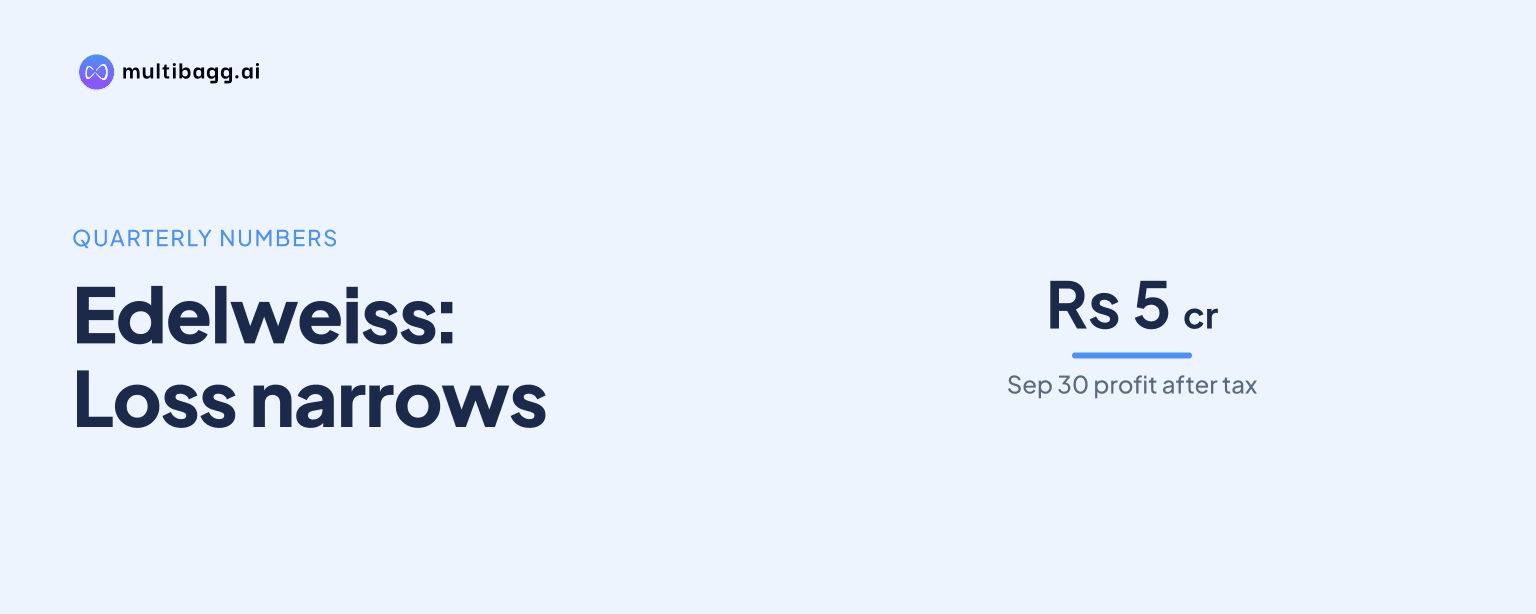
Edelweiss Financial Services Limited reported a Rs 17.10 crore pre-tax loss in its insurance business for the quarter ended September 30, 2026, down from Rs 67.35 crore a year earlier, while its general insurer Zuno recorded Rs 5 crore of profit after tax. Management said combined insurance losses for the six months ended September declined 58% year-on-year.
Know Edelweiss Financial Services inside out
Results, valuation, peers and who's buying, in one view.
How much did Edelweiss’s insurance loss narrow?
Edelweiss’s insurance segment loss before tax narrowed by Rs 50.25 crore year-on-year to Rs 17.10 crore in the September 2026 quarter. The result also improved from a Rs 33.68 crore loss in the June 2026 quarter, according to the consolidated segment results.
For the half year ended September 30, 2026, the insurance segment reported a pre-tax loss of Rs 50.78 crore, compared with Rs 71.63 crore in the corresponding previous-year period. That was a Rs 20.85 crore reduction in the reported segment loss, while management’s presentation said combined insurance losses fell 58% year-on-year.
Insurance segment income rose 37% year-on-year to Rs 950.46 crore in the September quarter from Rs 693.37 crore, although it was below Rs 1,034.64 crore in the preceding June quarter. The filing does not provide an insurance-segment expense breakdown that attributes the improvement in loss to specific claims, costs or investment movements.
Why did Zuno report a quarterly profit?
Zuno turned profitable in the September 2026 quarter, recording Rs 5 crore of profit after tax, according to Edelweiss’s results release. The announcement identifies Zuno as the group’s general insurance business and says it became profitable during the quarter.
Zuno’s Rs 5 crore figure and the Rs 17.10 crore insurance-segment loss measure different scopes and profit lines. Zuno’s disclosure is general insurance profit after tax, while the consolidated segment result is the broader insurance business before tax, including life insurance, so the figures cannot be directly offset to derive either insurer’s result.
The insurance segment held Rs 15,392.23 crore of assets and Rs 14,219.76 crore of liabilities as of September 30, 2026. Segment capital employed, defined in the results as segment assets less segment liabilities, was Rs 1,172.47 crore, down from Rs 1,310.50 crore a year earlier and Rs 1,355.88 crore at June 30, 2026.
Zuno’s auditor also referred to the actuarial valuation of incurred-but-not-reported and incurred-but-not-enough-reported claims at September 30, 2026. The auditor said Zuno’s appointed actuary certified the valuation under the applicable accounting standards and Insurance Regulatory and Development Authority of India guidelines.
How did Zuno’s premium growth compare with the industry?
Zuno’s gross direct premium income, or GDPI, increased 41% year-on-year in the September 2026 quarter, compared with 7% industry growth cited by Edelweiss. The company also reported gross written premium, or GWP, of Rs 366 crore, up 40% year-on-year.
Motor was Zuno’s largest disclosed line, accounting for 60% of quarterly GWP. Motor GDPI grew 66% year-on-year, compared with the 12% industry growth rate cited in the release, making it both the largest disclosed premium mix and the fastest disclosed growth comparison for the insurer.
The release does not disclose Zuno’s claims ratio, combined ratio, underwriting result or investment income for the September quarter. The Rs 5 crore profit therefore establishes quarterly profitability, but the supplied filing does not identify whether underwriting, investments, claims, expenses or another item was the principal driver.
Got a follow-up? Ask IRIS
What did life insurance contribute to Edelweiss insurance?
Edelweiss’s life insurance business reported gross premium of Rs 558 crore for the September 2026 quarter, up 11% year-on-year. Its assets under management, or AUM, reached Rs 11,067 crore, 13% above the prior-year level, while embedded value was reported at Rs 2,333 crore.
The life insurer issued 15,591 policies in the quarter. Participating and non-participating products together accounted for 78% of new-business premium, providing the filing’s stated product-mix measure for the period.
Life insurance and general insurance premiums are not presented on the same basis: the release reports life gross premium of Rs 558 crore and general-insurance GWP of Rs 366 crore. The consolidated financial statements instead show insurance-business premium income of Rs 769.53 crore for the September quarter, compared with Rs 654.60 crore a year earlier, so the individual operating metrics should not be added to recreate the accounting line item.
The group’s consolidated balance sheet showed Rs 11,230.29 crore of provision for policyholders’ liabilities at September 30, 2026, compared with Rs 10,561.78 crore at March 31, 2026. The consolidated income statement also recorded a Rs 199.84 crore change in insurance policy liability on an actuarial basis during the September quarter.
How material was insurance to Edelweiss’s September-quarter results?
Insurance was Edelweiss’s second-largest reported segment by income in the September 2026 quarter, at Rs 950.46 crore, after the capital business at Rs 1,125.29 crore. It exceeded alternatives income of Rs 279.88 crore and asset reconstruction income of Rs 195.13 crore, while total consolidated income was Rs 2,602.10 crore.
At group level, Edelweiss reported Rs 192.62 crore of profit attributable to owners for the September quarter, up from Rs 128.41 crore a year earlier. The consolidated result included a Rs 386 crore post-tax gain from the strategic sale and deconsolidation of Nido Home Finance, which ceased to be a subsidiary on September 25, 2026.
Management said the insurance businesses were on track to become profitable alongside the reported 58% reduction in combined losses for the six months ended September. This is management’s forward-looking assessment rather than a target with a stated date, and the release notes that future results may vary with economic conditions, interest rates, securities-market volatility, regulation and execution.
Conclusion
The September-quarter disclosures show a substantially smaller pre-tax loss across the broader insurance segment and a first reported profitable quarter for Zuno. Zuno’s 41% GDPI growth against the cited industry rate of 7%, including 66% motor GDPI growth, accompanied the general insurer’s Rs 5 crore profit after tax, while life insurance delivered Rs 558 crore of gross premium.
The next reporting periods will indicate whether Zuno can sustain profitability and whether the wider insurance segment can eliminate its Rs 50.78 crore first-half pre-tax loss. Investors can also watch life insurance AUM, which stood at Rs 11,067 crore on September 30, 2026, and management’s stated plan to make the insurance businesses profitable.