










Edelweiss cuts net debt 26% and projects US$63.6 crore liquidity
Key highlights
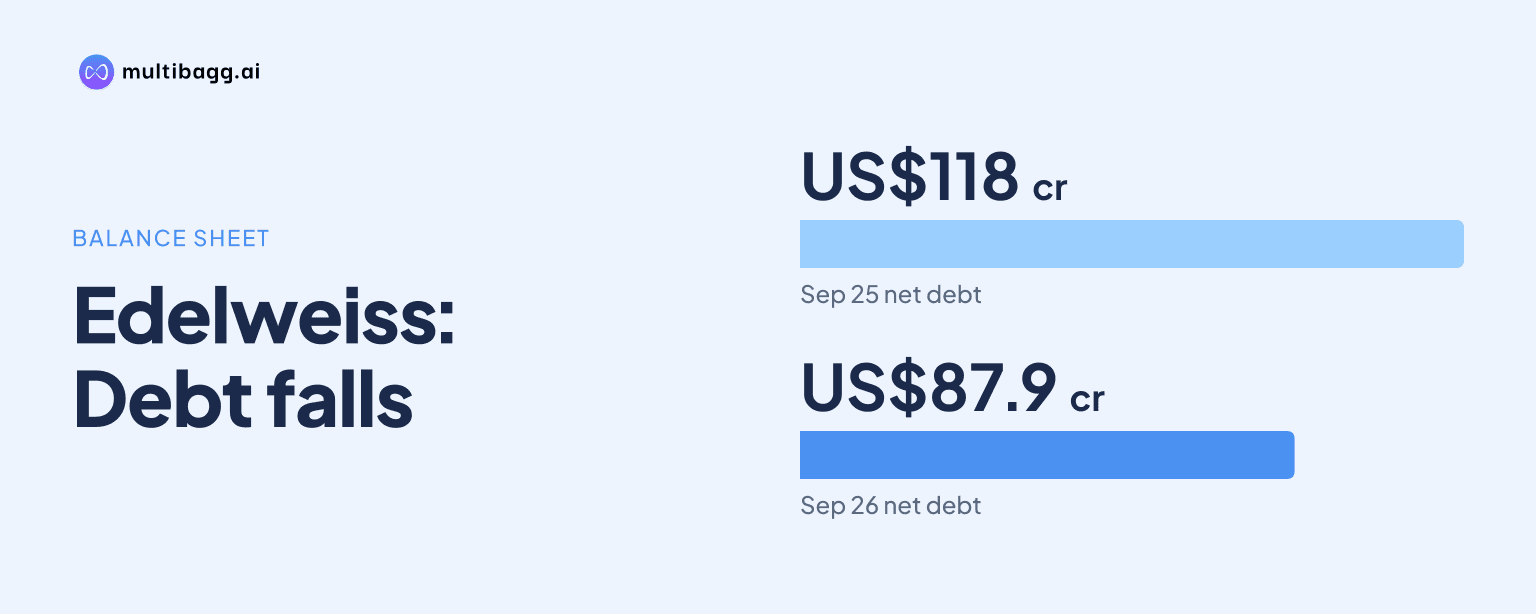
- Edelweiss reported US$87.9 crore of consolidated net debt in Sep 26, down 26% from US$118 crore in Sep 25.
- Corporate accounted for US$56.4 crore of Edelweiss’s US$87.9 crore Sep 26 consolidated net debt.
- Edelweiss projects US$63.6 crore of closing available liquidity for Oct 26 to Sep 27.
- Edelweiss forecasts US$69.8 crore of repayments and US$34.4 crore of disbursements over Oct 26 to Sep 27.
powered by IRIS
Edelweiss cut consolidated net debt 26% year on year to US$87.9 crore in Sep 26 and projects US$63.6 crore of closing available liquidity for Oct 26 to Sep 27, after US$104.2 crore of forecast outflows. The liquidity schedule starts with US$74 crore and includes US$93.8 crore of inflows.
Know Edelweiss Financial Services inside out
Results, valuation, peers and who's buying, in one view.
How much did Edelweiss reduce consolidated net debt?
Edelweiss reduced consolidated net debt by US$30.1 crore between Sep 25 and Sep 26, as the reported balance fell from US$118 crore to US$87.9 crore. The decline equals 26% year on year based on the two balances disclosed in the presentation, with the Sep 26 figure representing the group’s reported consolidated net debt.
The debt slide contains two stated year-on-year measures. Its first table, headed consolidated net debt, shows the 26% decline between Sep 25 and Sep 26, while the slide heading says corporate net debt declined 18% year on year. Edelweiss does not disclose a Sep 25 corporate-only debt balance on the page, so the 18% corporate comparison cannot be calculated from the supplied figures.
Which businesses made up Edelweiss’s Sep 26 net debt?
Edelweiss reported US$56.4 crore of net debt in Corporate in Sep 26, making it the largest component of the US$87.9 crore consolidated total. NBFC, or non-banking financial company, accounted for US$20.7 crore, followed by Asset Reconstruction at US$9.4 crore and Alternative Asset Management at US$1.4 crore.
The four disclosed business balances add to the US$87.9 crore consolidated figure. Corporate was larger than the combined US$31.5 crore reported for NBFC, Asset Reconstruction and Alternative Asset Management, while Alternative Asset Management was the smallest contributor. The presentation does not disclose gross borrowings, cash balances, interest costs or debt maturities behind the Sep 26 net-debt calculation.
How does Edelweiss project liquidity through Sep 27?
Edelweiss projects closing available liquidity of US$63.6 crore for the 12 months from Oct 26 to Sep 27. The forecast begins with US$74 crore of opening available liquidity and assumes US$66.7 crore of expected inflows plus US$27.1 crore of fresh borrowings, together totalling US$93.8 crore.
Before outflows, opening liquidity and total inflows amount to US$167.8 crore. Edelweiss forecasts US$69.8 crore of repayments and US$34.4 crore of disbursements, producing total outflows of US$104.2 crore and the stated US$63.6 crore closing balance. Closing liquidity is therefore US$10.4 crore below the opening amount, although the presentation describes the position as surplus liquidity cover.
The forecast depends on the scheduled US$66.7 crore of expected inflows and US$27.1 crore of fresh borrowings. Repayments are the largest identified outflow at US$69.8 crore, more than twice the US$34.4 crore planned for disbursements. Edelweiss also says assets in each tenor range adequately cover liabilities, but the supplied page provides no numerical asset-liability maturity schedule.
Got a follow-up? Ask IRIS
Are Edelweiss’s operating businesses capitalized for stated needs?
Edelweiss reports capital adequacy of 37% for Asset Reconstruction and 23% for its NBFC, while describing each operating business as well capitalized for regulatory and growth needs. These are point-in-time regulatory measures in the presentation, which does not give comparable earlier-period capital-adequacy ratios.
The insurance businesses are shown with solvency ratios rather than capital-adequacy ratios. General Insurance, branded Zuno, reported a 160% solvency ratio, while Life Insurance reported 171%, a difference of 11 percentage points. Edelweiss does not provide the applicable regulatory thresholds or prior-period solvency figures on the disclosed page.
Operating metrics differed across these businesses in the Sep 26 presentation. Zuno reported gross written premium of US$3.8 crore, up 40% year on year, and profit after tax of US$10 lakh in what Edelweiss called its first profitable quarter. The NBFC reported micro, small and medium enterprise disbursals of US$5.8 crore, three times the year-earlier level, alongside its US$20.7 crore net-debt balance.
What are Edelweiss’s FY27 priorities after deleveraging?
Edelweiss lists scaling profit after tax in asset-management businesses, insurance profitability and calibrated credit-business expansion among its FY27 focus areas. Alternative Asset Management profit after tax rose 35% year on year in the first half of FY27, while Mutual Fund profit after tax rose 64%; Zuno is marked as profitable in the quarter.
The company also identifies threefold year-on-year growth in NBFC micro, small and medium enterprise disbursals as part of calibrated credit expansion. Separately, Edelweiss marked the listing of Edelweiss Alternatives and Carlyle becoming a strategic majority investor in Nido as completed FY27 actions. The presentation does not connect those completed actions directly to the Oct 26 to Sep 27 liquidity schedule.
Carlyle’s total Nido investment exceeds US$20.8 crore and includes about US$7.6 crore of primary capital already received, with a further roughly US$7.6 crore due within 18 months. A secondary purchase of a 45% stake from Edelweiss for about US$6.3 crore has been completed, and Edelweiss expects to hold about 26% of Nido. Management says Nido’s net worth would nearly triple to about US$24 crore on completion of the primary infusion.
Conclusion
Edelweiss’s disclosed balance-sheet figures show a US$30.1 crore year-on-year reduction in consolidated net debt to US$87.9 crore in Sep 26, with Corporate accounting for US$56.4 crore of the total. Its liquidity plan retains US$63.6 crore after US$104.2 crore of outflows, led by US$69.8 crore of repayments.
The next measures to watch are execution of the Oct 26 to Sep 27 schedule, particularly US$66.7 crore of expected inflows and US$27.1 crore of fresh borrowings, and the remaining roughly US$7.6 crore Nido primary infusion due within 18 months. Management’s FY27 plan also points to asset-management profit growth, insurance profitability and calibrated NBFC expansion.