










Zuno Turns Profitable in H1FY27 as COR Falls to 118%
Key highlights
- Zuno reported positive profit before tax in H1FY27 after losses in H1FY26 and FY26.
- Zuno’s gross written premium grew 49% year on year in H1FY27.
- Zuno’s combined operating ratio fell 10 percentage points year on year to 118% in H1FY27.
- Zuno’s operating-expense ratio declined to 11.1% in H1FY27 from 15.8% a year earlier.
powered by IRIS
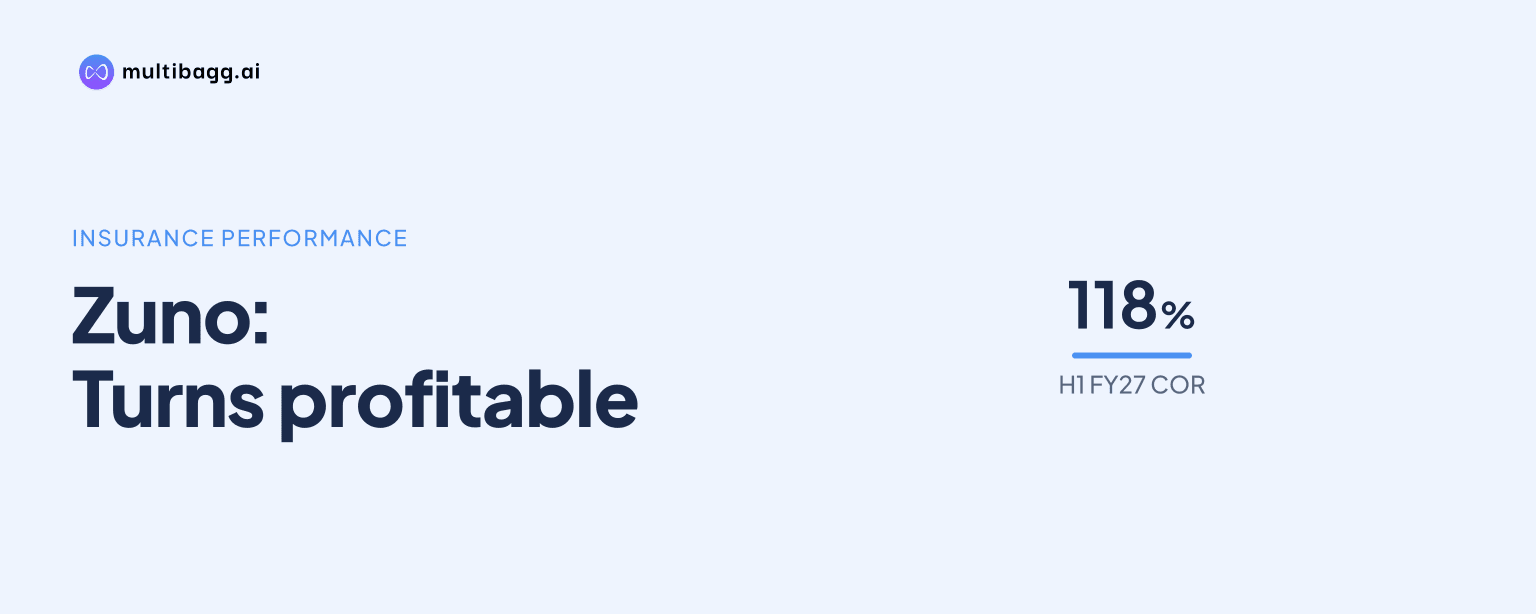
Zuno turned profitable in H1FY27, reporting positive profit before tax as gross written premium rose 49% year on year and the combined operating ratio fell to 118% from 128%. The presentation links the turnaround to lower operating costs relative to premium, with the operating-expense ratio at 11.1%, down 4.7 percentage points.
Know Edelweiss Financial Services inside out
Results, valuation, peers and who's buying, in one view.
How did Zuno turn profitable in H1FY27?
Zuno turned profitable in H1FY27 after reporting profit-before-tax losses in FY22, FY24, FY26 and H1FY26. The presentation records a positive profit before tax, or PBT, for the first half of FY27, following a loss in H1FY26 and a full-year loss in FY26. It describes this as the business turning profitable and says the company is on track for FY27 profitability.
The principal operating comparison is the combined operating ratio, or COR, which improved to 118% in H1FY27 from 128% in H1FY26. That 10-percentage-point change also put COR below the 124% reported for FY26, 136% for FY24 and 155% for FY22. The presentation does not provide a claims ratio, underwriting-profit measure or product-level profit split to isolate the individual contributors to the PBT result.
Zuno presents the first-half result as a combination of growth, profitability and quality. Its stated mechanism is operating leverage from the digital model: a larger premium base is associated with a lower operating-expense ratio, which Zuno defines as operating expenses divided by gross written premium, or GWP. The source does not quantify how much of the H1FY27 PBT improvement came from expense reduction rather than claims, pricing, investment income or other factors.
How fast did Zuno grow compared with the industry?
Zuno’s GWP grew 49% year on year in H1FY27, compared with its reported 38% compound annual growth rate, or CAGR, across FY22 to FY26. The presentation says Zuno’s FY22-FY26 GWP CAGR was 38%, while the industry’s was 11%, making Zuno’s reported growth rate about 3.5 times the industry rate over that historical period. The 49% H1FY27 figure is a year-on-year comparison and is not presented as a full-year forecast.
The growth history shows GWP rising between FY22, FY24 and FY26 before the 49% H1FY27 increase. This matters because the first-half expansion occurred on a premium base that had already grown at a 38% CAGR over four fiscal years. The presentation links the higher scale to its digital operating model but does not disclose growth by motor sub-segment, distribution channel or customer cohort.
Assets under management, or AUM, rose 26% year on year in H1FY27. The source presents AUM beside GWP and PBT, but does not state whether the AUM movement contributed to first-half profitability. The update also reports more than 10 million customers, 100% digital policy issuance and a 4.6 rating for the Zuno App in October 2026, without assigning a direct premium or profit impact to those measures.
Zuno identifies motor as the foundation of its franchise and intends to broaden its presence in private car, adjacent motor and mobility segments. The presentation calls for leadership across motor and other focus segments, but does not give H1FY27 premium growth figures for those individual categories. As a result, the disclosed 49% GWP growth establishes overall expansion rather than a segment-by-segment growth ranking.
Got a follow-up? Ask IRIS
Which expense measures improved in H1FY27?
Zuno’s operating-expense ratio improved to 11.1% in H1FY27 from 15.8% in H1FY26, a reduction of 4.7 percentage points. It was also below the 12.2% shown for FY26 in the H1FY27 comparison table. Since the ratio is calculated as operating expenses divided by GWP, the 49% increase in first-half GWP is relevant to the reduction in expenses as a share of premium.
The longer disclosed trend is a decline from 28.0% in FY22 to 18.0% in FY24 and 12.0% in a separate FY26 historical chart. That FY26 historical chart differs slightly from the 12.2% FY26 figure in the H1FY27 comparison table. For the direct H1FY26-to-H1FY27 comparison, Zuno reports 11.1% and the 4.7-percentage-point year-on-year reduction.
Net expenses of management, or Net EOM, declined to 31.6% in H1FY27 from 34.1% in H1FY26. The H1FY27 figure was nevertheless above the 30.5% stated for FY26, showing that the first-half improvement against the prior-year half did not take Net EOM below the prior full-year level. Zuno defines Net EOM as operating expenses plus commission, with FY26 stated net of rural and InsureTech allowances.
Zuno attributes the cost trend to a digital operating model that includes autonomous processes, artificial-intelligence-driven decisions and digital customer journeys. Its stated customer tools include single-click buying, paperless policy issuance and renewal, instant Know Your Customer checks, artificial-intelligence claim-registration bots and Zuno Pay. The company does not disclose the cost saving, adoption rate or claims benefit attached to any individual mechanism.
What targets has Zuno set after H1FY27?
Zuno’s management says it is on track for FY27 profitability after the positive H1FY27 PBT result. This is an outlook statement rather than a disclosed full-year PBT target, as the presentation gives no target profit, quarterly profitability milestone or expected exit run rate. The H1FY27 outcome therefore provides evidence of a first-half turning point, not a quantified forecast for the full fiscal year.
The company’s sustainable-economics aspiration is a COR below 100%, compared with the reported 118% in H1FY27. Its structural-operating-advantage aspiration is an operating-expense ratio of 6% to 7% of GWP, against 11.1% in H1FY27. Reaching those aspirations would require further improvement beyond the 10-percentage-point COR reduction and 4.7-percentage-point operating-expense-ratio reduction reported for the first half.
Zuno’s three stated long bets are its motor franchise, its digital machine and customer experience. Under customer experience, the company cites a five-minute fastest motor-claims settlement in Q2 2026, along with a plan to move from protection to prevention and use app-driven personalisation. The source does not disclose a future claims-settlement target or a date for reaching the below-100% COR aspiration.
Conclusion
Zuno’s H1FY27 presentation documents a shift from losses to positive PBT alongside 49% year-on-year GWP growth. The improvement coincided with a COR of 118%, down 10 percentage points from H1FY26, and an operating-expense ratio of 11.1%, down 4.7 percentage points. The data support management’s view that scale and digital operations are reducing expense intensity, while the source leaves claims and product-level drivers undisclosed.
The next measure to watch is whether Zuno delivers the management-stated aim of FY27 profitability while moving toward its disclosed below-100% COR aspiration. Investors can also track whether the operating-expense ratio continues from 11.1% toward management’s 6% to 7% target, and whether Net EOM improves from the 31.6% reported in H1FY27.