










Zuno says four-week launches enable 95% unassisted policies
Key highlights
- Zuno reports a four-week product go-to-market cycle and a seven-day add-on go-to-market cycle.
- Zuno says 95% of policies are unassisted and about 90,000 policies are issued each month.
- Zuno reports 99.99% system availability, more than 466 APIs and an API response time of about 200 milliseconds.
- Zuno reports a 50% AI-assisted development-cycle reduction and an approximately two-point conversion uplift from ZunoWise.
powered by IRIS
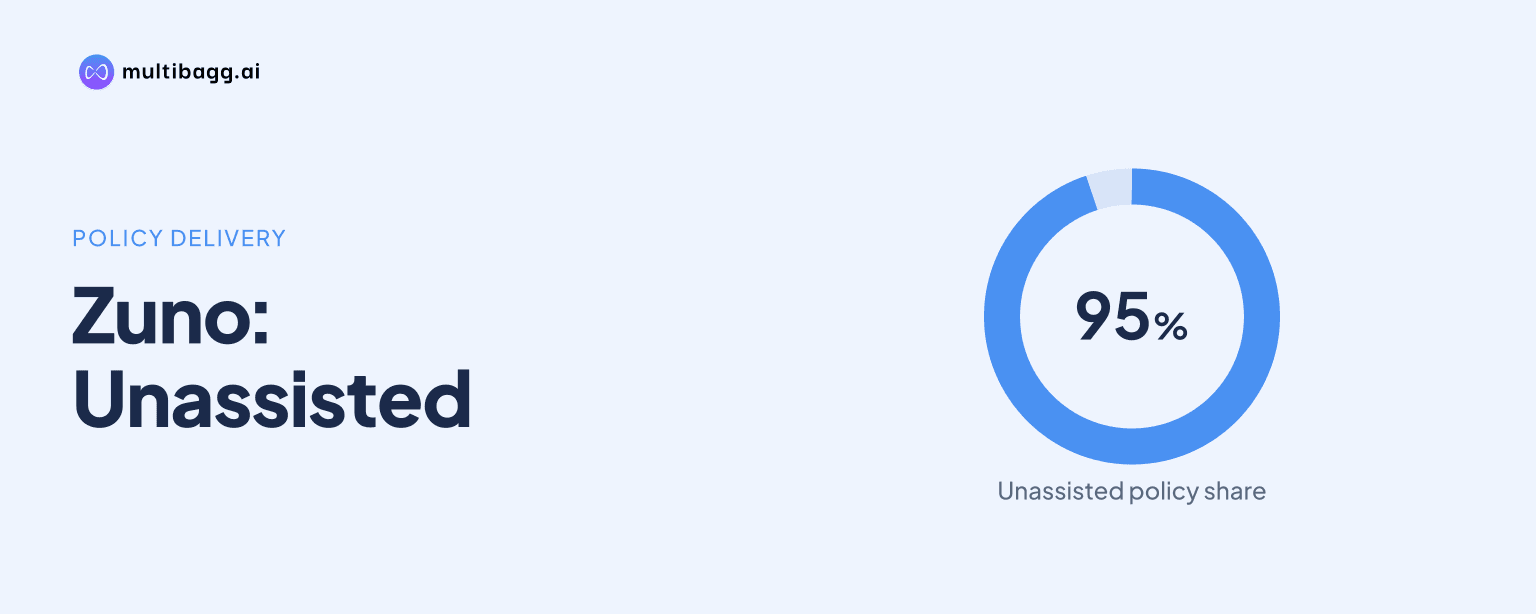
Zuno says its digital platform supports product go-to-market in four weeks and enables 95% of policies to be issued unassisted. Its reported operating measures also include 99.99% system availability, about 90,000 policies issued per month and policy issuance in under 30 seconds, showing how its technology stack is intended to support automated distribution.
Know Edelweiss Financial Services inside out
Results, valuation, peers and who's buying, in one view.
How quickly does Zuno launch products and partner integrations?
Zuno reports a four-week product go-to-market, or GTM, cycle, a seven-day add-on GTM cycle and partner integration in less than one week. These measures sit within its digital platform-led operating-efficiency disclosure. The presentation does not specify the measurement period, product count or whether each measure applies to every insurance line.
Across release types, the reported time falls from four weeks for a product to seven days for an add-on, indicating that Zuno treats additions to existing products differently from broader launches. Zuno has separately identified motor offerings including SmartDrive, specialised electric-vehicle covers, Fuel Guard and day-based own-damage cover, but it does not state that the four-week GTM measure applies solely to motor products.
Zuno also reports a 50% reduction in its AI-assisted development cycle under its faster-GTM use case. The disclosure does not provide the prior development duration, the number of releases assessed or the period covered. It therefore establishes a reported reduction in the development cycle without showing the absolute number of days saved.
What proportion of Zuno policies are unassisted?
Zuno says 95% of its policies are unassisted and that it issues about 90,000 policies per month. The company presents both measures under automated operations at scale, alongside 24×7 claims insta-payouts. It does not define the precise operational threshold for an unassisted policy or provide a product-wise split.
The unassisted-policy share is reported with issuance in under 30 seconds and a successful-payment rate of about 97%. These measures describe separate parts of the purchase process: payment success, policy issuance speed and the extent of unassisted issuance. Zuno does not explain the remaining 5% of policies or identify whether they involve underwriting review, customer support or other exceptions.
Zuno's customer-experience disclosure separately states that 100% of policies are issued digitally for its customer base of more than 10 million. Digital issuance and unassisted issuance are not necessarily the same measure, because the presentation does not define whether a digitally issued policy can still involve human support. The company also reports a 4.6 App Store rating for the Zuno App in October 2026.
What technology supports Zuno's automated insurance operations?
Zuno describes a five-layer architecture comprising an experience overlay, agentic artificial intelligence, or AI, data and identity, microservices and event-driven platforms, and serverless compute. Its experience layer includes the website with Agent ZIA, the Zuno App with Zuno Sense, the STAAR App, EDGE and open application programming interfaces, or APIs, with Partner Agent.
The data and identity layer includes a data lake, data warehouse, Helios Data Taps, Dedupe and Customer 360. Zuno lists Phoenix, Claimsville, ZunoPay, ZunoCom, Central Know Your Customer, or KYC, Jarvis and Zuno Relay in its microservices and event-driven layer. These named systems cover customer interaction, claims, payment, identity and data functions rather than only online policy sales.
At the compute layer, Zuno lists Amazon Web Services with “100X Autoscale”, multicloud, SAP Core and Health Core, while reporting 99.99% system availability. The presentation does not state the interval used for the availability measure, the services included or the treatment of planned maintenance. More than 466 APIs across journeys and an API response time of about 200 milliseconds are the other reported integration measures.
Got a follow-up? Ask IRIS
How does Zuno use AI in pricing, fraud and support?
Zuno identifies six AI applications: faster GTM, granular pricing, a do-it-yourself agent platform, fraud identification, personalised support and natural-language decision tools. Its Orion platform is described as a unified system to build, deploy, govern and monitor AI agents securely. Zunowise, ZAC for Business and Zuno Lens are also named in the company's architecture.
For motor pricing, Zuno says ZunoWise is a dynamic pricing model intended to optimise for loss ratio and conversion, reporting an approximately two-point uplift in conversion. The presentation does not disclose the starting conversion rate, the policy sample or the time period. As a result, the final conversion percentage cannot be calculated from the information provided.
For fraud, Zuno reports “2x Savings” from machine-learning-powered identification, complemented by its large-language-model-based ORBIT Agent. The stated mechanism is to identify fraud before payout rather than after it. Zuno does not give the savings amount, the comparison baseline, the period or the percentage of claims screened.
Zuno also identifies ZIA as an AI-powered customer agent and ZAC as an AI tool for partners, with the stated objective of personalised support without linear service cost. Its natural-language-processing dashboards are intended to turn raw data into plain-language insight for teams. The presentation does not disclose user numbers, query volumes, service-cost savings or decision-time reductions from these tools.
How do Zuno's platform speeds differ across activities?
Zuno reports distinct time measures for different activities: about 200 milliseconds for an API response, under 30 seconds for policy issuance, less than one week for partner integration, seven days for an add-on GTM cycle and four weeks for a product GTM cycle. The duration increases with the scope of the activity, from a system response to an integration or product release. These are not like-for-like changes over time.
For claims, Zuno reports 24×7 insta-payouts in its operating-efficiency section. Separately, it says its fastest motor claim was settled in five minutes in Q2 2026. The five-minute settlement is a motor-claims measure, whereas the 24×7 statement describes availability of insta-payouts, so neither figure establishes an average claims-settlement time or payout value.
Conclusion
Zuno's reported operating model combines a four-week product GTM cycle with 95% unassisted policies, about 90,000 monthly policy issuances and 99.99% system availability. Its technology disclosure links those measures to more than 466 APIs, a reported 200-millisecond API response time and systems spanning data, KYC, payments, claims and customer-facing channels.
What to watch next is the execution of Zuno's disclosed Orion plan to build, deploy, govern and monitor AI agents securely, alongside the operating outcomes from ZunoWise pricing and ORBIT fraud identification. Management reports an approximately two-point conversion uplift from motor pricing and 2x fraud savings, but has not disclosed the underlying baselines, time periods or financial values.