










Zuno private-car premium grew at a 44% CAGR over four years
Key highlights
- Zuno’s private-car GWP rose from US$1.7 crore in FY22 to US$7.3 crore in FY26, a stated 44% four-year CAGR.
- Zuno has recorded more than 96 million kilometres of proprietary driving data since May 2020.
- About 15% of eligible Zuno policies use telematics, and Zuno reports about 50% lower claims at scores of 95 or above.
- Zuno reports 95% unassisted issuance, about 90,000 policies issued monthly and 99.99% system availability.
powered by IRIS
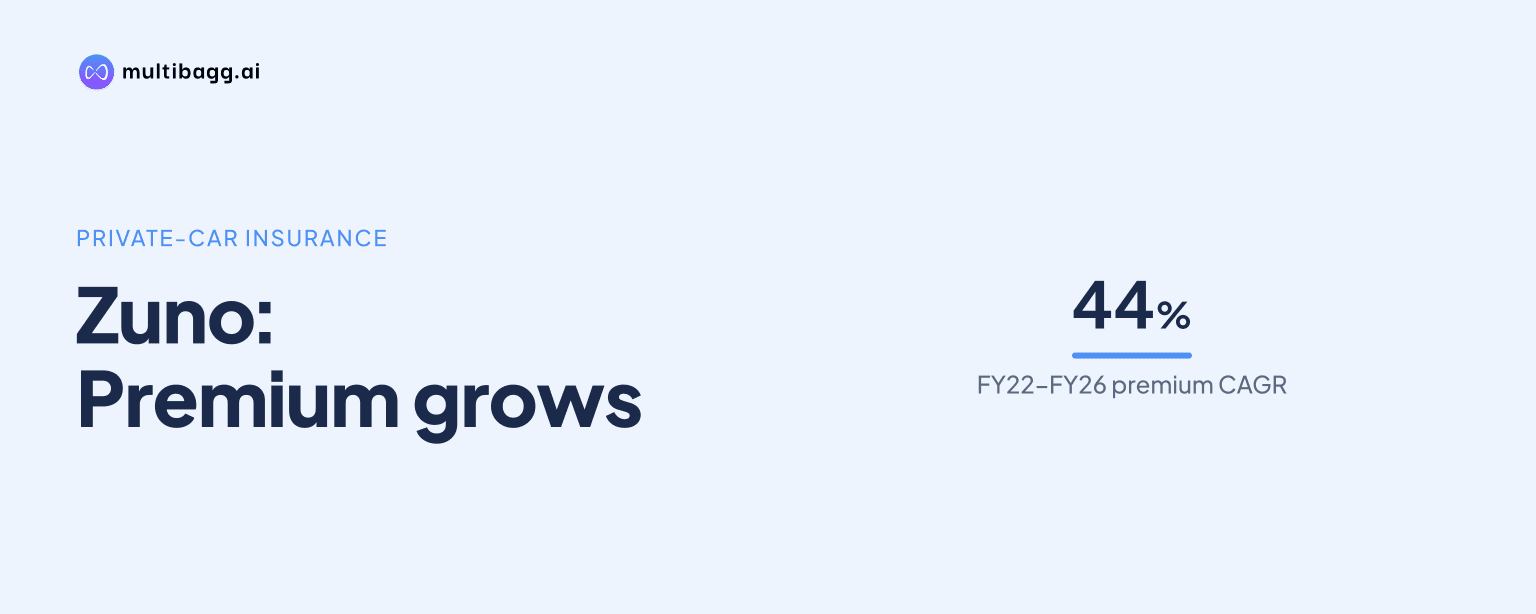
Zuno’s private-car gross written premium grew at a stated 44% compound annual growth rate, or CAGR, from FY22 to FY26, rising from US$1.7 crore to US$7.3 crore, while its telematics programme recorded more than 96 million kilometres and reported about 50% lower claims for driving scores of 95 or above.
Know Edelweiss Financial Services inside out
Results, valuation, peers and who's buying, in one view.
How fast has Zuno’s private-car premium grown?
Zuno’s private-car gross written premium, or GWP, rose from US$1.7 crore in FY22 to US$3.3 crore in FY24 and US$7.3 crore in FY26. That FY22-FY26 progression produced the 44% four-year CAGR stated in the presentation, with the increase accelerating in absolute terms from US$1.6 crore over FY22-FY24 to US$4 crore over FY24-FY26.
Zuno identifies private car as the focus of its approach rather than presenting the GWP figures as growth across every insurance category. Its strategy combines product innovation, a digital and artificial-intelligence-enabled platform, and customer experience, while the presentation identifies pricing pressure across product lines as a reason that risk selection and operating efficiency matter.
Which partnerships support Zuno’s private-car focus?
Zuno says it has nine original equipment manufacturer, or OEM, partners, with the three largest OEMs among them. The named partners are Mahindra Rise, TATA, MARUTI SUZUKI, NISSAN RENAULT FINANCIAL SERVICES INDIA, MG, Jeep, Volkswagen, SKODA and Audi.
The nine-brand network spans vehicle makers and finance-linked distribution, alongside the private-car GWP increase from US$1.7 crore in FY22 to US$7.3 crore in FY26. Zuno does not disclose policy volumes, GWP, claims experience or profitability for any individual OEM partner, so the presentation establishes the scale of the partner list but does not identify the contribution of each relationship.
Zuno’s platform reports partner integration in less than one week, which is a stated operating measure relevant to an OEM-led route. The presentation also reports more than 466 application programming interfaces, or APIs, across journeys, indicating that partner connectivity is part of the company’s stated digital operating model.
What private-car products has Zuno introduced?
Zuno’s flagship private-car product is Zuno SmartDrive, which it describes as India’s first driving-behaviour-based motor insurance with embedded telematics. The product is part of a usage-based insurance, or UBI, programme that began in May 2020 and links observed driving behaviour with insurance risk selection.
Zuno also lists specialist covers for emerging electric-vehicle, or EV, risks, including battery analytics and make-and-model risk scores. Its Fuel Guard add-on covers engine damage from approved blended fuels, while day-based own-damage, or OD, cover aligns OD renewal with third-party, or TP, policy expiry for bundled new-car policies.
A bundled new-car policy pairs one-year OD cover with mandatory three-year TP cover, according to the presentation, creating a mismatch between renewal dates. Zuno also says it was first to launch residual value insurance for new vehicles, but it provides no separate GWP, policy, pricing or claims data for SmartDrive, EV covers, Fuel Guard, day-based OD or residual value insurance.
Got a follow-up? Ask IRIS
How does Zuno use telematics data for underwriting?
Zuno has recorded more than 96 million kilometres of proprietary driving data during its five-year UBI journey since May 2020. The company says this data links driving behaviour to claims and supports personalised pricing, granular risk selection and customer engagement.
About 15% of eligible Zuno policies use telematics, meaning the programme applies to a defined eligible population rather than every policy. Zuno reports about 50% lower claims for customers with scores of 95 or above, connecting its highest disclosed score band with a lower claims outcome.
The presentation does not disclose the comparison group for the approximately 50% lower-claims figure, the number of scored policies, the measurement period, or whether the measure reflects claim frequency, severity or total claims cost. It does state that the programme progressed from sandbox experimentation in May 2020 to a scalable behaviour-linked insurance model over five years.
How does Zuno’s platform support private-car delivery?
Zuno reports 99.99% system availability, a four-week product go-to-market period, a seven-day add-on go-to-market period and partner integration in less than one week. These measures support a private-car product range that includes telematics, EV-related covers and renewal-oriented add-ons.
The company also reports about 90,000 policies issued per month and 95% unassisted policy issuance. Its customer-facing measures include policy issuance in less than 30 seconds, API response times of about 200 milliseconds, successful payments of about 97%, 24-by-7 claims insta-payouts and an app rating of 4.6 stars.
Zuno’s architecture includes data and identity systems, microservices, event-driven platforms and Amazon Web Services infrastructure with stated 100-times autoscaling. The presentation does not provide a cost ratio, expense ratio or profit measure alongside these operating metrics, so their financial effect is not quantified in the disclosed pages.
What external changes could affect Zuno’s model?
Zuno identifies pricing pressure across product lines, proposed distribution reforms involving lower expense limits and commission caps, and an International Financial Reporting Standards, or IFRS, transition in FY28. The company says regulatory and pricing cycles are turning in ways that favour disciplined, digital-native players.
The presentation frames risk selection and efficiency as key levers for profitability in this setting. Its 44% private-car CAGR, more than 96 million kilometres of driving data and 95% unassisted issuance describe the operating model, but the disclosed pages do not quantify the effect of commission limits or IFRS on future earnings.
Conclusion
Zuno’s private-car strategy combines a stated 44% CAGR from FY22 to FY26 with nine OEM partners, telematics-led Zuno SmartDrive and specialised products for EV, fuel and renewal-date risks. The company’s more than 96 million kilometres of driving data and reported 95% unassisted issuance link its growth plan to behaviour-based underwriting and digital delivery.
The next measures to watch are whether telematics use rises above about 15% of eligible policies and whether the reported approximately 50% lower claims at scores of 95 or above continues as the programme scales. Management also identifies proposed distribution reforms and the FY28 IFRS transition as forthcoming changes that could affect the importance of expense control, commissions and risk selection.