










Zuno Reports Four-Week Launches and 2x AI Fraud Savings
Key highlights
- Zuno reports a four-week product go-to-market cycle, versus seven days for add-ons and less than one week for partner integrations.
- Zuno says 95% of policies are issued unassisted, with about 90,000 policies issued per month.
- Zuno reports 99.99% system availability, 466-plus APIs and API response times of about 200 milliseconds.
- Zuno says AI-supported fraud identification delivers two times savings and motor-pricing AI lifts conversion by about two points.
powered by IRIS
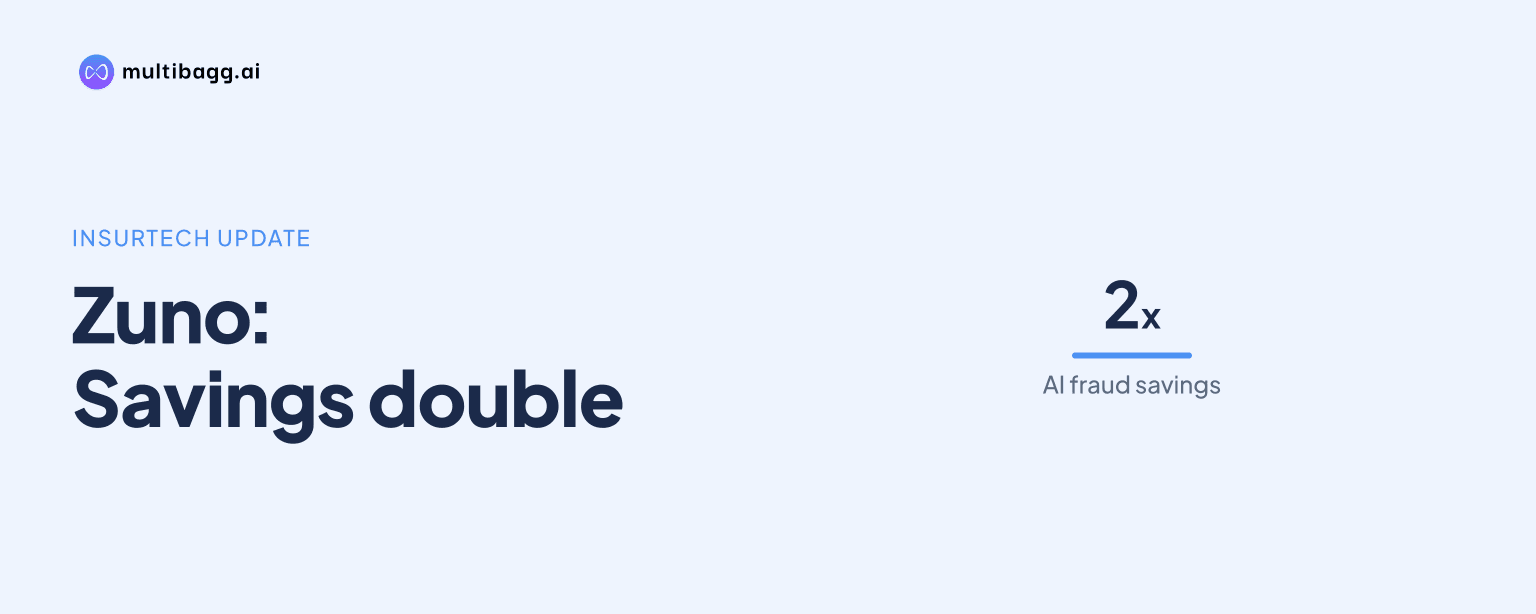
Zuno reports a four-week product go-to-market cycle and says its machine-learning fraud identification, complemented by the ORBIT large language model agent, delivers two times savings by identifying fraud before payout. The insurer also reports 95% unassisted policy issuance, about 90,000 policies issued monthly and 99.99% system availability.
Know Edelweiss Financial Services inside out
Results, valuation, peers and who's buying, in one view.
What technology architecture supports Zuno’s operating model?
Zuno’s operating model is built across five technology layers: an experience overlay, agentic artificial intelligence, data and identity, microservices and event-driven platforms, and serverless compute. The experience layer includes the Zuno website with ZIA, the Zuno App with Zuno Sense, the STAAR App, EDGE and open application programming interfaces, or APIs, for partner agents.
The lower layers connect the Data Lake, Data Warehouse, Helios Data Taps, Dedupe and Customer 360 with systems including Phoenix, Claimsville, ZunoPay, ZunoCom, Central Know Your Customer and Zuno Relay. Zuno lists Amazon Web Services, or AWS, with 100X autoscale capability, multicloud infrastructure, SAP Core and Health Core in its serverless-compute layer.
Zuno’s reported 466-plus APIs across customer and operating journeys provide a measure of how extensively those systems are connected. The company also reports an API response time of about 200 milliseconds, while its platform availability is listed at 99.99%. These are operating metrics reported by Zuno.
How quickly does Zuno say it can launch products and integrations?
Zuno says it can take a product to market in four weeks, launch an add-on in seven days and complete a partner integration in under one week. The comparison shows that the company assigns different delivery times to three workflow types, with add-ons and partner integrations listed as faster than a full product launch.
Zuno separately says artificial-intelligence-assisted development has reduced its go-to-market cycle by 50%. The presentation does not provide the starting cycle time, the measurement period or a breakdown between motor products, other products and add-ons, so the four-week product metric should not be treated as a disclosed before-and-after reduction for a specific insurance line.
The company’s product-development claim sits alongside an “always on, always shipping” operating model and 99.99% system availability. Its private-car innovation materials show products such as SmartDrive telematics cover, Fuel Guard, day-based own-damage cover and residual value insurance, but the four-week platform metric itself is labelled simply as product go-to-market.
How automated are Zuno’s insurance operations?
Zuno reports that 95% of policies are issued without assistance and that it issues about 90,000 policies per month. It also reports policy issuance in under 30 seconds, positioning automation as the mechanism behind a high share of digital issuance rather than merely an online application channel.
Payments are another stated operating measure: Zuno reports about 97% successful payments and 24×7 claims insta-payouts. The company does not disclose a payment volume, a claims payout value or a comparative payment-success figure for an earlier period, so these figures describe reported process performance rather than financial impact.
The customer-facing measures are consistent with the same digital model. Zuno reports a 4.6-star app rating and lists the Zuno App, Zuno Sense, ZunoPay and the website as parts of its experience layer. These products connect the quoted issuance and payment measures to customer-facing channels, while the 466-plus APIs show the supporting integration layer.
Got a follow-up? Ask IRIS
How does Zuno say AI changes pricing, fraud detection and support?
Zuno identifies six AI applications, beginning with a 50% reduction in the development cycle and dynamic motor pricing through ZunoWise. The company says ZunoWise optimises for loss ratio and conversion, and reports an approximately two-point uplift in conversion. It does not disclose the base conversion rate, the testing method or the period over which that uplift was measured.
For fraud, Zuno says machine-learning-powered identification is complemented by the large language model-based ORBIT Agent and catches fraud before payout rather than after payout. The company reports two times savings from this approach, but provides neither the rupee value of savings nor the prior-period fraud-loss baseline. The figure is therefore a company-reported outcome metric, not a disclosed financial statement item.
Zuno also uses Orion as a unified platform to build, deploy, govern and monitor AI agents, according to the presentation. Its support tools include ZIA for customers and ZAC for partners, while natural-language-processing dashboards are intended to turn raw data into plain-language insight. The stated objective is personalised support without linear service-cost growth, although no service-cost figure is provided.
What do these metrics show about Zuno’s digital strategy?
Taken together, Zuno’s measures describe a model focused on speed, automation and decision support: 28 days for product go-to-market, seven days for add-ons, less than seven days for partner integration and under 30 seconds for policy issuance. The comparison is across process types rather than across reporting periods, but it indicates that Zuno expects modular additions and external integrations to move faster than a full product launch.
The presentation also links the operating platform to insurance-specific decisions. ZunoWise is aimed at motor pricing, ORBIT is used with machine learning for fraud identification, and the company reports about a two-point conversion uplift alongside two times fraud savings. Those reported outcomes suggest that Zuno is measuring AI through operational and conversion indicators, although the presentation does not provide loss ratios, fraud rates or savings in rupees.
Conclusion
Zuno’s disclosures show how its digital platform is intended to connect customer issuance, payments, product delivery, motor pricing and fraud controls. The company’s stated architecture combines 466-plus APIs, customer applications, data systems and AI tools such as ZunoWise, Orion and ORBIT to support those activities.
What to watch next is whether Zuno discloses the underlying baselines for its stated 50% development-cycle reduction, approximately two-point conversion uplift and two times fraud savings. The presentation identifies the AI mechanisms behind these measures but leaves their measurement periods, rupee savings and financial implications unresolved.