










Zuno private-car premium reached Rs 704 crore during FY26
Key highlights
- Zuno’s private-car GWP increased from Rs 162 crore in FY22 to Rs 704 crore in FY26, a reported 44% four-year CAGR.
- Zuno lists 9 OEM partners, including Mahindra Rise, TATA and MARUTI SUZUKI.
- Zuno’s usage-based insurance programme has recorded more than 96 million kilometres of driving data since May 2020.
- About 15% of eligible policies use telematics, while drivers scoring 95 or higher showed about 50% lower claims.
powered by IRIS
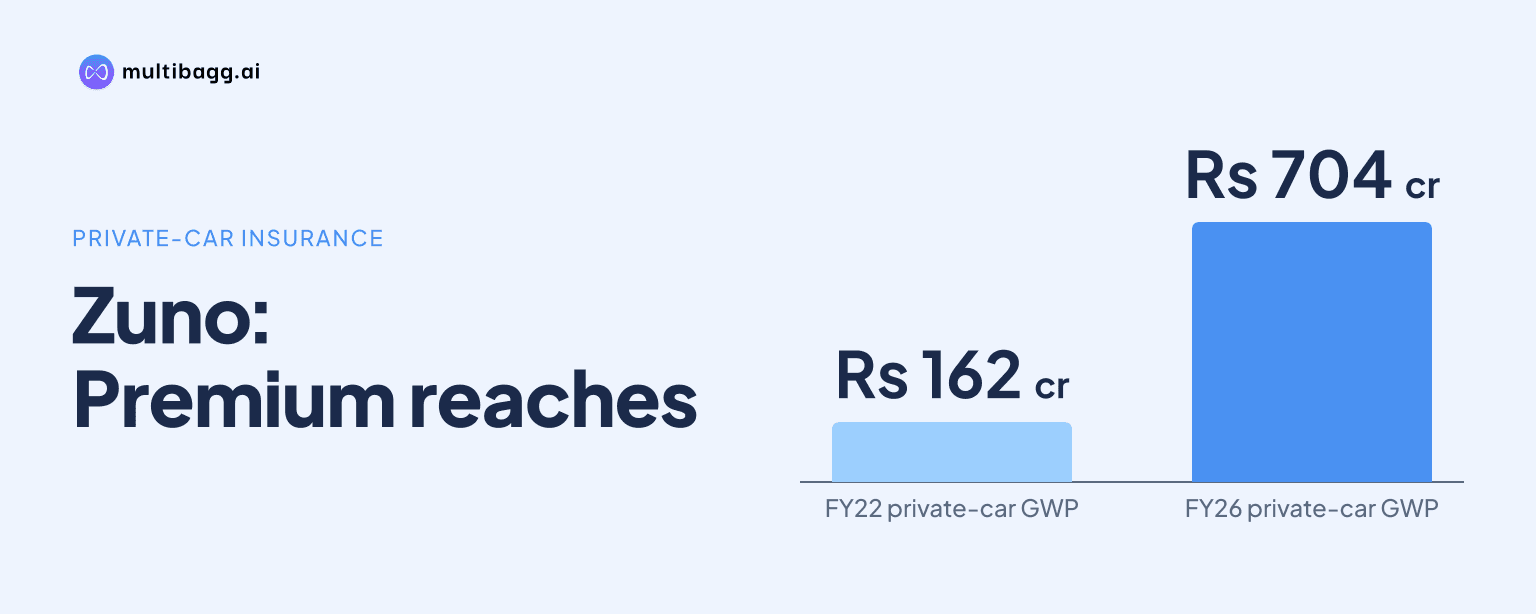
Zuno’s private-car gross written premium (GWP) reached Rs 704 crore in FY26 from Rs 162 crore in FY22, a company-stated four-year compound annual growth rate (CAGR) of 44%, as it concentrated on private-car products, nine original equipment manufacturer (OEM) relationships and driving-behaviour data covering more than 96 million kilometres.
Know Edelweiss Financial Services inside out
Results, valuation, peers and who's buying, in one view.
How fast did Zuno’s private-car premium grow?
Zuno’s private-car GWP rose from Rs 162 crore in FY22 to Rs 704 crore in FY26, with the company reporting a 44% four-year CAGR calculated on private-car GWP. The disclosed data show that GWP was Rs 320 crore in FY24, so the private-car portfolio added Rs 158 crore between FY22 and FY24 and a further Rs 384 crore between FY24 and FY26.
The FY24 to FY26 increase was larger in absolute rupee terms than the increase over the preceding FY22 to FY24 period. Zuno identifies private car as the focus of its approach and presents the Rs 704 crore FY26 figure alongside three levers: product innovation, a digital and artificial intelligence (AI)-enabled platform, and customer experience.
The presentation does not provide annual private-car GWP for FY23 or FY25, so the disclosed series does not show the year-by-year path to the stated 44% CAGR. It does, however, show that private-car GWP more than doubled from Rs 320 crore in FY24 to Rs 704 crore in FY26, following its rise from Rs 162 crore in FY22.
Which OEM relationships support Zuno’s private-car strategy?
Zuno lists nine OEM partners: Mahindra Rise, TATA, MARUTI SUZUKI, NISSAN RENAULT FINANCIAL SERVICES INDIA, MG, Jeep, Volkswagen, SKODA and Audi. The presentation also states that its three largest OEMs are among these nine partners, linking its private-car focus to vehicle-manufacturer distribution relationships.
Zuno does not disclose GWP by individual OEM or the premium contribution of any of the nine partners. It states that the three largest OEMs are included in the partner group, while overall private-car GWP increased from Rs 320 crore in FY24 to Rs 704 crore in FY26. The available material therefore establishes the partner count and portfolio growth, but not a direct premium contribution from each relationship.
The nine-partner list spans domestic and international vehicle brands, but Zuno provides no date for the start of each tie-up or measure of policies sourced through them. Its stated evidence for the strategy remains the Rs 704 crore private-car GWP in FY26 and the product, data and platform measures it presents for the segment.
How does Zuno SmartDrive use telematics data?
Zuno SmartDrive is Zuno’s driving-behaviour-based motor insurance product, using embedded telematics and more than 96 million kilometres of recorded driving data accumulated over a five-year journey that began in May 2020. Zuno describes SmartDrive as India’s first and only driving-behaviour-based motor insurance and says its usage-based insurance model progressed from sandbox experimentation to a scalable, behaviour-linked model.
About 15% of eligible policies use telematics, according to Zuno’s disclosed penetration figure. Among drivers with a score of 95 or higher, the presentation reports about 50% lower claims, which Zuno presents as evidence linking safer driving scores with lower risk. Management says usage-based insurance enables personalised pricing, granular risk selection and customer engagement; the supplied material does not quantify any resulting premium discount or loss-ratio change.
The 96 million-plus kilometres are described as proprietary data linking driving behaviour to claims, rather than as a measure of total policies or total customers. Zuno’s disclosed 15% penetration means telematics is used for a subset of eligible policies, while the 95-or-higher score comparison is the presentation’s stated claims outcome for that scored group.
Got a follow-up? Ask IRIS
Which private-car products address newer vehicle and renewal risks?
Zuno has added private-car covers for electric-vehicle, fuel and renewal-date risks alongside SmartDrive. For electric vehicles (EVs), it cites specialised covers, battery analytics and make-and-model risk scores. For approved blended fuels, its Fuel Guard cover is designed for engine damage, while Residual Value Insurance is a product Zuno says it was first to launch for new vehicles.
Its day-based own-damage (OD) cover is designed to align OD protection with third-party (TP) expiry on renewal for bundled new-car policies. Zuno explains the mechanism through the bundled structure of one-year OD cover and three-year mandatory TP cover: the differing end dates can require customers to match OD renewal with TP expiry. The product therefore addresses an administrative timing issue rather than changing the disclosed three-year TP requirement.
These products sit within a private-car category that Zuno calls the most competitive category, although the presentation gives no product-level premium or claims figures for Fuel Guard, day-based OD, EV covers or Residual Value Insurance. The disclosed quantitative product evidence is instead the 96 million-plus telematics kilometres, about 15% eligible-policy penetration and about 50% lower claims at scores of 95 or above.
How does Zuno’s digital platform support private-car operations?
Zuno reports 99.99% system availability, a four-week product go-to-market period and a seven-day add-on go-to-market period as measures of platform delivery. Its architecture includes a website with Agent ZIA, the Zuno App with Zuno Sense, open application programming interfaces (APIs), data infrastructure, microservices and Amazon Web Services-based serverless compute with 100X autoscale.
The operating measures disclose 95% unassisted policies, about 90,000 policies issued per month and more than 466 APIs across journeys. Zuno also cites 24×7 claims with insta-payouts. These measures are presented across operations and do not separately identify private-car policies, expenses or claims handling.
At the customer interface, Zuno reports policy issuance in under 30 seconds, API response of about 200 milliseconds, successful payments of about 97% and a 4.6-star app rating. These figures describe speed, automation and payment completion, but the presentation does not provide a period-by-period expense comparison or link the metrics directly to the Rs 704 crore FY26 private-car GWP.
Conclusion
Zuno’s disclosed growth strategy is concentrated in private-car insurance: GWP rose by Rs 542 crore between FY22 and FY26, while the company built a driving-data set exceeding 96 million kilometres and listed nine OEM partners. The product portfolio combines behaviour-linked insurance, EV-related analytics, fuel protection and renewal-alignment features, with the digital platform supplying the quoted automation and issuance-speed measures.
The next disclosed development to watch is the transition to International Financial Reporting Standards in FY28, which Zuno says will reflect the economic value of the business and reward prudent pricing and efficient operations. Proposed distribution reforms, including lower expense limits and commission caps, are also relevant because Zuno identifies regulatory and pricing cycles as factors favouring disciplined, digital-native operating models.