










Zuno: India’s non-life penetration is one-quarter globally
Key highlights
- India’s non-life penetration was 1.0% of GDP versus a 4.2% global average.
- Industry growth rose to an 11% four-year CAGR in FY22-FY26 from 10% in FY18-FY22.
- Private GI insurers recorded a 13% four-year CAGR in both reported periods.
- About 50% of registered vehicles were uninsured, according to Zuno.
powered by IRIS
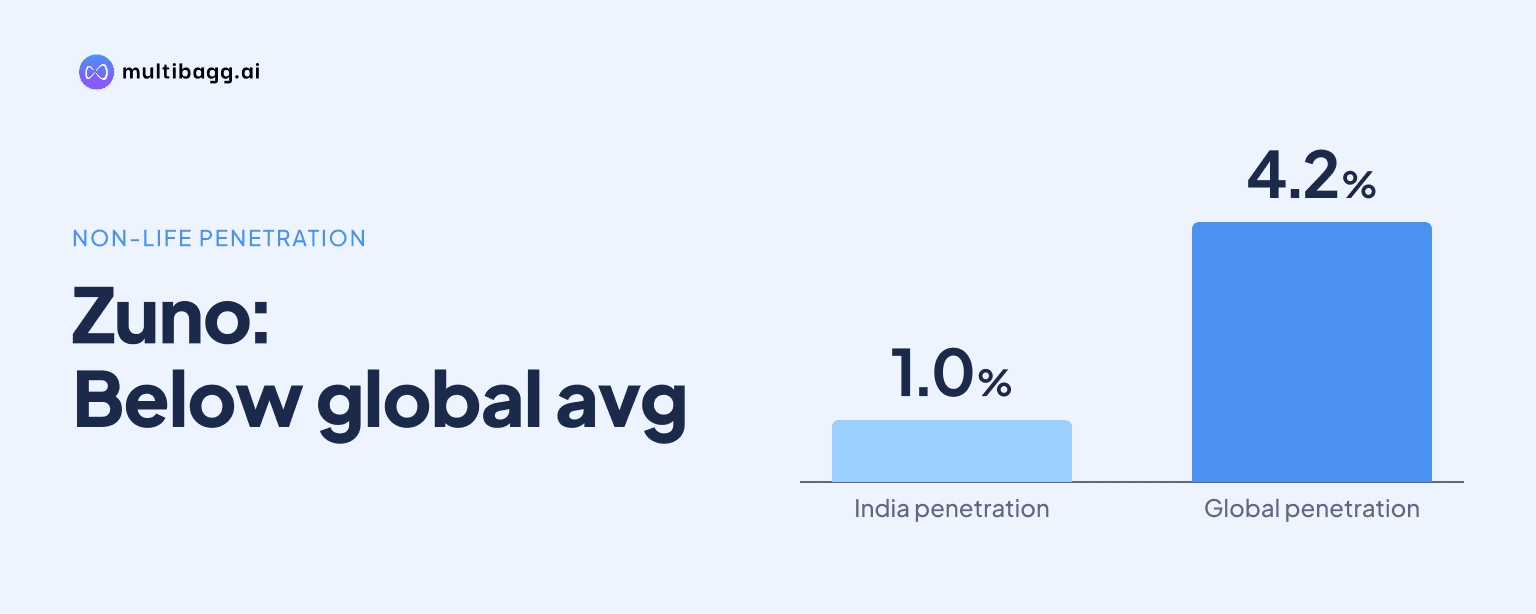
Zuno General Insurance Limited says India’s non-life insurance penetration was 1.0% of gross domestic product, or GDP, against a 4.2% global average, placing it at about one-quarter of the benchmark. In its November 2026 update, Zuno also reports 11% industry growth in FY22-FY26 and identifies regulatory changes that increase the importance of cost efficiency.
Know Edelweiss Financial Services inside out
Results, valuation, peers and who's buying, in one view.
How fast has India’s non-life insurance market grown?
India’s non-life industry recorded an 11% four-year compound annual growth rate, or CAGR, in FY22-FY26, compared with 10% in FY18-FY22. The one-percentage-point change shows that industry growth accelerated modestly in the later four-year period. Zuno describes this 11% pace as consistent growth led by private insurers.
Private general insurance, or private GI, insurers recorded a 13% four-year CAGR in both FY18-FY22 and FY22-FY26. Their growth rate therefore remained unchanged, while the gap over the total industry narrowed to 2 percentage points in FY22-FY26 from 3 percentage points in FY18-FY22. Zuno provides growth rates rather than industry premium totals, market shares or insurer-level comparisons in this section.
Zuno links the market backdrop to its private-car focus, reporting a 44% four-year CAGR in private-car gross written premium, or GWP. That company figure is not comparable with the 11% total-industry rate on a like-for-like basis because it covers a specific Zuno product segment. Its disclosed operating approach centres on private cars, product innovation and a digital platform.
How large is India’s non-life insurance protection gap?
India’s non-life penetration was 1.0% of GDP versus a 4.2% global average, according to Zuno. Penetration measures premium as a share of economic output, so the comparison indicates the relative scale of insurance activity rather than the number of uninsured people or businesses. The 1.0% figure is roughly one-quarter of the cited global level.
Non-life insurance density was USD 25 per capita in India, compared with about USD 500 globally. Density measures premium per person, placing India at about 5% of the global benchmark cited by Zuno. This difference is wider than the penetration comparison, showing that the presentation uses two separate measures of insurance usage.
Zuno also says about 50% of registered vehicles are uninsured. The figure is relevant to the company’s private-car strategy and to its usage-based motor insurance offering, but the update does not divide uninsured vehicles by category, location or policy type. It also does not forecast when penetration, density or the uninsured-vehicle share could change.
Got a follow-up? Ask IRIS
Which regulatory shifts does Zuno identify?
Zuno identifies pricing pressure across product lines, a transition to International Financial Reporting Standards, or IFRS, in FY28, and proposed distribution reforms as shifts that make efficiency more important. It says risk selection and efficiency are key profitability levers during pricing pressure. However, the November 2026 update does not quantify pricing movements or specify the product lines affected.
The FY28 IFRS transition is described by Zuno as reflecting the true economic value of insurance business and rewarding prudent pricing and efficient operations. This is management’s stated view of the accounting change, rather than a quantified financial projection. The presentation gives no estimate of an effect on Zuno’s earnings, capital, reserves or valuation.
Zuno says the proposed distribution reforms involve lower expense limits and caps on commission. The use of “proposed” means the update does not state final thresholds, effective dates or implementation terms. Its stated mechanism is that tighter expense and commission limits would raise the relevance of an insurer’s operating model and distribution cost structure.
What operating gaps does Zuno say remain in insurance?
Zuno says gaps persist in product innovation, operating efficiency and customer experience, creating an opportunity for innovation-led business models. On product innovation, it says competition is largely based on price or payout. The presentation gives no industry-wide count of products, product launches or innovation expenditure to measure that assessment.
On efficiency, Zuno says legacy technology stacks and organisational models can leave incumbents with a cost curve that is difficult to bend. That observation connects with the proposed lower expense limits and commission caps on page 7, although Zuno does not disclose a comparison of expense ratios between legacy and digital-native insurers. Its conclusion that regulatory and pricing cycles favour disciplined, digital-native players is therefore qualitative.
On customer experience, Zuno points to claims scepticism, jargon-filled communication and iterative, opaque processes. It does not provide claims turnaround times, complaint ratios or satisfaction scores for the sector. Zuno’s response combines product innovation, a digital and artificial intelligence-enabled platform, and customer experience initiatives.
Zuno describes Zuno Smart Drive as India’s first and only driving-behaviour-based motor insurance product. It says its usage-based car insurance work spans five years and has generated data from more than 96 million kilometres linking driving behaviour to claims. Those are company claims in the November 2026 presentation, not measures of the broader non-life market.
Conclusion
The presentation describes a market with 11% industry CAGR in FY22-FY26 but materially lower insurance use than the global benchmarks it cites: 1.0% penetration against 4.2%, and USD 25 density against about USD 500. Zuno places its 44% private-car GWP CAGR and its driving-behaviour-based product within that structural protection gap.
The next disclosed milestone is the FY28 IFRS transition, which management says will make prudent pricing and efficient operations more visible in reported economics. The final form, numerical limits and implementation date of the proposed expense and commission reforms also remain unresolved in the November 2026 update.