










Zuno reports H1FY27 profit as premium rises 49% year on year
Key highlights
- Zuno reported Rs 1 crore profit before tax in H1FY27 versus a Rs 18 crore loss in H1FY26.
- H1FY27 gross written premium rose 49% year on year to Rs 781 crore.
- Zuno’s combined operating ratio fell to 118% in H1FY27 from 128% in H1FY26.
- The multi-year Opex ratio declined from 28.0% in FY22 to 11.0% in H1FY27.
powered by IRIS
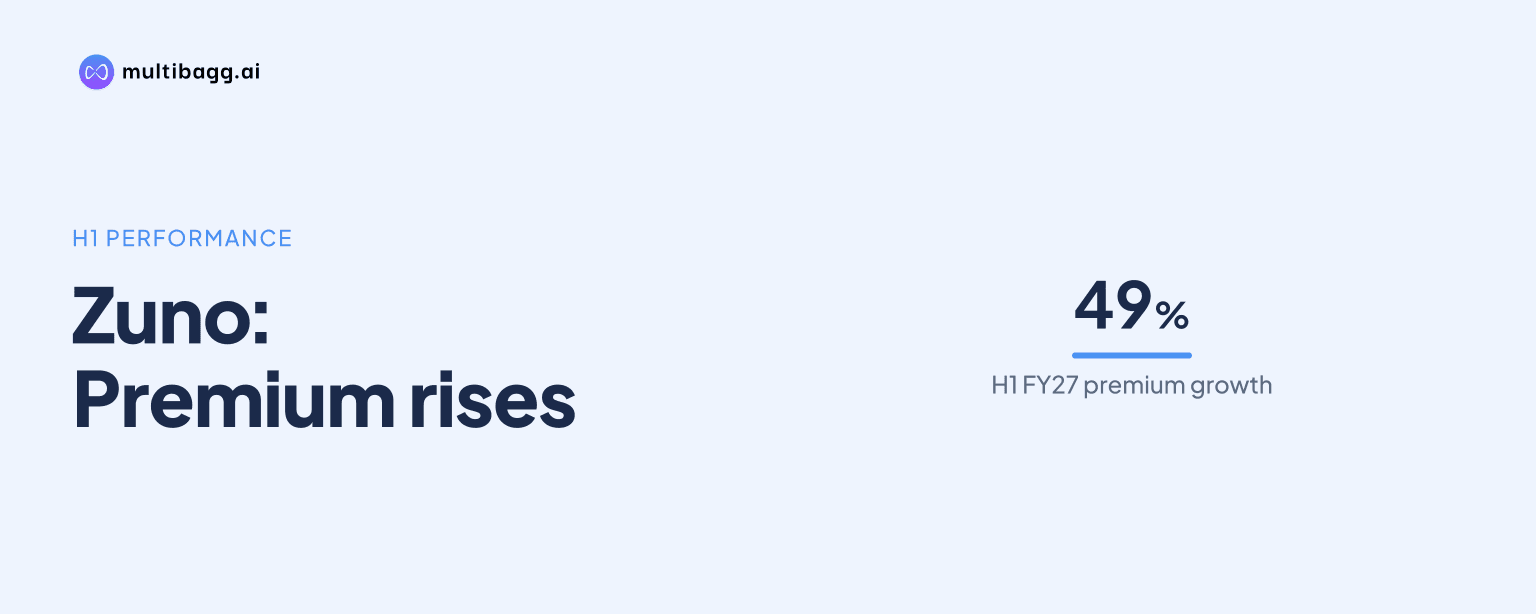
Zuno reported Rs 1 crore of profit before tax in H1FY27, reversing a Rs 18 crore loss in H1FY26, as gross written premium rose 49% year on year to Rs 781 crore and the combined operating ratio fell 10 percentage points to 118%.
Know Edelweiss Financial Services inside out
Results, valuation, peers and who's buying, in one view.
How did Zuno become profitable in H1FY27?
Zuno became profitable on a profit-before-tax basis in H1FY27, reporting Rs 1 crore against a Rs 18 crore loss in H1FY26 and a Rs 57 crore loss in FY26. The presentation describes H1FY27 as the point at which the business turned profitable and says Zuno is on track for FY27 profitability, without providing a full-year profit target.
Gross written premium, or GWP, increased to Rs 781 crore in H1FY27 from Rs 524 crore in H1FY26. Assets under management, or AUM, rose 26% year on year to Rs 1,895 crore from Rs 1,506 crore. The figures show that the reported shift to profit occurred while both premium volume and assets increased.
The longer profit sequence was not linear. Zuno recorded a Rs 105 crore loss in FY22, followed by a Rs 123 crore loss in FY24, before narrowing the loss to Rs 57 crore in FY26 and moving to Rs 1 crore of profit in H1FY27. The FY24 result was therefore worse than FY22, while the following reported periods moved towards break-even.
How fast has Zuno grown compared with the industry?
Zuno’s GWP grew at a compound annual growth rate, or CAGR, of 38% between FY22 and FY26, compared with 11% for the industry over the same period. Zuno characterises its growth rate as 3.5 times the industry rate, with GWP increasing from Rs 361 crore in FY22 to Rs 1,294 crore in FY26.
Zuno reported Rs 852 crore of GWP in FY24, between the Rs 361 crore recorded in FY22 and Rs 1,294 crore in FY26. The FY22-to-FY26 increase was about 3.5 times on the presentation’s rounded figures. H1FY27 GWP of Rs 781 crore was 60% of FY26 GWP, although the presentation provides neither a seasonal premium pattern nor an FY27 GWP forecast.
Zuno attributes operating leverage to its digital model. Its customer material says 100% of policies are issued digitally and refers to more than 10 million customers, while listing digital quote generation, issuance, servicing, claims and renewals. It also reports that its fastest motor claims were settled in five minutes in Q2 2026 and that the Zuno app had a 4.6 App Store rating in October 2026.
Got a follow-up? Ask IRIS
Which cost and underwriting ratios have changed?
Zuno’s operating-expense, or Opex, ratio declined from 28.0% in FY22 to 11.0% in H1FY27 in its multi-year table, a 17.0-percentage-point reduction. Zuno defines the Opex ratio as operating expenses divided by GWP and says its digital-native cost structure is improving unit economics as scale rises.
The combined operating ratio, or COR, fell from 155% in FY22 to 118% in H1FY27, a 37-percentage-point decline. COR was 136% in FY24 and 124% in FY26, meaning every displayed annual period after FY22 had a lower ratio. On the direct half-year comparison, COR decreased from 128% in H1FY26 to 118% in H1FY27.
Zuno’s separate H1FY27 comparison gives an Opex ratio of 11.1%, versus 15.8% in H1FY26, a 4.7-percentage-point reduction, while its FY26 figure in that table is 12.2%. The multi-year table instead shows 11.0% for H1FY27 and 12.0% for FY26. Net expenses of management, which include Opex and commission and are net of specified allowances, fell from 34.1% in H1FY26 to 31.6% in H1FY27 but remained above FY26’s 30.5%.
What are Zuno’s stated operating targets?
Zuno says it is on track for FY27 profitability after its Rs 1 crore H1FY27 PBT, but management does not state a numerical FY27 PBT objective. Its stated sustainable-economics aspiration is a sub-100% COR, compared with the 118% reported in H1FY27. That leaves an 18-percentage-point difference between the first-half result and the stated objective.
Management also aspires to an Opex-to-GWP ratio of 6% to 7%, compared with approximately 11% in H1FY27. Zuno says the intended model is supported by artificial intelligence, automation and digital journeys, including autonomous processes and artificial-intelligence-driven decisions at scale. The presentation links this model to a cost structure that management says is difficult to replicate.
Zuno’s other stated bets concern its motor franchise and customer experience. It plans to build breadth and depth in motor, extend into adjacent motor and mobility segments, and use the Zuno app for personalisation and engagement. Its wider aspiration includes market leadership in chosen segments and protection for 1 billion lives and risks, rather than a dated operating forecast.
Conclusion
Zuno’s H1FY27 result combined Rs 1 crore of PBT with Rs 781 crore of GWP, up 49% year on year, while COR declined to 118% from 128% in H1FY26. Across the FY22-to-H1FY27 figures, the Opex ratio fell from 28.0% to 11.0% and COR decreased from 155% to 118%, consistent with the presentation’s account of rising scale and digital operating leverage.
The next disclosed milestones are whether Zuno converts its H1FY27 profit into full-year FY27 profitability and whether COR moves towards management’s sub-100% aspiration. Investors can also monitor whether the Opex ratio progresses from about 11% towards the stated 6% to 7% range while GWP growth continues beyond H1FY27’s 49% rate.