










Kiri posts positive H1 EBITDA, but Q2 EBITDA margin declines
Key highlights
- Kiri’s standalone H1-FY27 EBITDA was Rs 21.4 crore, compared with a Rs 30.8 crore loss in H1-FY26.
- Standalone Q2-FY27 revenue grew 48.1% year on year to Rs 288.2 crore, while EBITDA margin fell to 1.42% from 5.86% in Q1-FY27.
- Kiri reported Rs 274.7 crore of standalone other income in H1-FY27, against profit after tax of Rs 247.5 crore.
- Kiri has disclosed about Rs 13,300 crore of estimated costs for its copper, fertilizer, renewable-power and jetty projects.
powered by IRIS
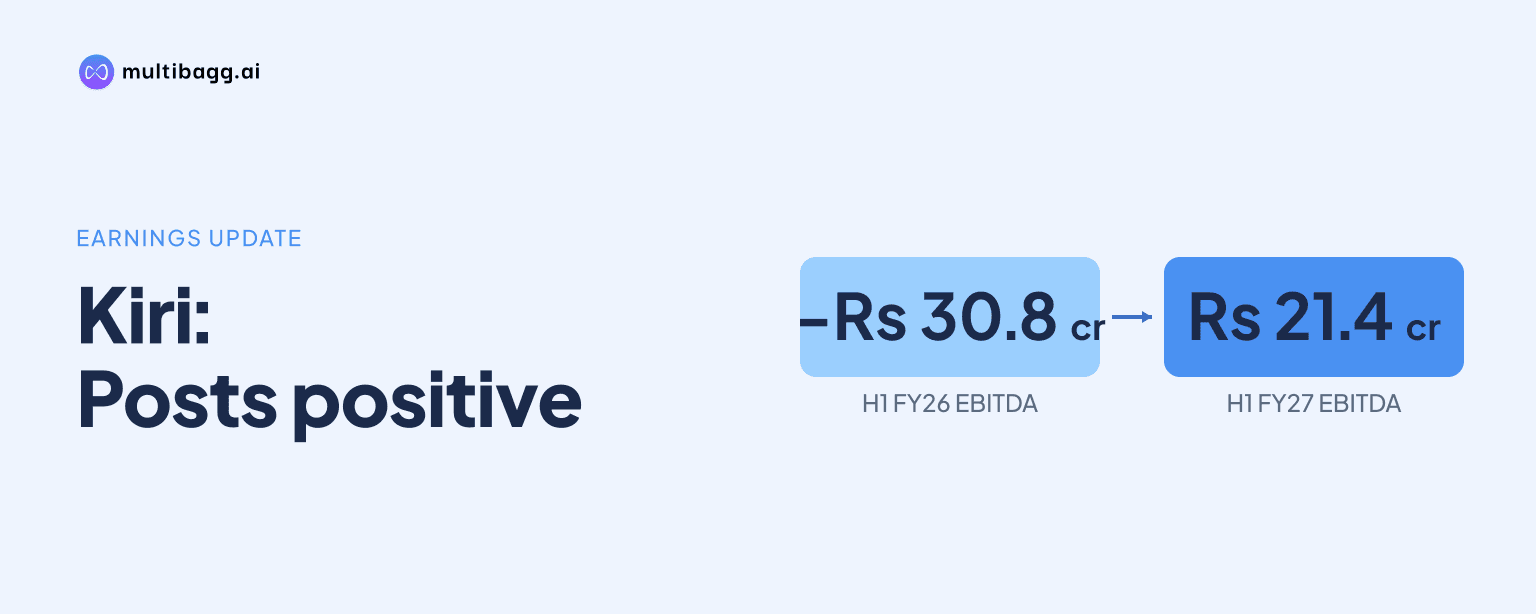
Kiri Industries Limited reported standalone EBITDA of Rs 21.4 crore in H1-FY27, reversing a Rs 30.8 crore loss a year earlier, but its Q2-FY27 EBITDA margin fell to 1.42% from 5.86% in Q1-FY27. H1 profit after tax of Rs 247.5 crore was supported by Rs 274.7 crore of other income.
Know Kiri Industries inside out
Results, valuation, peers and who's buying, in one view.
How did Kiri’s H1 operating performance change?
Kiri’s standalone operating performance turned positive in H1-FY27 as revenue from operations rose 55.4% year on year to Rs 583.5 crore and EBITDA reached Rs 21.4 crore, against an EBITDA loss of Rs 30.8 crore in H1-FY26. EBITDA, or earnings before interest, tax, depreciation and amortisation, excludes other income under the presentation’s definition, and the H1-FY27 margin was 3.67%.
The improvement followed negative standalone EBITDA in each of FY24, FY25 and FY26, at Rs 63.3 crore, Rs 43.7 crore and Rs 211.1 crore respectively. In H1-FY27, total expenses increased 38.4% to Rs 562.1 crore, below the 55.4% revenue increase, producing the positive EBITDA result.
Kiri attributed better industry conditions to stronger realisations in dye intermediates, particularly H-Acid. In Q2-FY27, it also cited H-Acid and Vinyl Sulphone pricing as factors behind a standalone material margin of 29.1%, compared with 26.4% in Q2-FY26; the presentation does not disclose an H1 material-margin figure.
Why did Kiri’s Q2 EBITDA margin decline?
Kiri’s standalone Q2-FY27 EBITDA was Rs 4.1 crore, compared with a Rs 14.3 crore loss in Q2-FY26 but down 76.3% from Rs 17.3 crore in Q1-FY27. Revenue increased 48.1% year on year to Rs 288.2 crore, yet declined 2.4% sequentially from Rs 295.3 crore, while EBITDA margin reduced to 1.42% from 5.86%.
Total standalone expenses were Rs 284.1 crore in Q2-FY27, up 36.0% year on year and 2.2% from Q1-FY27. Kiri said higher fuel, power and effluent-treatment costs affected operating EBITDA; its operational highlights cite operating EBITDA of Rs 6.9 crore, while the quarterly income statement reports EBITDA of Rs 4.1 crore without reconciling the two figures.
Kiri posted a standalone net loss of Rs 22.7 crore in Q2-FY27, versus a Rs 21.1 crore loss a year earlier and a Rs 270.2 crore profit in Q1-FY27. Other income moved from Rs 284.1 crore in Q1-FY27 to negative Rs 9.5 crore in Q2-FY27, while depreciation was Rs 11.6 crore and finance cost was Rs 0.8 crore.
Got a follow-up? Ask IRIS
Why was Kiri’s H1 profit after tax above EBITDA?
Kiri’s standalone profit after tax of Rs 247.5 crore in H1-FY27 exceeded its EBITDA of Rs 21.4 crore because other income was Rs 274.7 crore. Profit before tax was Rs 271.0 crore, and tax of Rs 23.5 crore was charged during the half year.
Kiri identified realised treasury gains of Rs 22.9 crore in Q2-FY27, alongside dividend, interest and other income of Rs 21.8 crore in its operational highlights. The quarterly standalone income statement, however, records total other income of negative Rs 9.5 crore, and the presentation does not provide a reconciliation between that line item and the separately disclosed treasury, dividend and interest amounts.
How did Kiri’s consolidated results compare with standalone results?
Kiri reported consolidated H1-FY27 revenue of Rs 610.9 crore, EBITDA of Rs 11.1 crore and profit after tax of Rs 231.3 crore. Consolidated revenue grew 47.0% from Rs 415.6 crore in H1-FY26, while EBITDA turned positive from a Rs 29.9 crore loss; the 1.82% consolidated EBITDA margin was below the 3.67% standalone margin.
Q2-FY27 remained loss-making on the consolidated basis, with EBITDA at negative Rs 4.9 crore and profit after tax at negative Rs 38.7 crore. Consolidated other income was Rs 270.3 crore in H1-FY27 against Rs 35.4 crore a year earlier, while the share of profit from associate and joint venture declined 77.1% to Rs 36.8 crore from Rs 160.7 crore.
What is Kiri planning alongside its current operations?
Kiri said phased commissioning of its integrated copper and fertilizer complex is scheduled to begin in H1-FY28, with downstream value-added facilities planned before the smelting complex. Equipment deliveries have started, and civil, foundation, structural, jetty, desalination and raw-material handling work is progressing; construction has a 36-month completion timeline beginning on 1 October 2025.
The copper complex is estimated to cost about Rs 8,100 crore, the fertilizer project about Rs 3,600 crore, and renewable power and the jetty about Rs 1,600 crore. Kiri disclosed proposed equity funding of about Rs 4,000 crore, including Rs 1,036 crore infused in September 2024, and said the project is projected to generate an internal rate of return of about 25%.
Conclusion
Kiri’s H1-FY27 operating result shows a return to positive standalone EBITDA after losses in the comparable half year and each of the prior three full financial years. The latest quarter, however, showed lower sequential revenue, a 1.42% EBITDA margin and a Rs 22.7 crore standalone net loss, while H1 profit after tax relied substantially on other income.
The next disclosed operating issue is whether realisations for H-Acid and Vinyl Sulphone can offset fuel, power and effluent-treatment costs. Kiri’s project execution is also a key disclosed milestone, with phased commissioning of the copper and fertilizer complex planned from H1-FY28 and remaining equity funding proposed in phases.