










Kiri Industries Gets Exchange Nod for ₹288.92 Crore Warrants
Key highlights
- Kiri Industries received BSE and NSE in-principle approval for 6,082,600 preferential warrants on 4 November 2026.
- The warrants are priced at ₹475 each and can raise up to ₹288.92 crore.
- Each warrant can convert into one equity share within 18 months from allotment.
- Full conversion could dilute the post-issue equity share capital by up to 4.98%.
powered by IRIS
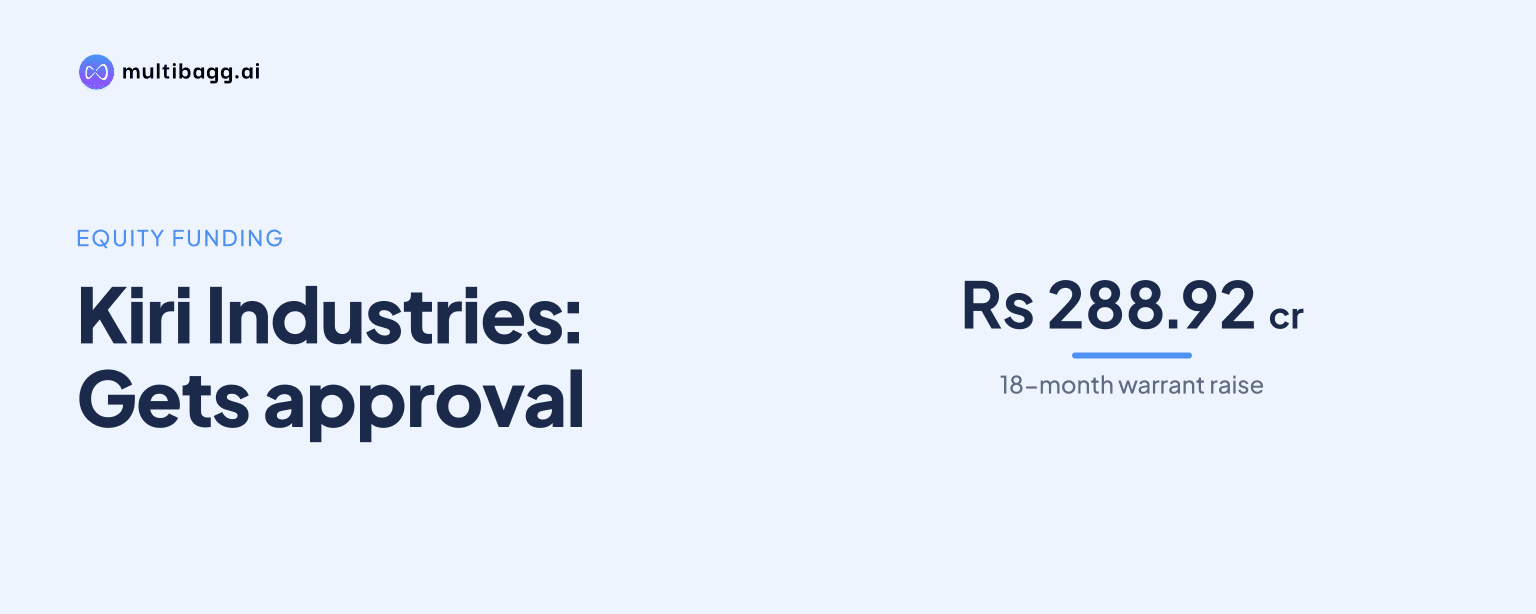
Kiri Industries Limited has received in-principle approval from BSE and NSE for 60.83 lakh preferential warrants priced at ₹475 each, an issue that can raise up to ₹288.92 crore and may dilute existing shareholders by up to 4.98% on a fully diluted basis.
Know Kiri Industries inside out
Results, valuation, peers and who's buying, in one view.
What approval has Kiri Industries received for the warrant issue?
Kiri Industries Limited announced on 4 November 2026 that BSE and the National Stock Exchange of India had granted in-principle approval for its proposed preferential issue of 6,082,600 convertible warrants. The approval covers warrants proposed to be allotted to the company’s promoters and promoter group members.
Each warrant carries the right to convert into one equity share of Kiri Industries. The proposed issue price is ₹475 per warrant, comprising a face value component and a premium of ₹465 per warrant. At the stated price and number of warrants, the issue size is ₹288.92 crore.
The exchange approval is an important procedural step for the preferential allotment. The company has stated that the issue remains subject to compliance with applicable regulatory requirements and listing conditions. The warrants are being issued under the Securities and Exchange Board of India’s ICDR Regulations governing preferential issues.
Who will receive the warrants and what are the conversion terms?
The proposed allottees are promoter and promoter group members Manishkumar Kiri, Anupama Kiri and Hemil Kiri. The proposed transaction therefore involves capital being raised from the company’s existing promoter group rather than through a public issue or rights issue.
The warrants can be converted into equity shares within 18 months from the date of allotment. Conversion may take place in one or more tranches during that period. Upon conversion and payment of the applicable balance consideration, the resulting equity shares would rank pari passu with the company’s existing equity shares.
Kiri Industries has said the warrants could represent up to 4.98% of the post-issue equity share capital on a fully diluted basis. This indicates the maximum potential ownership dilution for shareholders if all 6,082,600 warrants are converted.
How does this issue compare with Kiri Industries' earlier warrant conversion?
Kiri Industries had previously completed a promoter-led warrant conversion process initiated in October 2024. In April 2026, the board approved the allotment of 5,145,446 equity shares following conversion of warrants by promoters and promoter group members.
Those shares were issued at ₹369 each, including a premium of ₹359 per share. Kiri Industries reported receiving balance consideration of ₹181 per warrant, aggregating to ₹93.13 crore, in connection with that conversion. The company said all outstanding warrants from that earlier process had then been converted into equity shares.
The 2024 preferential issue involved 13,333,789 warrants at an issue price of ₹369 each. The earlier disclosures stated that, after full conversion, promoter and promoter group shareholding would be 41.71% on a fully diluted basis. The current proposal is a separate warrant issue at a higher price of ₹475 per warrant.
Got a follow-up? Ask IRIS
What does the preferential issue mean for shareholders and investors?
The new warrants create a route for Kiri Industries to receive up to ₹288.92 crore if the warrants are converted within the specified 18-month period. Since conversion is linked to an additional equity issuance, the number of outstanding shares could rise by as many as 6,082,600 shares.
For existing shareholders, the key consideration is the stated maximum dilution of 4.98% on a fully diluted basis. Dilution does not occur immediately merely because the warrants receive approval; it occurs as the warrants are allotted and then converted into equity shares in accordance with the applicable terms.
The issue price of ₹475 also provides the specific conversion price disclosed by the company for this transaction. Investors may assess the proposal alongside the company’s future disclosures on allotment, conversion, shareholding patterns and use of funds. The supplied announcement does not specify a detailed end-use for the proposed capital.
Why are exchange and regulatory conditions relevant to the transaction?
Preferential allotments by listed companies are governed by SEBI regulations and stock exchange listing requirements. In-principle approval from BSE and NSE confirms that the exchanges have considered the application for the proposed issue under the relevant framework, subject to the conditions attached to the approval.
Kiri Industries had earlier scheduled its annual general meeting for 29 September 2026 in connection with the corporate actions reported during 2026. The current exchange approval follows the board’s earlier decision to approve the preferential warrant proposal, and the company must continue to make disclosures required under the listing regulations.
For the market, the transaction is relevant because it combines promoter participation, potential capital inflow and future equity dilution. The disclosed terms allow investors to quantify the maximum number of shares that may be issued and the maximum potential issue proceeds, while the actual conversion timing can occur in one or more tranches over 18 months.
Conclusion
Kiri Industries has obtained BSE and NSE in-principle approval for a preferential issue of 60.83 lakh warrants to named promoter and promoter group members at ₹475 each. If fully converted, the proposal can bring in up to ₹288.92 crore and increase the equity base by up to 4.98% on a fully diluted basis.
The next disclosures to watch are the allotment of the warrants, the receipt of consideration and any subsequent conversion notices during the 18-month conversion period. Investors can also track updated shareholding patterns to measure the effect of conversions on promoter ownership and the total equity share capital.