










Kirloskar Oil Engines Limited margin falls to 11% in Q2
Key highlights
- KOEL reported Q2 FY27 consolidated revenue from operations of Rs 2,284 crore, up 17% year on year.
- Standalone Q2 FY27 EBITDA margin fell to 11% from 14% in Q2 FY26.
- Standalone PowerGen revenue rose 17% to Rs 792 crore, while international revenue increased 50% to Rs 257 crore.
- KOEL ended Q2 FY27 with net cash of Rs 309 crore and a 31-day cash conversion cycle.
powered by IRIS
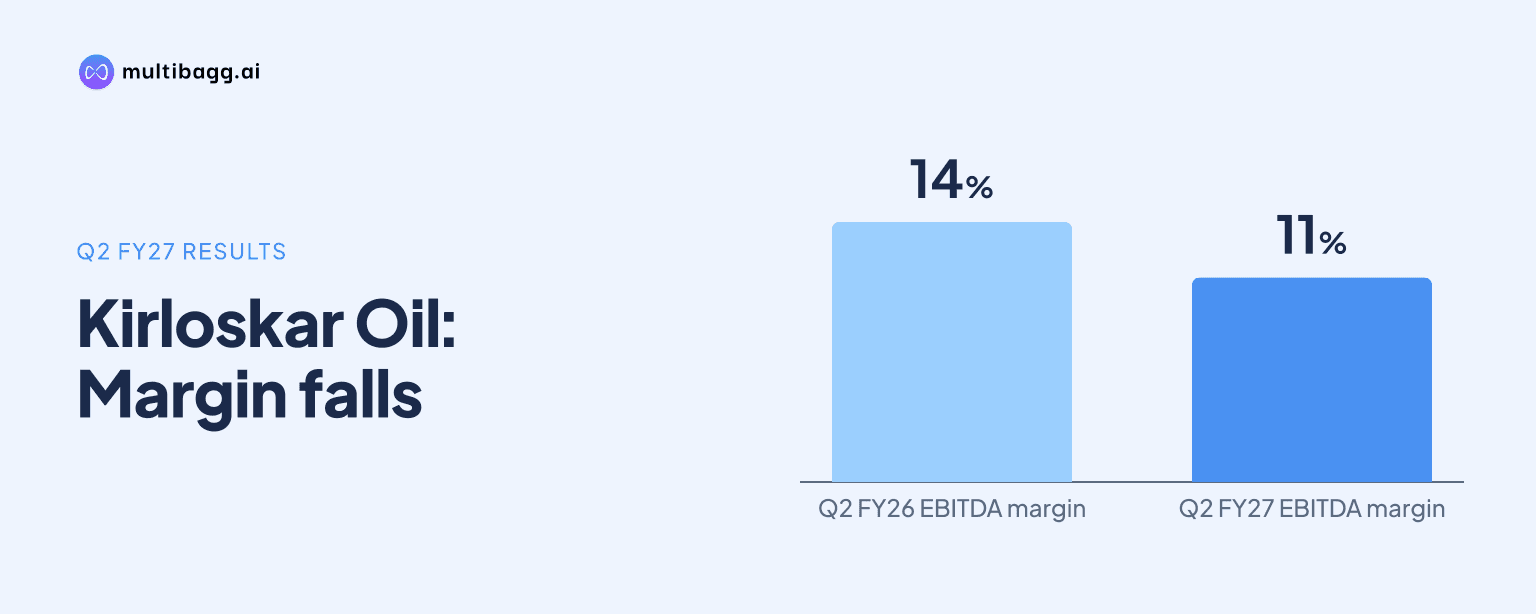
In Q2 FY27, Kirloskar Oil Engines Limited reported a standalone earnings before interest, tax, depreciation and amortisation (EBITDA) margin of 11%, down from 14% a year earlier, despite record consolidated revenue from operations of Rs 2,284 crore, up 17%. Higher crude oil, copper, aluminium and pig-iron costs reduced operating profitability.
Know Kirloskar Oil Engines inside out
Results, valuation, peers and who's buying, in one view.
What drove KOEL's record Q2 FY27 sales?
KOEL's record sales were driven by growth in PowerGen, distribution and aftermarket, international operations and fluid dynamics. Management cited consolidated quarterly revenue of Rs 2,257 crore, up 17% year on year and 14% sequentially, while the formal financial review reported revenue from operations of Rs 2,284 crore, versus Rs 1,951 crore in Q2 FY26. The call did not explain the difference between those two consolidated top-line figures.
Standalone net sales reached a record Rs 1,722 crore in Q2 FY27, up 19% from Rs 1,449 crore in Q2 FY26 and 18% sequentially. For H1 FY27, standalone sales rose 17% to Rs 3,184 crore from Rs 2,711 crore in H1 FY26. The growth therefore continued into the first half, although the increase in sales did not produce higher EBITDA or net profit.
PowerGen was the largest standalone business unit, with revenue up 17% to Rs 792 crore. Distribution and aftermarket revenue rose 29% to Rs 293 crore, and international revenue increased 50% to Rs 257 crore. Industrial revenue grew only 2% to Rs 381 crore; management attributed that result to execution challenges rather than to a change in industrial demand or the unit's trajectory.
Why did KOEL's EBITDA margin fall to 11%?
KOEL's standalone EBITDA margin fell to 11% in Q2 FY27 because higher costs for crude oil, copper, aluminium and pig iron outweighed the effect of pricing and operational actions. EBITDA declined 6% to Rs 191 crore from Rs 204 crore even as net sales increased by Rs 273 crore. Net profit from continuing operations declined 14% to Rs 115 crore from Rs 134 crore.
The pressure extended across the first half. H1 FY27 standalone EBITDA fell 5% to Rs 357 crore from Rs 376 crore, while the EBITDA margin declined to 11.1% from 13.8% in H1 FY26. That comparison shows that the margin reduction was not confined to a single quarter, despite 17% H1 sales growth to Rs 3,184 crore.
Sequentially, the Q2 FY27 margin softened by 30 basis points, with one basis point equal to one-hundredth of a percentage point. Management said operational execution kept the margin broadly stable quarter on quarter. It also identified higher employee costs from the annual merit cycle, crude-linked increases in indirect expenses and consumables, and spending on global marketing events as Q2 cost factors.
Which KOEL businesses grew fastest in Q2 FY27?
KOEL's international business and distribution and aftermarket unit recorded the fastest standalone growth, rising 50% and 29%, respectively, in Q2 FY27. On a gross consolidated basis, management said international revenue rose 59% to Rs 413 crore and accounted for about 20% of total sales. Management cautioned that international revenue can be uneven between quarters and said repeat orders, customer diversity and collections are more relevant measures than one quarter's growth rate.
PowerGen contributed more than 45% of international business during the quarter, marking a shift from the earlier concentration in Middle East firefighting original equipment manufacturers and South African mining engines. Management cited high-horsepower PowerGen demand from African mining and infrastructure, record secondary sales through UAE rental and contractor channels, an Optiprime order in Zambia, and the first systems dispatched to China.
Fluid dynamics operating revenue grew about 28% to Rs 331 crore, with domestic sales up about 24% and exports up about 32%. KOEL linked the increase to dealer and master-distributor additions, new stock-keeping units and allied products across diesel pump sets, industrial pumps and electric products. Management said the fluid dynamics operation had achieved market leadership in engine-driven industrial pumps.
At the consolidated level, business-to-business revenue rose 20% to Rs 1,745 crore, generating profit before interest and tax of Rs 148 crore. Business-to-consumer revenue rose 28% to Rs 330 crore and its profit before interest and tax increased 26% to Rs 23 crore. Financial-services subsidiary Arka reported Rs 209 crore of revenue and profit before tax of Rs 6.1 crore.
Got a follow-up? Ask IRIS
How is KOEL addressing commodity-cost inflation?
KOEL is addressing inflation through targeted price increases, value engineering, higher volumes for fixed-cost absorption and tighter discretionary-spending controls. Management said pricing varies by business and customer type: general-business price changes can move relatively quickly, while large original equipment manufacturer contracts require negotiation and implementation cycles. Existing orders can also carry prices agreed before the latest commodity movements.
Management said it had not completed price pass-through because inflation remained a recurring issue amid global geopolitical conditions. Its engineering work includes improved power density, tailored product offerings and Optiprime Hybrid Systems. The industrial business is also working with key original equipment manufacturers on targeted price increases, while management said its aim is to pass on inflation where possible and sequentially improve margins.
The chief financial officer said KOEL had already incurred part of the capability costs needed for its future growth plan, and that incremental revenue should provide better absorption if execution proceeds as planned. Management did not give a company-wide price-increase percentage, saying such a number would be misleading because customer arrangements and product categories differ.
KOEL reported net cash of Rs 309 crore at the end of Q2 FY27. Its cash conversion cycle was 31 days, net inventory days improved by one day from the prior quarter to 63 days, and net receivable days were 43. Arka ended the half year with assets under management of Rs 7,781 crore, H1 FY27 profit after tax of Rs 11.5 crore and net non-performing assets of 0.5%.
What are KOEL's stated growth plans beyond Q2 FY27?
KOEL is pursuing international expansion, higher-horsepower PowerGen applications and technology partnerships as part of its stated growth plan. Management said the 1,010 kilovolt-ampere node had market share above 30%, while Optiprime was seeing demand from data centres, real estate, hospitality and manufacturing. It did not disclose the high-horsepower segment's revenue contribution.
During Q2 FY27, KOEL entered a flexible service agreement with DEUTZ to expand global distribution of its 1.6-litre global-standard engine platform, initially in the Americas. Management described the agreement as significant but did not provide revenue guidance because outcomes depend on end-customer demand. Kirloskar Advanced Systems also completed its maiden commercial billing in specialised defence and aerospace systems.
Management reiterated its aim for international business to account for 30% of revenue by FY30 and referred to a $2 billion ambition by the same year. It said Q4 is normally its strongest quarter and that demand remained robust across its markets and segments. However, management's near-term focus remains execution and profitability, given commodity-cost inflation.
Conclusion
KOEL combined broad-based sales growth with lower profitability in Q2 FY27: standalone sales rose 19% to Rs 1,722 crore, but EBITDA declined 6% to Rs 191 crore and margin fell from 14% to 11%. PowerGen, international operations, distribution and aftermarket, and fluid dynamics expanded, while commodity costs limited the earnings conversion from that growth.
The next disclosures should show whether targeted pricing, value engineering and higher volumes improve margin absorption after the 30-basis-point sequential decline in Q2 FY27. Management also awaits a customer-confirmed revised schedule for its delayed data-centre project, while progress toward international business contributing 30% of revenue by FY30 remains a stated target.