










KOEL international business rises 59% as PowerGen leads
Key highlights
- KOEL’s gross consolidated international business rose 59% year on year to Rs 413 crore in Q2 FY27.
- PowerGen contributed more than 45% of KOEL’s international business in Q2 FY27.
- KOEL’s standalone international revenue reached Rs 257 crore, up 50% year on year in Q2 FY27.
- KOEL retains an ambition for international business to reach 30% of revenue by FY30.
powered by IRIS
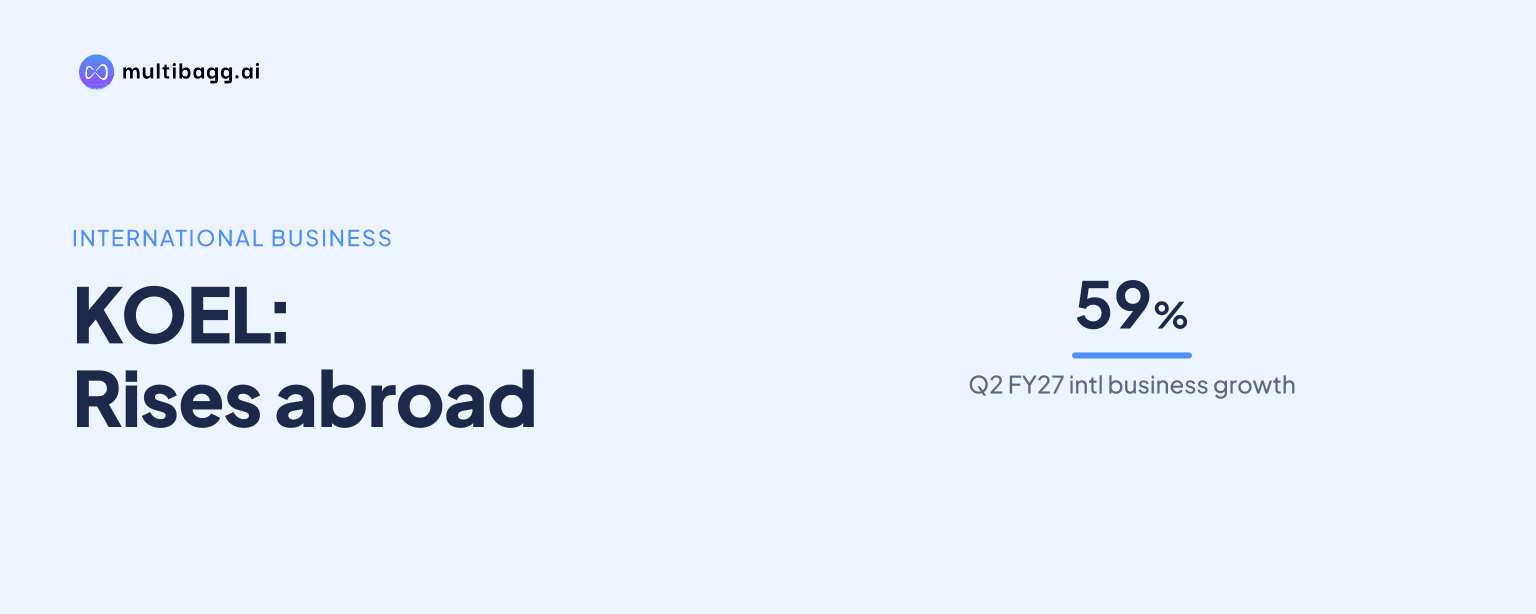
Kirloskar Oil Engines Limited said gross consolidated international business rose 59% year on year to Rs 413 crore in the second quarter of fiscal year 2027 (Q2 FY27), as PowerGen supplied more than 45% of overseas sales. Management attributed the change to a two-year rebuild of channels, country models and original equipment manufacturer partnerships, rather than one shipment.
Know Kirloskar Oil Engines inside out
Results, valuation, peers and who's buying, in one view.
Why did KOEL’s international business grow 59% in Q2 FY27?
KOEL’s gross consolidated international business increased 59% year on year to Rs 413 crore in Q2 FY27 and represented about 20% of total sales mix. Management said the growth was broad-based across regions and businesses, despite container shortages and shipping delays during the quarter.
The reported figure differs by reporting basis. Standalone international business revenue reached Rs 257 crore, up 50% year on year, while Rs 413 crore represents gross consolidated international business. Management said order intake was significantly stronger than a year earlier, but cautioned that international revenue can be uneven between quarters.
Management said repeat orders, customer diversity and collections are more useful indicators of export progress than one quarter’s growth rate. The company’s view was that logistics disruptions held back reported Q2 FY27 revenue relative to underlying demand.
How has PowerGen changed KOEL’s export mix?
PowerGen became a key driver of KOEL’s international business in Q2 FY27, contributing more than 45% of overseas sales. Management contrasted this with the historical export base of engines supplied to firefighting equipment manufacturers in the Middle East and mining operations in South Africa.
The international shift coincided with 17% growth in standalone PowerGen revenue to Rs 792 crore in Q2 FY27. KOEL said its market share in the 1010 kilovolt-ampere high-horsepower power-generation node was above 30%, while its Optiprime range was gaining demand from data centres, real estate, hospitality and manufacturing.
Africa contributed high-horsepower power-generation sales for mining and infrastructure, and KOEL added distributors in Angola and the Democratic Republic of Congo. In the Middle East, rental and contractor demand in the United Arab Emirates produced record channel secondary sales; KOEL also secured an Optiprime order in Zambia and dispatched its first systems to China.
Got a follow-up? Ask IRIS
What is KOEL’s export strategy beyond traditional markets?
KOEL’s export strategy centres on channel development, country-specific business models and original equipment manufacturer, or OEM, partnerships. Management said it began redesigning the international structure two years ago because the company had previously been oriented mainly toward the domestic market.
In Q2 FY27, KOEL formalised a flexible service agreement with DEUTZ to expand global distribution of its 1.6-litre global-standard engine platform, initially in the Americas. Management did not provide revenue guidance for the arrangement because volumes depend on demand from DEUTZ’s end customers.
Industrial exports added OEM customers in North Africa, Turkey, Saudi Arabia and East Asia during the quarter. Separately, KOEL’s fluid dynamics business reported operating revenue of Rs 331 crore, up about 28% year on year, including export growth of about 32% across diesel pump sets, industrial pumps and electric products.
Can KOEL reach 30% international revenue by FY30?
KOEL retained its ambition for international business to account for 30% of revenue by fiscal year 2030 (FY30), compared with about 20% of sales mix in Q2 FY27. Management presented the target as an aspiration supported by channels, partnerships and PowerGen expansion, rather than as near-term revenue guidance.
Management said neither international business nor distribution and aftermarket growth included one-time benefits in Q2 FY27, describing both as franchises built over several years. However, it gave no annual export revenue forecast or intermediate timetable for the 30% international-revenue objective.
Profitability remains relevant to the expansion plan because standalone earnings before interest, tax, depreciation and amortisation (EBITDA) fell 6% year on year to Rs 191 crore in Q2 FY27. EBITDA margin declined to 11% from 14% a year earlier as commodity costs increased, although management said it is pursuing price increases, value engineering, volume growth and spending discipline.
Management identified international business, high-horsepower products and aftermarket as potential margin drivers, without disclosing their individual profitability. It said capability costs for these areas had already been booked and that incremental revenue could improve fixed-cost absorption if execution proceeds as planned.
Conclusion
KOEL’s Q2 FY27 export performance points to a broader change in its overseas business, from a concentration in firefighting and mining engines toward power generation, industrial OEM sales and pump exports. The shift is supported by new distributors, regional channel activity and a greater role for products aimed at higher-power and mission-critical applications.
Investors will next watch repeat orders, collections and customer diversity, which management identified as better measures than quarterly export revenue alone. Other disclosed milestones include progress on the DEUTZ programme in the Americas, movement toward the FY30 30% international-revenue ambition, and a revised schedule for the customer-delayed data-centre project once the customer confirms it.