










KJL H1 PAT rose 47% as EBITDA margin widened 111 bps
Key highlights
- KJL reported H1 FY27 PAT of ₹56.91 crore, up 47.1% year on year.
- H1 FY27 EBITDA margin increased 111 basis points to 6.75%.
- Inventory rose ₹104.71 crore to ₹512.49 crore at 30 September 2026.
- H1 FY27 operating cash flow was positive at ₹3.61 crore despite the inventory build.
powered by IRIS
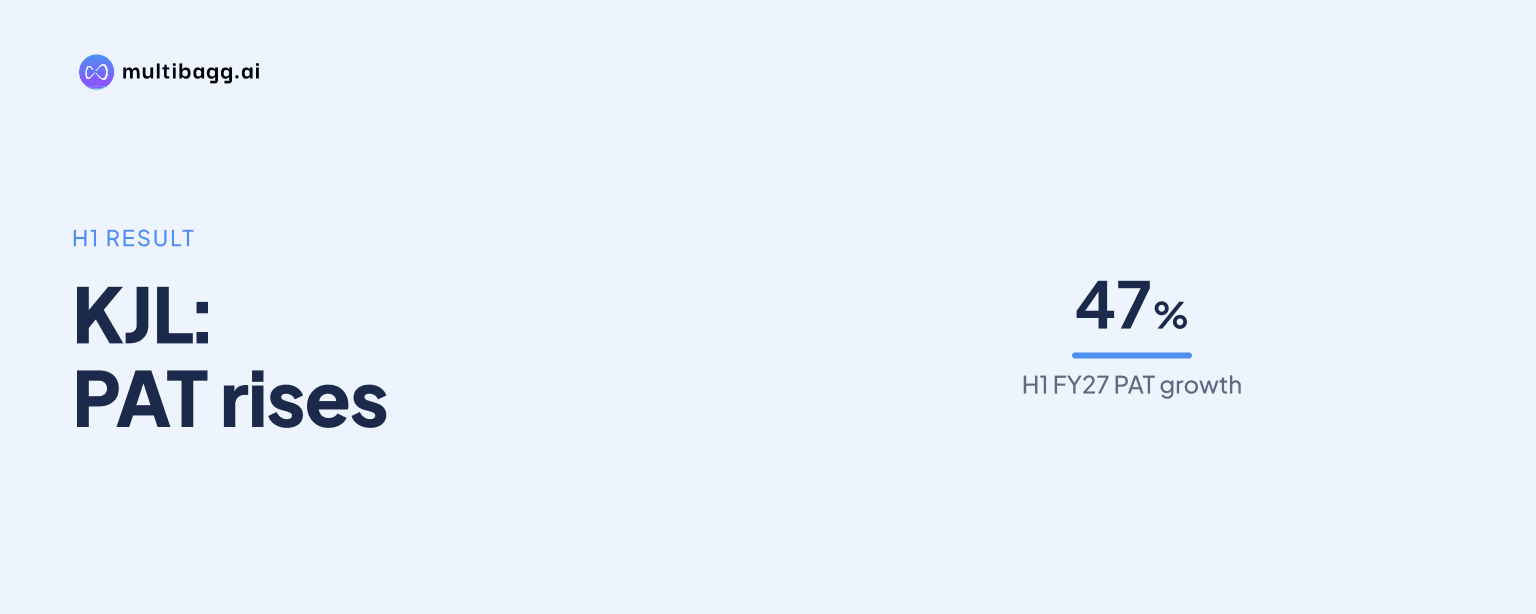
Khazanchi Jewellers Limited (KJL) reported H1 FY27 profit after tax (PAT) of ₹56.91 crore, up 47.1% year on year, while earnings before interest, tax, depreciation and amortisation (EBITDA) margin increased 111 basis points to 6.75%. Inventory rose ₹104.71 crore for the festive and wedding season, yet operating cash flow remained positive at ₹3.61 crore.
Know Khazanchi Jewellers inside out
Results, valuation, peers and who's buying, in one view.
How did KJL's H1 FY27 profit outpace income growth?
KJL's H1 FY27 PAT outpaced income growth, rising 47.1% to ₹56.91 crore while total income increased 25.1% to ₹1,191.76 crore. Revenue from operations reached ₹1,191.29 crore, compared with ₹952.34 crore in H1 FY26, while other income was ₹0.46 crore against ₹0.42 crore a year earlier.
EBITDA increased 49.6% to ₹80.46 crore from ₹53.78 crore, a faster rate than total-income growth. Profit before tax rose 46.8% to ₹75.97 crore from ₹51.74 crore, while PAT margin increased 71 basis points to 4.78% from 4.06%. Earnings per share increased 46.8% to ₹22.97 from ₹15.64.
The H1 result also exceeded the prior-year half on margins. EBITDA margin rose to 6.75% from 5.64%, and PAT margin reached 4.78% from 4.06%. KJL's H1 FY27 total income of ₹1,191.76 crore was 58.1% of its FY26 total income of ₹2,051.02 crore.
Why did KJL's EBITDA margin increase in H1 FY27?
KJL's presentation does not identify one specific operating driver for the 111-basis-point EBITDA margin increase, but it reported EBITDA growth of 49.6% against total-income growth of 25.1%. The margin reached 6.75% in H1 FY27 versus 5.64% in H1 FY26, while PAT margin rose to 4.78% from 4.06%.
Expense lines increased in absolute terms during the half year. Cost of materials and purchases rose to ₹1,105.55 crore from ₹895.77 crore, employee-benefit expense increased to ₹2.36 crore from ₹1.13 crore, and other expenses rose to ₹3.39 crore from ₹2.08 crore. Total expenditure was ₹1,111.30 crore, compared with ₹898.98 crore in H1 FY26.
KJL reported retail, or business-to-consumer sales, of ₹153.30 crore in H1 FY27, representing 13% of revenue, compared with a 5% share in H1 FY26. Management said retail sales grew 3.3 times year on year and described retail as its margin engine, but the presentation does not disclose a separate retail margin or assign the overall margin expansion to that business.
What did KJL's Q2 FY27 results show?
KJL's Q2 FY27 PAT increased 23.6% to ₹29.09 crore as total income rose 10.3% to ₹605.67 crore. EBITDA grew 24.1% to ₹40.48 crore from ₹32.63 crore in Q2 FY26, and EBITDA margin expanded 74 basis points to 6.68%.
Q2 PAT margin was 4.80%, up 51 basis points from 4.29% in Q2 FY26. Finance costs increased to ₹1.27 crore from ₹1.04 crore, and depreciation rose to ₹0.32 crore from ₹0.05 crore. Q2 earnings per share increased 24.1% to ₹11.81 from ₹9.52.
Sequentially, Q2 total income rose to ₹605.67 crore from ₹586.36 crore in Q1 FY27, while EBITDA increased to ₹40.48 crore from ₹39.98 crore. EBITDA margin declined 14 basis points from 6.82% in Q1 FY27 to 6.68% in Q2 FY27, whereas PAT margin increased five basis points from 4.75% to 4.80%.
Got a follow-up? Ask IRIS
How did KJL fund its festive inventory build?
KJL added ₹104.71 crore of inventory in H1 FY27 and reported operating cash flow of ₹3.61 crore, compared with negative operating cash flow of ₹35.88 crore in FY26. Inventory stood at ₹512.49 crore on 30 September 2026, up from ₹407.78 crore on 31 March 2026, with the presentation identifying the festive and wedding season as the reason for the stock build.
Operating profit before working-capital changes was ₹80.62 crore in H1 FY27. Trade payables rose ₹37.76 crore to ₹65.11 crore, which KJL said meant suppliers funded part of the inventory increase. Trade receivables fell ₹3.74 crore to ₹18.46 crore, and the presentation reported receivable days of three and a cash-conversion cycle of about 78 days.
Borrowings, all classified as current, increased ₹3.87 crore to ₹114.27 crore over the half year, while net worth rose ₹55.61 crore to ₹375.18 crore. KJL reported debt to equity of 0.30 times, interest cover of 22 times and no long-term debt. Cash and bank balances increased to ₹5.65 crore from ₹3.51 crore after a ₹1.24 crore dividend payment.
What is KJL's retail and expansion plan?
KJL plans to increase retail's share of revenue to 35% to 40% within three to four years, from 13% in H1 FY27 and 14% in Q2 FY27. Wholesale remained the larger business, with H1 FY27 sales of ₹1,030.30 crore, or 86% of revenue, while other sales were ₹7.70 crore, or 1%.
Management said KJL's 10,000-square-foot flagship showroom in Sowcarpet continued to receive a strong response and outlined plans for eight to 10 stores over the next three to four years. The company said its wholesale business serves more than 1,000 jewellery houses and chains, with many relationships extending beyond a decade, and identified new regions as its next wholesale focus.
The presentation identified Vajraa Diamonds as another growth area, reporting Q2 diamond sales at 5.1 times the prior-year level without disclosing their rupee value. Management said KJL remains on track for ₹5,000 crore in revenue by 2030, a management target rather than a reported result. KJL began trading on the main boards of BSE and NSE on 27 October 2026 after migrating from BSE SME.
Conclusion
KJL's H1 FY27 performance combined faster growth in EBITDA and PAT than in total income with higher operating and net margins. The ₹104.71 crore inventory build increased total assets to ₹566.08 crore at 30 September 2026, while positive operating cash flow reflected ₹80.62 crore of operating profit before working-capital changes, lower receivables and higher trade payables.
The next reported period will indicate whether festive and wedding-season demand converts the ₹512.49 crore inventory position into revenue and cash flow. Investors can also track management's disclosed plan for eight to 10 stores, a retail revenue mix of 35% to 40% within three to four years, new wholesale regions and the ₹5,000 crore revenue target for 2030.