










Khazanchi retail share hits 13% as it plans 8-10 stores
Key highlights
- Khazanchi reported Rs 153.30 crore of B2C revenue, equal to 13% of H1 FY27 revenue from operations.
- Khazanchi said B2C sales grew 3.3 times in H1 FY27 versus H1 FY26.
- Khazanchi plans 8-10 stores over three to four years and targets a 40% retail revenue share by FY30.
- Khazanchi's B2B wholesale revenue was Rs 1,030.30 crore, or 86% of H1 FY27 revenue.
powered by IRIS
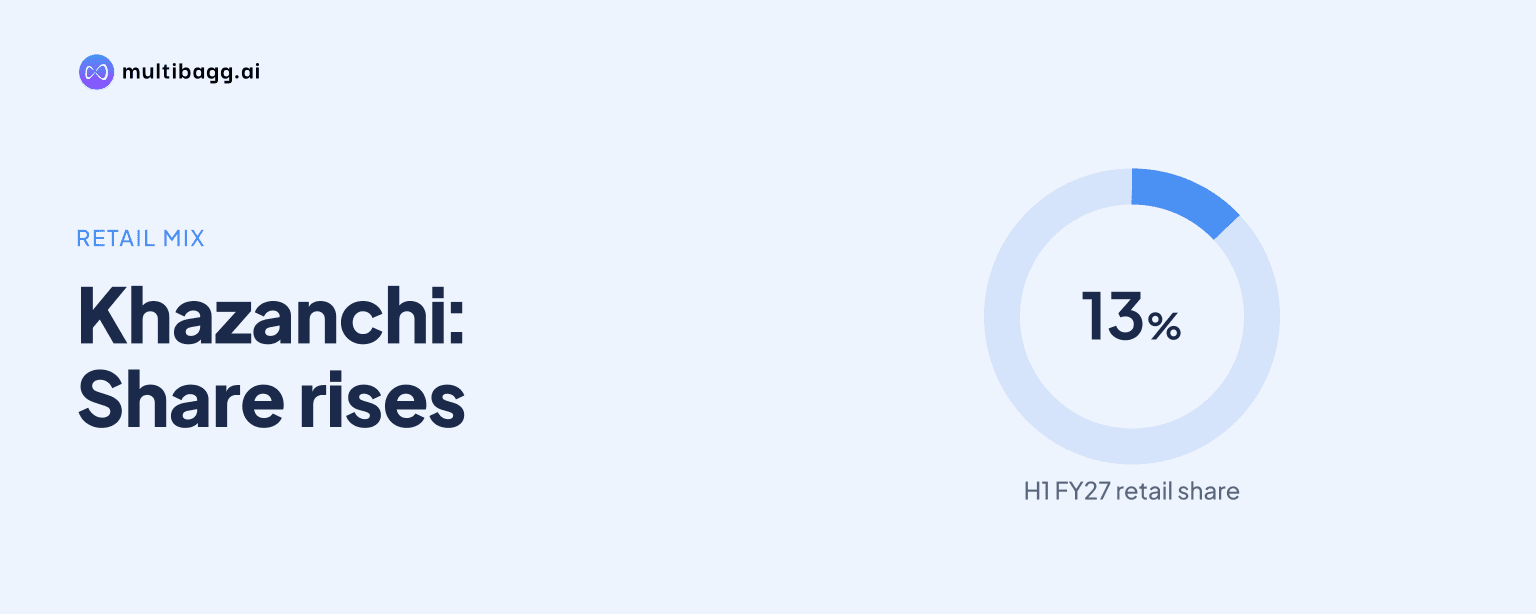
Khazanchi Jewellers Limited lifted retail to 13% of revenue in H1 FY27, from 5% a year earlier, as business-to-consumer sales reached Rs 153.30 crore and grew 3.3 times versus H1 FY26. Khazanchi plans 8-10 stores in three to four years while targeting a 40% retail revenue share by FY30.
Know Khazanchi Jewellers inside out
Results, valuation, peers and who's buying, in one view.
How much of Khazanchi's revenue comes from retail?
Khazanchi derived 13% of H1 FY27 revenue from business-to-consumer, or B2C, retail sales, while business-to-business, or B2B, wholesale sales accounted for 86%. B2C revenue was Rs 153.30 crore, B2B revenue was Rs 1,030.30 crore and other sales were Rs 7.70 crore, against total revenue from operations of Rs 1,191.30 crore.
The 13% retail contribution compares with the 5% share cited for a year earlier, while B2C sales grew 3.3 times in H1 FY27 versus H1 FY26. Khazanchi describes wholesale as its scale engine and retail as its margin engine, but it does not disclose separate gross margins, operating margins or profits for the two channels.
The mix remains predominantly wholesale despite the retail increase. Khazanchi's B2B network served 16 states in H1 FY27, and its stated wholesale growth levers include new geographies, new customers, a larger wallet share and a B2B ordering app.
What is Khazanchi's 8-10-store retail plan?
Khazanchi plans a rollout of 8-10 stores over three to four years, comprising flagship outlets and premium boutiques. The disclosed retail base is a 10,000-square-foot flagship showroom on NSC Bose Road in Sowcarpet, Chennai, carrying bridal, temple, antique, diamond and lightweight jewellery.
The company also discloses a Jewellery Purchase Plan app and a B2C e-commerce business under development. It does not provide store-opening dates, prospective cities, capital expenditure, sales per store, online-sales projections or a timetable for the e-commerce launch.
Khazanchi links the expansion to premiumisation through Vajraa Diamonds. Its wider product offer includes gold, diamond and precious-stone jewellery, alongside bullion coins and bars, while its operating model combines direct bullion sourcing, an in-house design library and authorised partner manufacturing units.
The stated FY30 objective is for retail to represent 40% of revenue, compared with 13% in H1 FY27. The presentation gives no annual retail-share milestones between H1 FY27 and FY30, so the store rollout is the disclosed mechanism for pursuing that mix shift.
Why does Tamil Nadu matter to Khazanchi's retail growth?
Tamil Nadu represented 77% of Khazanchi's revenue in H1 FY27, compared with 23% from other states, because all retail sales are made in Tamil Nadu. The state's share was 75% in FY26 and 71% in FY25, although it remained below the 84% reported in FY24.
The presentation directly associates the higher state contribution with retail growth, since the B2C business is entirely located in Tamil Nadu. It does not disclose state-level retail revenue or state-level B2B revenue, so the relative contributions of retail growth, Tamil Nadu wholesale sales and sales elsewhere cannot be calculated.
Khazanchi is headquartered in Sowcarpet, Chennai, which it describes as one of India's largest jewellery trading hubs, and its 10,000-square-foot flagship is in the same locality. That local retail base contrasts with its B2B network across 16 states.
On the wholesale side, Khazanchi says no client contributes more than 5-6% of revenue and that many trade partners have worked with the company for more than a decade. This suggests that the disclosed concentration issue is geographic, with Tamil Nadu at 77% of H1 FY27 revenue, rather than a reliance on one named wholesale customer.
Got a follow-up? Ask IRIS
Can a larger retail mix affect Khazanchi's profitability?
Khazanchi says retail earns higher margins, but the presentation does not quantify retail profitability or show whether the 13% B2C share changed H1 FY27 consolidated margins. The 40% FY30 retail-share target is management's stated mix objective rather than a disclosed earnings forecast.
At the consolidated level, revenue from operations increased to Rs 2,049.22 crore in FY26 from Rs 1,771.93 crore in FY25. Earnings before interest, tax, depreciation and amortisation, or EBITDA, rose to Rs 126.99 crore from Rs 64.92 crore, and EBITDA margin moved to 6.19% from 3.66%.
Profit after tax increased to Rs 89.42 crore in FY26 from Rs 44.96 crore in FY25, while profit after tax margin rose to 4.36% from 2.54%. These changes show higher consolidated profitability in FY26, but the source does not allocate the change between B2B and B2C operations.
Inventory was Rs 512.49 crore at September 2026, up from Rs 407.78 crore at FY26, while current borrowings rose to Rs 114.27 crore from Rs 110.40 crore. Khazanchi does not assign inventory, borrowings or expected store costs between its wholesale and retail businesses.
What should readers monitor in Khazanchi's retail transition?
Readers should monitor whether Khazanchi begins converting the 8-10-store plan into disclosed openings and whether B2C revenue rises from Rs 153.30 crore in H1 FY27. The presentation does not provide store productivity, retail margin or e-commerce revenue data that would measure the economics of the rollout.
Wholesale will remain central during any retail expansion because it generated Rs 1,030.30 crore, or 86% of H1 FY27 revenue. Growth in B2B sales could affect the pace at which retail reaches a 40% share even if B2C revenue continues to increase.
Tamil Nadu's revenue contribution is also relevant because it rose from 75% in FY26 to 77% in H1 FY27 and all retail sales are in that state. Further stores in Tamil Nadu would be consistent with the disclosed current retail footprint, though Khazanchi has not identified the locations of planned outlets.
Conclusion
Khazanchi's H1 FY27 figures show a faster-growing retail operation within a business still led by wholesale: B2C contributed Rs 153.30 crore and 13% of revenue, while B2B contributed Rs 1,030.30 crore and 86%. The move from a 5% retail share a year earlier indicates a changing channel mix, but channel-level profitability is not disclosed.
The next items to watch are implementation of the 8-10-store plan over three to four years, progress on B2C e-commerce and movement toward management's FY30 target of a 40% retail revenue share. Tamil Nadu's revenue share, at 77% in H1 FY27, will also remain relevant because every reported retail sale is currently made in that state.