










KP Green Engineering fixed assets double; cash flow turns negative
Key highlights
- KP Green Engineering’s fixed assets rose 109% to Rs 695 crore at Sep-26 from Rs 332 crore at Sep-25.
- Operating cash flow changed to a Rs 110 crore outflow in H1 FY27 from a Rs 57 crore inflow in H1 FY26.
- Financing cash inflow increased to Rs 127 crore in H1 FY27 from Rs 88 crore a year earlier.
- Debt increased to Rs 447 crore and the debt-to-equity ratio rose to 0.91 times in H1 FY27.
powered by IRIS
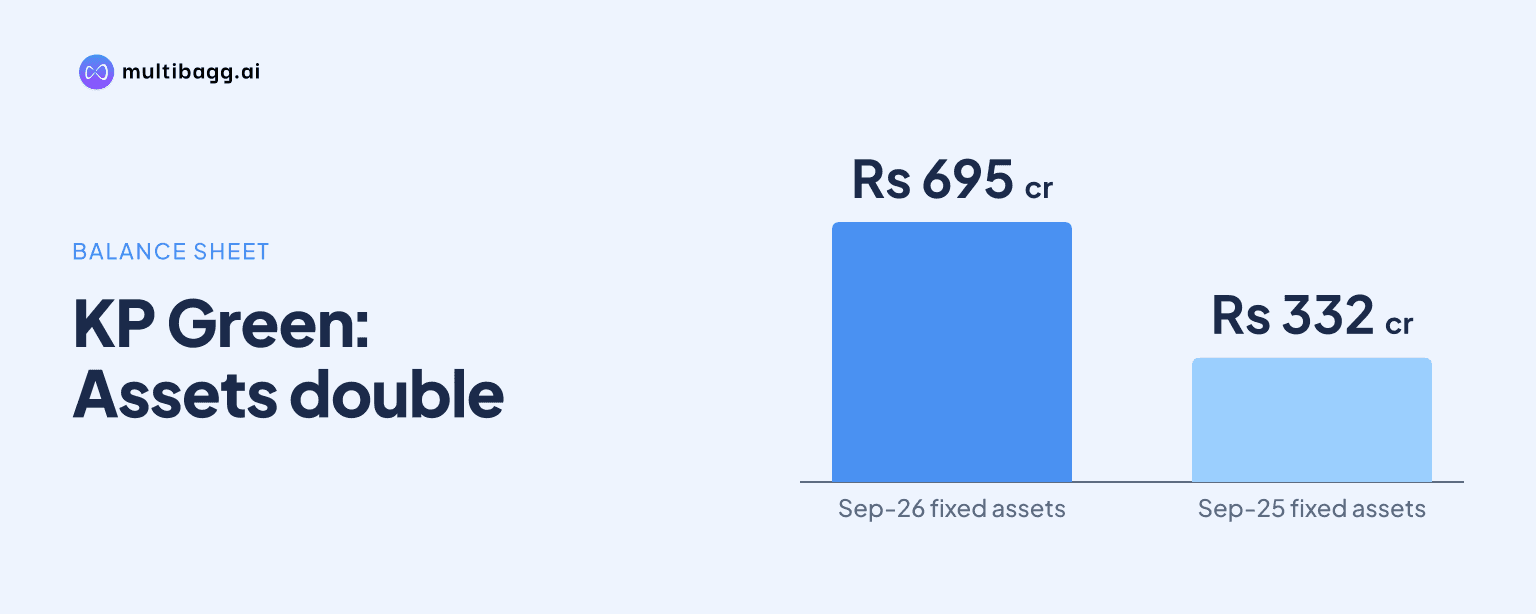
KP Green Engineering Limited reported fixed assets of Rs 695 crore at Sep-26, up 109% from Rs 332 crore at Sep-25, while operating cash flow reversed to a Rs 110 crore outflow in H1 FY27 from a Rs 57 crore inflow a year earlier. Financing inflows of Rs 127 crore supported period-end cash of Rs 15 crore.
Know KP Green Engineering inside out
Results, valuation, peers and who's buying, in one view.
What changed in KP Green Engineering’s asset base?
KP Green Engineering’s fixed assets rose by Rs 363 crore year on year to Rs 695 crore at Sep-26, compared with Rs 332 crore at Sep-25. The company reported this as 109% growth, meaning the fixed-asset balance was more than twice the level shown for the comparable prior-half period.
The expansion was part of a Rs 677 crore increase in the consolidated balance-sheet total, which reached Rs 1,831 crore in H1 FY27 from Rs 1,154 crore in H1 FY26. Current assets increased to Rs 1,027 crore from Rs 742 crore, while other non-current assets increased to Rs 110 crore from Rs 79 crore. Fixed assets accounted for Rs 363 crore of the Rs 677 crore increase in total assets.
The asset increase coincided with higher liabilities and shareholders’ funds. Shareholders’ funds rose by Rs 109 crore to Rs 491 crore, while total liabilities excluding shareholders’ funds rose by Rs 568 crore to Rs 1,340 crore. The presentation does not provide a project-by-project breakdown of the Rs 363 crore increase in fixed assets.
Why did KP Green Engineering’s operating cash flow turn negative?
KP Green Engineering’s operating cash flow turned into a Rs 110 crore outflow in H1 FY27 from a Rs 57 crore inflow in H1 FY26, a year-on-year movement of Rs 167 crore. The presentation reports the cash-flow outcome but does not identify the operating working-capital items, payments or other specific drivers behind the reversal.
Cash used in investing activities was lower in H1 FY27, at Rs 11 crore, compared with an outflow of Rs 149 crore in H1 FY26. That Rs 138 crore reduction in investing cash use did not offset the change in operating cash generation, because KP Green Engineering moved from positive operating cash flow of Rs 57 crore to a Rs 110 crore outflow.
Financing activities provided Rs 127 crore in H1 FY27, up from Rs 88 crore in H1 FY26. Combined with the smaller Rs 11 crore investing outflow, that financing inflow enabled a Rs 6 crore net increase in cash and cash equivalents despite the Rs 110 crore operating outflow.
Got a follow-up? Ask IRIS
How did KP Green Engineering fund its balance-sheet expansion?
KP Green Engineering reported debt of Rs 447 crore in H1 FY27, up Rs 251 crore from Rs 196 crore in H1 FY26, while equity increased by Rs 109 crore to Rs 491 crore. As debt increased faster than equity, the debt-to-equity ratio rose to 0.91 times from 0.51 times.
The balance-sheet summary separately shows long-term loans of Rs 78 crore at H1 FY27, compared with Rs 36 crore a year earlier. Other non-current liabilities increased to Rs 167 crore from Rs 15 crore, and current liabilities rose to Rs 1,096 crore from Rs 721 crore. The presentation’s debt figure is separate from these liability line items and does not provide a reconciliation between them.
The Rs 127 crore financing cash inflow was reported alongside higher debt and liabilities at H1 FY27. Cash profit, which KP Green Engineering presents separately in its income-statement summary, rose to Rs 75 crore from Rs 67 crore, but was below the Rs 110 crore operating cash outflow for the half year.
What did the expansion mean for KP Green Engineering’s earnings and liquidity?
KP Green Engineering’s total income increased 27% to Rs 682 crore in H1 FY27 from Rs 536 crore in H1 FY26, while earnings before interest, tax, depreciation and amortisation (EBITDA) increased 17% to Rs 119 crore from Rs 102 crore. EBITDA margin declined to 17% from 19% as total operating expense increased 30% to Rs 563 crore from Rs 434 crore.
Profit after tax fell 41% to Rs 34 crore from Rs 58 crore. Interest cost rose 114% to Rs 34 crore from Rs 16 crore, while depreciation and amortisation rose 356% to Rs 36 crore from Rs 8 crore. These two charges increased by a combined Rs 46 crore, compared with a Rs 17 crore increase in EBITDA, and profit before tax declined to Rs 50 crore from Rs 78 crore.
Liquidity at the end of the period was Rs 15 crore of cash and cash equivalents, compared with Rs 10 crore at the end of H1 FY26. KP Green Engineering began H1 FY27 with Rs 9 crore of cash and ended with Rs 15 crore after the Rs 127 crore financing inflow, Rs 110 crore operating outflow and Rs 11 crore investing outflow.
Revenue from operations rose 28% to Rs 679 crore from Rs 532 crore, while the related-party share of revenue fell to 17.0% in H1 FY27 from 49.5% in FY26. This comparison uses a six-month period for H1 FY27 and a full-year period for FY26, as presented by KP Green Engineering.
Conclusion
KP Green Engineering’s H1 FY27 figures show asset-led balance-sheet expansion alongside a reversal in operating cash generation. Fixed assets increased 109% to Rs 695 crore, total assets rose to Rs 1,831 crore and debt reached Rs 447 crore, while operating cash flow changed from a Rs 57 crore inflow to a Rs 110 crore outflow. Higher financing inflows preserved a Rs 6 crore net increase in cash.
The next disclosures will be important for detail on the fixed-asset build-out, the factors behind operating cash flow and the relationship between financing and future asset additions. KP Group has disclosed KP 3.0 targets by FY32 of 10 gigawatt-peak of owned generation, 10 gigawatt-peak of third-party engineering, procurement and construction capacity, and 10 gigawatt-hours of battery storage; these are group-level targets rather than financial targets for KP Green Engineering.