










Kwality Pharmaceuticals Limited cash cycle falls to 130 days
Key highlights
- KPL disclosed a 130-day cash-conversion cycle in Q2 FY27, versus 170 days in FY26 and 297 days in FY23.
- KPL’s debtor days fell by 34 days to 77, while payable days declined by 18 days to 126 from FY26.
- KPL reported Q2 FY27 consolidated revenue of Rs 181 crore, up 63% from Rs 111 crore in Q2 FY26.
- Management raised FY27 revenue guidance to more than Rs 720 crore from more than Rs 700 crore.
powered by IRIS
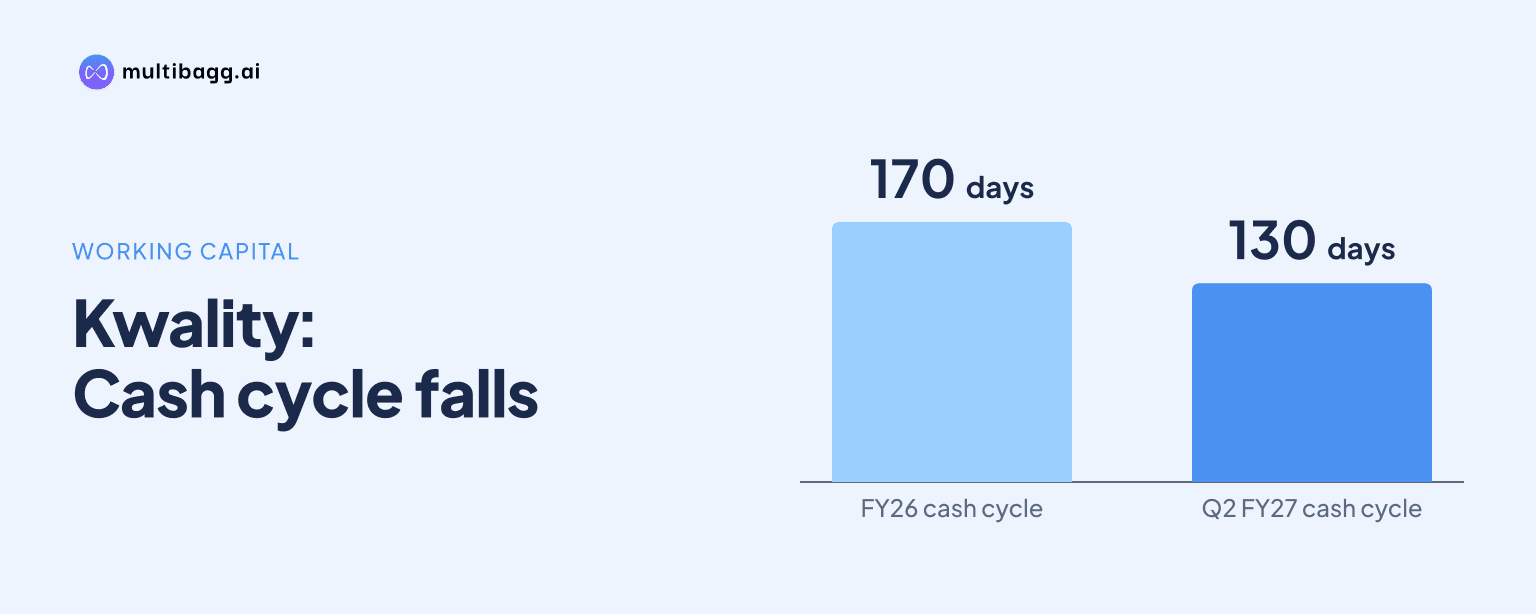
Kwality Pharmaceuticals Limited reported a 130-day cash-conversion cycle in its Q2 FY27 management discussion, down 167 days from 297 days in FY23, as debtor days declined to 77 from 111 in FY26 and payable days stood at 126. The disclosure accompanied results for the quarter ended September 30, 2026.
Know Kwality Pharmaceuticals inside out
Results, valuation, peers and who's buying, in one view.
How much did KPL’s cash-conversion cycle improve?
KPL’s cash-conversion cycle improved by 167 days over three years, falling from 297 days in FY23 to 130 days in the latest Q2 FY27 disclosure. The company also reported a 40-day reduction from the 170 days disclosed for FY26, placing the latest measure below both comparison periods.
KPL attributed the movement to tighter inventory management and improved receivables discipline. The company said its working-capital focus was strengthening cash generation and helping support growing business requirements, but it did not disclose inventory days, cash-flow figures, or working-capital balances alongside the 130-day measure.
The reported change spans a period in which the company has expanded its product and manufacturing plans. KPL’s management discussion cited a 40-molecule bioequivalence programme for global filings, of which studies for 19 products had been completed, but it did not assign any portion of the 167-day cycle improvement to a product, market, or customer group.
What changed in KPL’s receivables and payables?
KPL’s debtor days declined by 34 days to 77 from 111, while payable days declined by 18 days to 126 from 144 in FY26. The debtor-days decline is the quantified evidence KPL provided for its stated improvement in receivables discipline.
Payable days exceeded debtor days by 49 days in the latest disclosure, compared with a 33-day difference in FY26 between 144 payable days and 111 debtor days. These figures are separate working-capital measures, and KPL did not disclose the inventory-days component needed to show the calculation behind the 130-day cash-conversion cycle.
Both collection time and supplier-payment time fell versus FY26, while the cash-conversion cycle declined by 40 days from 170 days to 130 days. KPL described the outcome as continuing improvement in working-capital efficiency, rather than citing a one-off collection, supplier arrangement, product launch, or geography as the cause.
Got a follow-up? Ask IRIS
How did the cycle improvement coincide with KPL’s sales growth?
KPL disclosed the lower cash-conversion cycle alongside consolidated revenue of Rs 181 crore for the quarter ended September 30, 2026, up 63% from Rs 111 crore in Q2 FY26. Revenue also rose 11.7% sequentially from Rs 162 crore in Q1 FY27, indicating that the latest working-capital disclosure came during a period of higher sales.
For H1 FY27, KPL reported consolidated revenue of Rs 343 crore. The company did not calculate working capital as a percentage of revenue or quantify whether the 63% year-on-year revenue growth affected debtor days, payable days, inventory management, or the 130-day cycle.
KPL also reported an earnings before interest, tax, depreciation and amortisation margin of 27.5% in Q2 FY27, compared with 23.4% in Q2 FY26. Profit after tax doubled to Rs 50 crore from Rs 25 crore, while the profit-after-tax margin rose to 16% from 13%; these financial measures were disclosed separately from the working-capital discussion.
What could affect KPL’s cash-conversion cycle next?
KPL’s capacity plans may affect future inventory and working-capital requirements, although the filing provides no forecasts for either measure. During Q2 FY27, KPL acquired 4 acres adjacent to its Amritsar manufacturing campus for Unit 7, a proposed automated general manufacturing facility with more than four injectable lines and more than six oral solid dosage lines.
KPL said its oncology manufacturing expansion was progressing as scheduled, with completion anticipated by June 2027. Construction of the Hormone manufacturing facility has been completed, and KPL has initiated the manufacturing-licence audit process, but the company did not disclose expected production volumes, inventory needs, or revenue contribution from either facility.
Management raised FY27 revenue guidance to more than Rs 720 crore from more than Rs 700 crore, citing newly registered products and conversion of the regulatory pipeline into commercial opportunities. KPL also launched five ophthalmic products during the period and completed bioequivalence studies for 19 of 40 planned molecules, without providing future debtor-day, payable-day, or cash-cycle targets.
Conclusion
KPL’s latest working-capital disclosure shows a 130-day cash-conversion cycle, compared with 170 days in FY26 and 297 days in FY23. The 167-day three-year reduction coincided with debtor days falling to 77 from 111, while Q2 FY27 consolidated revenue rose 63% year on year to Rs 181 crore and profit after tax reached Rs 50 crore.
The next disclosed markers are management’s FY27 revenue guidance of more than Rs 720 crore, the manufacturing-licence audit for the completed Hormone facility, and oncology expansion completion anticipated by June 2027. Subsequent disclosures may show whether the 130-day cash-conversion cycle is sustained as KPL develops Unit 7, commercialises registered products, and expands specialised manufacturing capacity.