










Ladderup Finance posts ₹161.62 lakh H1 profit despite Q2 loss
Key highlights
- Ladderup Finance reported a standalone H1 FY27 profit after tax of ₹161.62 lakh, versus a ₹20.42 lakh loss a year earlier.
- Standalone Q2 FY27 loss after tax was ₹168.72 lakh after a ₹116.34 lakh impairment charge.
- Standalone revenue from operations declined to ₹42.27 lakh in Q2 FY27 from ₹483.93 lakh in Q1 FY27.
- Consolidated Q2 FY27 revenue from operations rose 34% year-on-year to ₹552.95 lakh.
powered by IRIS
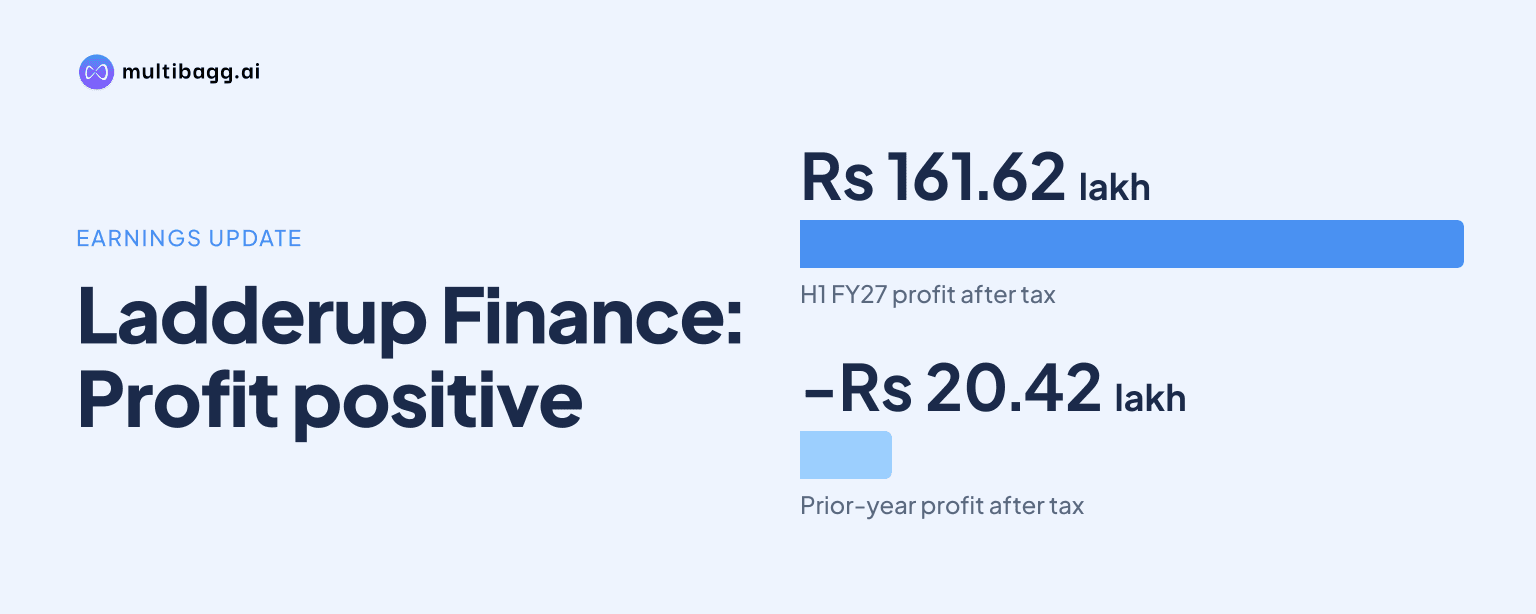
Ladderup Finance Limited reported a standalone profit after tax of ₹161.62 lakh for the half year ended September 30, 2026, despite posting a ₹168.72 lakh loss after tax in Q2 FY27 after an impairment charge and a sharp reduction in fair-value gains on financial assets.
Know Ladderup Finance inside out
Results, valuation, peers and who's buying, in one view.
What did Ladderup Finance report for Q2 FY27?
Ladderup Finance reported a standalone net loss after tax of ₹168.72 lakh for the quarter ended September 30, 2026, compared with a net profit of ₹330.35 lakh in the preceding quarter and a loss of ₹80.22 lakh in the corresponding quarter a year earlier. Total comprehensive income for the quarter was a loss of ₹223.76 lakh, including other comprehensive loss of ₹55.04 lakh.
The quarterly result reflected lower income from changes in the fair value of financial assets and an impairment provision. Standalone revenue from operations fell to ₹42.27 lakh in Q2 FY27 from ₹483.93 lakh in Q1 FY27. Net gain on fair-value changes declined to ₹28.12 lakh from ₹477.12 lakh in the previous quarter, while interest income was nil against ₹3.96 lakh in Q1.
Expenses rose to ₹209.14 lakh during the quarter, principally because of a ₹116.34 lakh impairment charge on financial instruments. Employee benefits expense was ₹28.83 lakh. The company reported a loss before tax of ₹166.87 lakh and basic earnings per share of negative ₹1.59 for the quarter.
How did Ladderup Finance perform in H1 FY27?
Ladderup Finance posted a standalone profit after tax of ₹161.62 lakh for the six months ended September 30, 2026, reversing a ₹20.42 lakh loss reported in the corresponding period of the previous year. Its standalone total comprehensive income for H1 FY27 was ₹760.16 lakh, comprising the reported profit and ₹598.54 lakh of other comprehensive income.
The half-year result shows that the first-quarter profit was sufficient to offset the second-quarter loss. However, the source data does not provide a separate detailed H1 income statement in the supplied material beyond the reported profit, comprehensive income and quarterly operating figures. The financial statements were reviewed by the Audit Committee and approved by the Board of Directors.
The company also issued consolidated results. Profit after tax attributable to owners for H1 FY27 was ₹238.65 lakh, while consolidated total comprehensive income stood at ₹899.74 lakh. These figures indicate that group entities contributed to the overall half-year outcome, even as the standalone entity recorded a quarterly loss.
Why did Ladderup Finance move into a quarterly loss?
Ladderup Finance moved into a Q2 loss because fair-value gains declined sharply and the company recognised a ₹116.34 lakh impairment charge on financial instruments. The fall in gains on financial assets was material because this item decreased from ₹477.12 lakh in Q1 FY27 to ₹28.12 lakh in Q2 FY27.
The impairment provision increased total quarterly expenses and directly affected the reported profit. Without treating the charge as a recurring operating item, the disclosed data still shows that lower investment-related gains and the absence of interest income reduced the income available to absorb regular costs. The company has not provided further detail in the supplied material on the financial instruments behind the impairment.
For investors, the quarter also illustrates that standalone earnings can be sensitive to fair-value movements. Such gains and losses can vary with valuations of financial assets and do not necessarily move in line with fee income or other operating revenue. The reported figures should therefore be assessed alongside both the standalone and consolidated statements.
Got a follow-up? Ask IRIS
How did the consolidated business and cash flows compare?
The consolidated business reported revenue from operations of ₹552.95 lakh in Q2 FY27, up 34% from ₹411.46 lakh in Q2 FY26, supported by fee and commission income of ₹515.06 lakh. Fee and commission income accounted for more than 93% of consolidated operational revenue in the quarter.
Despite the revenue increase, consolidated loss attributable to owners widened to ₹140.91 lakh in Q2 FY27 from ₹20.47 lakh in Q2 FY26. The disclosed reasons included higher employee benefits expense of ₹268.85 lakh and the impairment charge reflected at the group level. This distinction between rising fee income and weaker reported profit is relevant when examining the group’s cost base.
Standalone cash flow from operating activities was an outflow of ₹1,708.58 lakh in H1 FY27. Investing activities generated an inflow of ₹1,803.88 lakh, while financing activities recorded an outflow of ₹84.43 lakh. Standalone inventories increased to ₹1,714.81 lakh as of September 30, 2026, from ₹713.41 lakh at March 31, 2026.
On a consolidated basis, goodwill of ₹1,536.96 lakh appeared following Ladderup Asset Managers Private Limited’s acquisition of Jericho Ventures Private Limited in April 2026. The acquisition and the higher inventory balance are balance-sheet developments that investors may consider alongside operating cash outflow and the group’s increased reliance on fee and commission income.
What does the Q2 result mean for investors?
The Q2 result means that Ladderup Finance ended the first half with a standalone profit but faced substantial quarterly volatility from investment valuation movements and impairment costs. The H1 profit of ₹161.62 lakh and total comprehensive income of ₹760.16 lakh provide a positive half-year outcome, while the Q2 loss highlights the impact of the reported one-time and valuation-related items.
The consolidated data provides a separate perspective. Revenue growth in fee and commission income supported group operating revenue, but higher employee costs and impairment pressure resulted in a Q2 loss attributable to owners. The company’s financial position also changed through higher inventories, investing cash inflow and goodwill arising from an acquisition.
Conclusion
Ladderup Finance reported mixed FY27 second-quarter results: its standalone business recorded a ₹168.72 lakh loss, while its first-half standalone profit remained ₹161.62 lakh. The decline in fair-value gains and a ₹116.34 lakh impairment charge were central to the quarterly reversal, whereas consolidated fee income supported revenue growth at the group level.
Investors will watch whether fair-value gains recover, whether impairment-related costs recur, and how the higher inventory and acquisition-related goodwill affect subsequent disclosures. The next set of quarterly financial results should provide further evidence on the sustainability of fee income, employee-cost trends and operating cash flow.