










Dharmaj Crop Guard Ltd Q2 FY27 revenue falls 4% to ₹332.6 crore
Key highlights
- Dharmaj Crop Guard reported Q2 FY27 revenue of ₹332.6 crore, down 4% from ₹347.3 crore in Q2 FY26.
- Q2 FY27 EBITDA declined 24% to ₹24.3 crore, and EBITDA margin fell to 7% from 9%.
- Q2 FY27 PAT was ₹13.3 crore, down 24% year on year, with PAT margin at 4%.
- Total borrowings declined to ₹119.0 crore in H1 FY27 from ₹138.8 crore in H1 FY26.
powered by IRIS
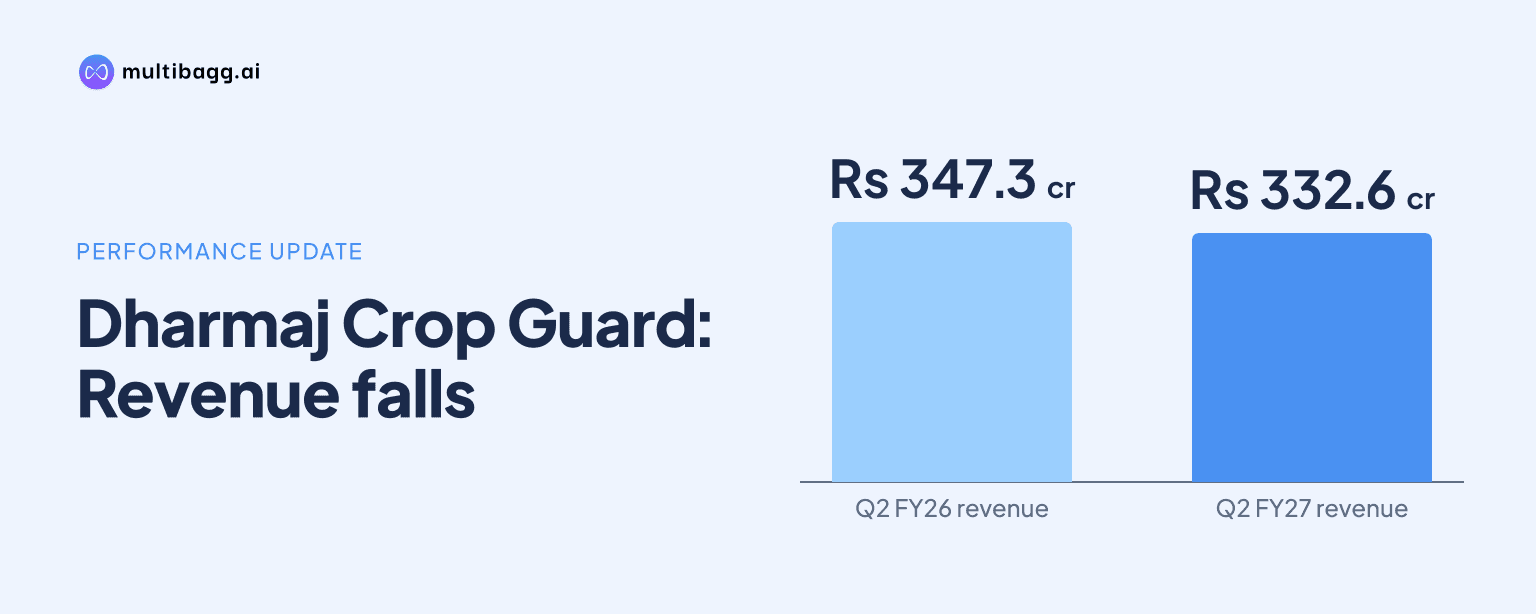
Dharmaj Crop Guard Ltd reported Q2 FY27 revenue from operations of ₹332.6 crore, down 4% year on year from ₹347.3 crore, while EBITDA declined 24% to ₹24.3 crore and the operating margin narrowed to 7% from 9%.
Know Dharmaj Crop Guard inside out
Results, valuation, peers and who's buying, in one view.
What did Dharmaj Crop Guard report for Q2 FY27?
Dharmaj Crop Guard Ltd reported a softer September-quarter performance, with lower revenue, operating profit and net profit compared with Q2 FY26. The company attributed margin compression during the quarter to higher input costs and weak margins in its Technicals business, according to the investor presentation.
Revenue from operations was ₹332.6 crore in Q2 FY27, compared with ₹347.3 crore a year earlier. EBITDA fell to ₹24.3 crore from ₹31.8 crore, and the EBITDA margin declined by 200 basis points to 7%. Profit after tax was ₹13.3 crore, down 24% from ₹17.4 crore in Q2 FY26, with the PAT margin slipping to 4% from 5%.
Operating expenses were ₹37.6 crore, 14% lower year on year. However, the reduction in expenses did not offset the effect of lower sales and pressure on Technicals margins. The presentation does not provide an earnings-call transcript or additional management commentary for the quarter, so the reported figures should not be treated as financial guidance.
How did the first half of FY27 compare with last year?
Dharmaj Crop Guard reported H1 FY27 revenue from operations of ₹716.7 crore, broadly unchanged from ₹714.6 crore in H1 FY26. The near-flat first-half revenue outcome indicates that the company maintained its overall sales base despite the weaker Q2 comparison.
The H1 EBITDA margin was 11.4%, marginally below 11.5% in H1 FY26. This relatively stable half-year margin contrasts with the sharper Q2 compression, although it also reflects continuing cost pressure cited in the presentation. The company has not provided a detailed H1 EBITDA or PAT amount in the supplied presentation extracts.
The quarterly pattern is relevant because the agrochemical business is seasonal, with demand influenced by crop cycles, weather and channel buying. Dharmaj Crop Guard had reported Q1 FY27 revenue from operations of ₹384.1 crore in its earlier quarterly disclosure. Q2 revenue of ₹332.6 crore was therefore lower than the preceding quarter, while the H1 total was broadly in line with the prior-year period.
Why did Dharmaj Crop Guard's margins decline in Q2 FY27?
Dharmaj Crop Guard said Q2 margins were affected by higher input costs and weak Technicals margins. EBITDA fell faster than revenue, declining 24% against the 4% revenue contraction, which resulted in the EBITDA margin falling to 7% from 9% a year earlier.
Technicals are an important part of the agrochemical value chain, and weaker profitability in this segment can affect the consolidated operating result even when overall revenue changes are modest. The presentation does not quantify the contribution of input-cost inflation or disclose product-level volumes, pricing changes or segment-wise profitability in the information provided.
The company described its H2 FY27 outlook as cautiously optimistic. It expects to push higher exports while sustaining its domestic business, although it noted that weak monsoon conditions could affect the Rabi season. This is an operational outlook rather than quantified earnings guidance, and no target for revenue, margin or profit was disclosed.
Got a follow-up? Ask IRIS
What does the borrowing position show for investors?
Dharmaj Crop Guard reduced total borrowings to ₹119.0 crore in H1 FY27 from ₹138.8 crore in H1 FY26. The decrease came from both non-current and current borrowings, indicating a lower reported debt position compared with the same point of the previous financial year.
Non-current borrowings declined to ₹45.0 crore from ₹58.1 crore, while current borrowings decreased to ₹74.0 crore from ₹80.7 crore. The reduction in borrowings is a notable balance-sheet data point alongside the pressure on quarterly profitability, though the supplied information does not disclose interest costs, cash flow, working-capital movements or the debt-repayment schedule.
No capex amount, project update or capital-expenditure target is provided in the supplied Q2 FY27 presentation details. Investors assessing expansion plans will therefore need to rely on subsequent company disclosures rather than infer capex spending from the change in borrowings.
How could the Q2 result affect Dharmaj Crop Guard's market assessment?
The Q2 numbers place attention on Dharmaj Crop Guard's ability to protect margins as input costs and Technicals profitability remain under pressure. Revenue declined by 4%, but EBITDA and PAT each declined by 24%, making the margin movement more significant than the top-line change during the quarter.
For investors, the H1 picture provides an offsetting data point: revenue was flat year on year and EBITDA margin was nearly stable at 11.4%. The reported reduction in total borrowings also improves the context for reviewing the company’s financial position. Still, the presentation does not offer a quantified recovery timetable or margin target for the second half.
The company has scheduled an investor and analyst conference call for November 6, 2026, to discuss Q2 and H1 FY27 performance. Management participants named in the call invitation include Chairman and Managing Director Rameshbhai Talavia, Whole-Time Director Jamankumar Talavia, Chief Executive Officer Vishal Domadia and Chief Financial Officer Vikas Agarwal. Any commentary from that event was not available in the supplied material.
Conclusion
Dharmaj Crop Guard’s Q2 FY27 presentation shows a 4% decline in revenue to ₹332.6 crore, alongside a sharper fall in EBITDA and PAT as the EBITDA margin narrowed to 7%. H1 revenue remained broadly flat and total borrowings declined to ₹119.0 crore, but the second-quarter figures underline the effect of input costs and weaker Technicals margins on profitability.
The next disclosed event is the November 6, 2026 investor and analyst call. Investors will watch for management’s comments on export demand, domestic Rabi-season conditions, input costs, Technicals margins and any capex plans, none of which were quantified in the supplied presentation extracts.