










Landmark study finds EV service revenue 45% above ICE cars
Key highlights
- Landmark’s Brand 1 study reported Rs 2.04569 lakh of annual EV after-sales revenue per car, 45% above ICE revenue.
- Landmark’s Brand 2 study reported Rs 49,515 of annual EV after-sales revenue per car, 9% above ICE revenue.
- EV accident-repair revenue was 147% higher in Brand 1 and 66% higher in Brand 2.
- Landmark reported Rs 1,050.8 crore of after-sales revenue in FY26 and Rs 550 crore in H1FY27.
powered by IRIS
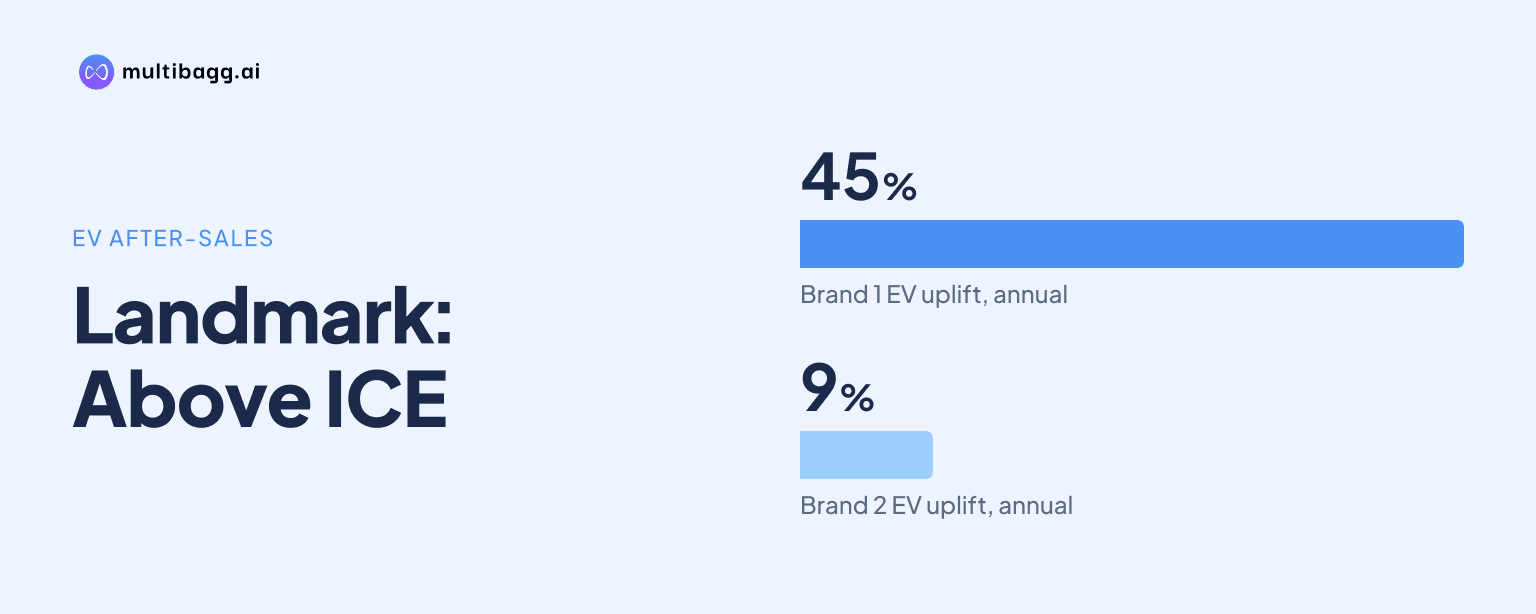
In its H1FY27 presentation, Landmark said annual after-sales revenue per electric vehicle (EV) was 45% higher than for internal-combustion-engine (ICE) cars in one internal brand study and 9% higher in another on a per-car, per-year basis. Higher accident-repair bills offset lower preventive-maintenance and general-repair spending.
Know Landmark Cars inside out
Results, valuation, peers and who's buying, in one view.
Does Landmark say EVs reduce after-sales revenue?
Landmark says its analysis of two brands suggests that rising EV penetration does not negatively affect after-sales revenue. The finding is limited to two internal studies covering brands that sell both EV and ICE vehicles, and Landmark says the observations are indicative rather than representative of the entire automotive industry.
In Brand 1, annual after-sales revenue was Rs 2.04569 lakh per EV, compared with Rs 1.42746 lakh per ICE car, a 45% difference. In Brand 2, annual revenue was Rs 49,515 per EV and Rs 45,618 per ICE car, a 9% difference. The gap was therefore materially wider in Brand 1.
The two comparisons show lower preventive-maintenance and general-repair revenue for EVs, down 12% in Brand 1 and 35% in Brand 2. However, Landmark reported higher accident-repair revenue and a greater annual visit frequency for EVs in both studies, resulting in higher total after-sales revenue per car.
What explains Landmark’s higher EV service revenue?
Landmark attributes the higher EV revenue in both studies chiefly to accident repairs and more workshop visits. Brand 1 recorded accident-repair revenue of Rs 1.22596 lakh per EV annually, compared with Rs 49,645 per ICE car, a 147% increase, while EV visit frequency was 2.33 times per year against 1.86 times for ICE cars.
In Brand 2, accident-repair revenue was Rs 32,760 per EV a year, versus Rs 19,746 per ICE car, or 66% more. EVs visited 3.87 times annually, compared with 2.36 visits for ICE vehicles, a 64% difference. These figures associate the higher total EV revenue with workshop activity beyond routine maintenance.
Annual vehicle running was also higher for EVs in the two samples. Brand 1 EVs averaged 12,519 kilometres a year, 37% above the 9,152 kilometres for ICE cars, while Brand 2 EVs averaged 21,000 kilometres, 62% above the ICE average of 13,000 kilometres. The presentation does not establish whether the additional distance caused the higher repair revenue or visit frequency.
How did routine maintenance compare for EV and ICE cars?
Preventive-maintenance and general-repair revenue was lower for EVs in both Landmark comparisons. Brand 1 reported Rs 81,973 per EV per year, compared with Rs 93,101 per ICE car, a 12% decline; Brand 2 reported Rs 16,755 for EVs and Rs 25,872 for ICE cars, a 35% decline.
In Brand 2, the Rs 9,117 lower EV routine-maintenance and general-repair bill was more than offset by Rs 13,014 of additional accident-repair revenue. Total annual EV after-sales revenue was consequently Rs 3,897 above the ICE figure, despite the lower revenue in the routine-maintenance category.
Brand 1 showed a larger absolute difference. EV preventive-maintenance and general-repair revenue was Rs 11,128 below the ICE level, while accident-repair revenue was Rs 72,951 higher. The resulting total-revenue difference was Rs 61,823 per car a year, making accident repairs the main numerical contributor to the reported 45% EV premium.
Got a follow-up? Ask IRIS
How significant is after-sales activity in Landmark’s results?
After-sales revenue reached Rs 1,050.8 crore in FY26, crossing Landmark’s stated Rs 1,000 crore milestone, and was Rs 550 crore in H1FY27. FY26 revenue rose from Rs 937.5 crore in FY25 and Rs 850.2 crore in FY24, extending the growth recorded by the after-sales business.
Landmark reported a 15.4% revenue compound annual growth rate over the last 10 years, a FY26 gross margin of about 41.2%, an earnings before interest, tax, depreciation and amortisation (EBITDA) margin of 18.1%, and return on capital employed of 29.8%. After-sales EBITDA was Rs 190.7 crore in FY26, compared with Rs 170.2 crore in FY25, while the margin moved from 18.2% to 18.1%.
Per-car service revenue increased to Rs 28,690 in H1FY27 from Rs 27,148 in FY26 and Rs 26,582 in FY25. Landmark also said after-sales revenue grew 11.4% year on year in Q2FY27 despite floods disrupting workshop operations in Gujarat, although it did not disclose the quarterly after-sales revenue amount.
What does Landmark’s EV mix mean for its workshops?
Landmark reported that its EV portfolio contributed about 29% of new-car-sales revenue in H1FY27. Its new high-growing brands accounted for 19% of after-sales revenue in H1FY27, up from 15% in FY26, and represented 37% of new-car-sales revenue, compared with 31% in FY26.
Landmark expects about 100% EV retention in its service network because specialised tools and skills lock in service work, but this is a company expectation rather than a reported retention outcome. The studies covered 300 EVs for Brand 1 and 1,855 EVs for Brand 2, each compared against the respective brand’s overall ICE fleet rather than a stated matched ICE sample.
Landmark is consolidating three Mumbai workshops into its 106,000-plus-square-foot multi-brand Jogeshwari facility, which serves Mercedes-Benz, BYD and Jeep. The workshop has an artificial-intelligence-powered scanner using 13 cameras and Light Detection and Ranging technology to capture about 150 images in four to five seconds, identifying scratches, dents and tyre tread before repair approval.
Conclusion
Landmark’s internal studies do not support a simple assumption that EV adoption necessarily reduces dealer after-sales income. In both brand comparisons, lower EV preventive-maintenance and general-repair revenue was outweighed by higher accident-repair revenue and more frequent visits, producing annual revenue premiums of 45% and 9% over ICE cars.
The next matters to watch are whether Landmark’s expected near-100% EV service retention is realised and whether EVs maintain their approximately 29% contribution to new-car-sales revenue. The operating effect of the Jogeshwari consolidation is also relevant, as Landmark intends the 106,000-plus-square-foot facility to replace three Mumbai workshops through multi-brand operations and automated inspection processes.