










Latent View guides FY27 revenue of $127 million as tech shrinks
Key highlights
- Latent View guided for about $127 million of FY27 organic revenue, more than 6% above FY26 revenue of $119.5 million.
- Management said about $125 million of the $127 million FY27 revenue target is signed and locked in.
- Latent View expects FY27 financial-services growth of 45% to 46% and industrials growth of 60% to 65%.
- Latent View expects technology-vertical revenue to decline about 5% in FY27 after client consolidation and budget cuts.
powered by IRIS
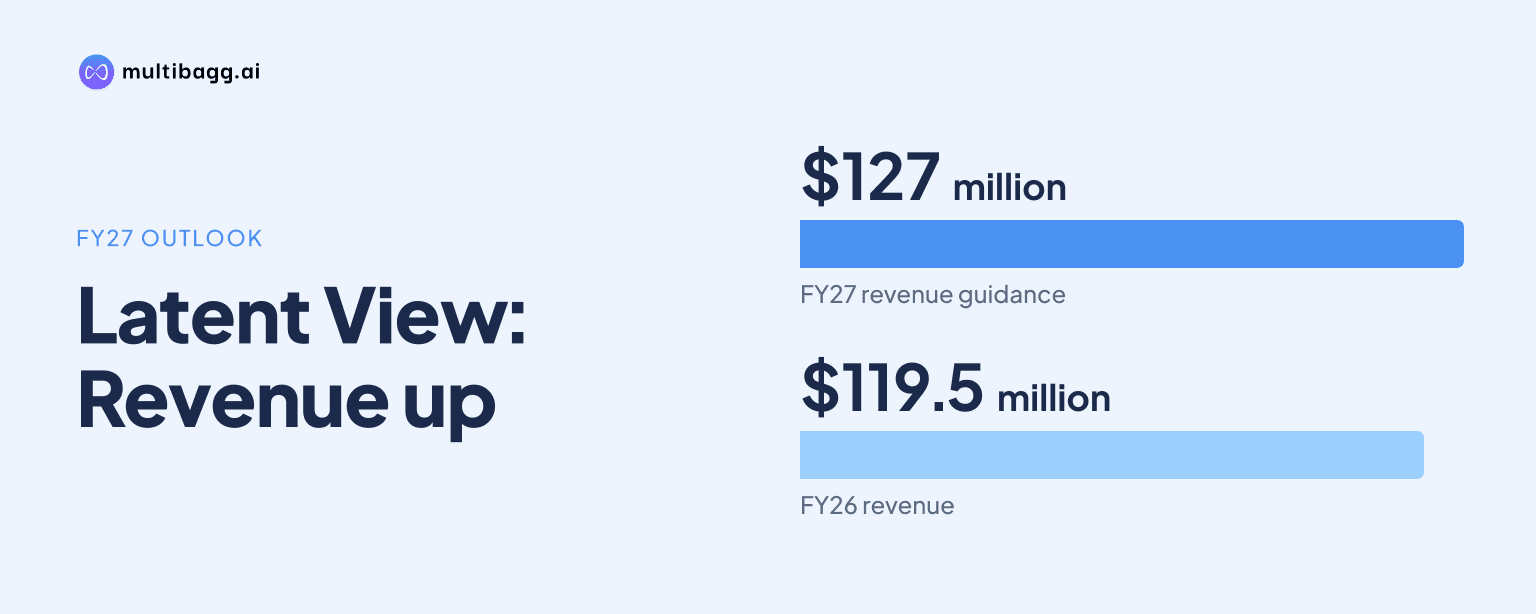
For FY27, Latent View Analytics Limited has guided for about $127 million of organic revenue, more than 6% above FY26 revenue of $119.5 million, despite expecting technology-vertical revenue to decline about 5%. Latent View said growth in financial services and industrials is expected to offset consolidation and budget cuts at major technology clients.
Know Latent View Analytics inside out
Results, valuation, peers and who's buying, in one view.
What is Latent View’s FY27 revenue guidance?
Latent View’s FY27 guidance is about $127 million of revenue, representing growth of more than 6% from the $119.5 million reported in FY26. Management said the figure covers organic growth only, meaning any revenue from acquisitions would be additional to the stated target.
Management said about $125 million of the $127 million target is already signed and locked in. The remaining roughly $2 million depends on advanced pipeline conversion in Q3 and Q4, including opportunities where paperwork has been submitted but is unsigned or commercial terms remain under negotiation.
The target requires a faster second half after revenue of close to $61 million in H1, an analyst noted during the November 2, 2026 call. Management agreed, but said its confidence in the full-year number is based primarily on signed work and late-stage opportunities rather than an assumed broad recovery in client demand.
Latent View returned to sequential growth in Q2, with US-dollar revenue rising about 2% from Q1 and Indian-rupee revenue increasing about 2.5%. Management described the quarter’s growth as broad-based, but the FY27 outlook points to significantly different performance across financial services, industrials, consumer-facing businesses and technology.
Why does Latent View expect technology revenue to decline?
Latent View expects its technology business to shrink about 5% in FY27 from FY26 because large clients are consolidating vendors and reducing budgets. This is a change from management’s earlier expectation that technology revenue would be broadly flat for FY27.
At one large technology client, the annual renewal and budgeting cycle in June resulted in consolidation and budget cuts within its gaming business. Latent View said it renewed most of its work at that account, but the cuts reduced expected full-year revenue from the client.
The company also reported continued pressure at its largest account, where vendor consolidation and the client’s own artificial-intelligence investments have contributed to budget reductions. Latent View won new work in other business streams, but video streaming, its largest business at that customer, continued to face headwinds during Q2.
Management said it believes the technology vertical is close to the bottom of the consolidation cycle, though it gave no recovery forecast. Most renewals for Latent View’s top technology accounts occur in November, December and January, and management said it would provide a further outlook with its Q3 update.
Which Latent View businesses are expected to offset the decline?
Financial services and industrials are expected to offset the technology contraction, with Latent View forecasting FY27 growth of 45% to 46% in financial services and 60% to 65% in industrials. These are management’s full-year outlook figures relative to FY26, rather than reported results.
Financial services grew 3.5% sequentially in Q2, with wealth management and asset management contributing to the increase. Latent View reported more than 10 wins during the quarter, including three wins in asset management or wealth management, which management identified as areas of particular momentum.
Industrials delivered the fastest cited sequential growth, rising 21.4% in Q2, led by automobile and auto-component manufacturers. Management said one large automotive client was poised to exceed $4 million on a full-year basis, while an auto-component client won through the Databricks relationship was expected to exceed $1 million.
Consumer packaged goods, or CPG, and retail increased 2.7% sequentially in Q2, returning to positive territory. However, Latent View expects the combined CPG and retail business to be roughly flat in FY27 because leadership exits after the Decision Point earnout affected CPG, even as retail continued to grow and add new logos.
The outlook therefore relies on a change in revenue mix: industrials is forecast to grow 60% to 65% and financial services 45% to 46%, while CPG and retail may be flat and technology may decline 5%. The faster-growing verticals must more than offset the technology reduction for Latent View to deliver company-wide growth of more than 6%.
Got a follow-up? Ask IRIS
How is Latent View building its growth pipeline?
Latent View is pursuing a two-year revenue aspiration of $200 million through deeper existing-client relationships, cross-selling, multiyear programmes and industry diversification. Management said it is seeking to replicate growth from its top five accounts across the next set of customers, reducing dependence on a limited number of large relationships.
Europe is a central part of that plan, with automotive, CPG and retail identified as entry verticals for higher-impact artificial-intelligence projects. Management said financial services and healthcare technology can have longer sales cycles because of regulation, while data-for-artificial-intelligence services can provide an entry point for data governance and foundation work.
Latent View is expanding data-for-artificial-intelligence services, Agentic AI and decision intelligence through accelerators including MigrateMate, ObserveMate and ContextMate. In Q2, ObserveMate, its Agentic AI accelerator for data observability, moved from a proof of concept to a full enterprise data-observability programme at a financial-services customer.
Management is also establishing a chief technology and artificial intelligence officer, or CTAIO, function and said it was in advanced discussions with candidates on November 2, 2026. The role is intended to unify reusable intellectual property, AI products, partnerships, co-selling and internal capability building, though no joining date was disclosed.
What are the margin and execution factors for FY27?
Latent View said Q2 gross margin was about 2 percentage points below Q1 because wage corrections, lower utilisation and a bench held for delayed projects increased costs. Wage corrections effective July 1 ranged from 8% to 10% for management-level employees and above in India, and from 4% to 5% in the United States, with an overall impact of about 1% to 1.2%.
Utilisation declined to 84% in Q2 from 85% in Q1 as Latent View retained staff for large projects originally expected to begin on September 1. Management said these projects were likely to start from November 1, which would deploy capacity that had been held in anticipation of the work.
The company also redeployed some AI engineers and Databricks specialists from its centres of excellence, or COEs, to active engagements to capture immediate revenue opportunities. Management described that as a one-time adjustment and said it would continue investing in COE capabilities under the planned CTAIO function.
Profit after tax margin improved in Q2 because of a one-time deferred-tax benefit related to employee stock-option plans, or ESOPs, following leadership hires. Management said the effective tax rate should remain between 26% and 28%, while a foreign-exchange movement of about Rs 80 lakh related to Decision Point retention-bonus payouts was the final reason adjusted earnings before interest, tax, depreciation and amortisation, or EBITDA, was reported in the quarter.
Conclusion
Latent View’s FY27 outlook is built on a clear sector trade-off: management expects a 5% technology decline from client consolidation and budget cuts, but forecasts financial-services growth of 45% to 46% and industrials growth of 60% to 65%. With about $125 million signed or locked in against the $127 million organic target, the guidance is largely supported by identified business rather than uncontracted demand.
The next developments to watch are the November-to-January renewal cycle for major technology clients, conversion of the roughly $2 million advanced pipeline during Q3 and Q4, and the expected November 1 start of delayed projects. Management has also said it will update the technology outlook with Q3 results and remains in advanced discussions to appoint the CTAIO leader.