










Latent View moves $200 million revenue target to end-2028
Key highlights
- Latent View moved its $200 million revenue target to the end of calendar 2028, about nine months after the prior end-FY28 timetable.
- Latent View had $125 million signed and locked in against its $127 million FY27 revenue plan on November 2, 2026.
- Latent View expects healthcare and life sciences to contribute at least $20 million of 2028 revenue.
- Latent View expects more than $30 million of full-year Databricks-influenced revenue, versus a $17 million base cited on the call.
powered by IRIS
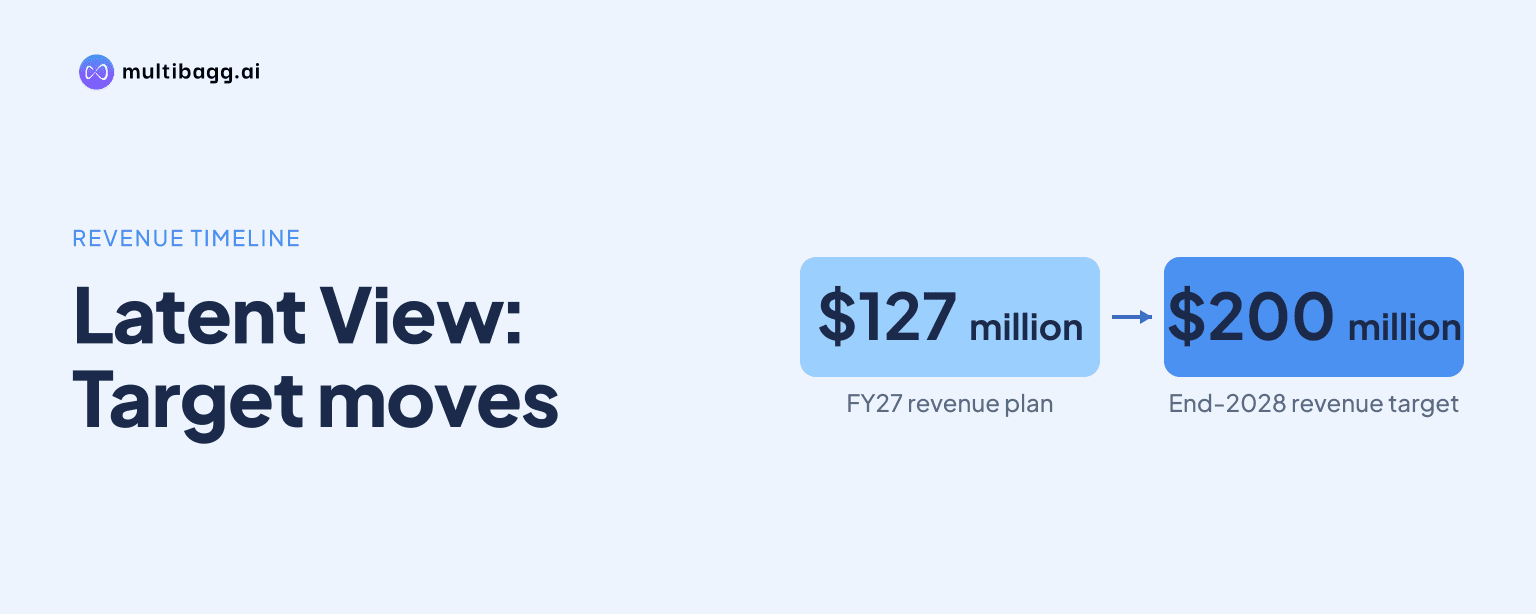
Latent View Analytics Limited has moved its $200 million revenue target to the end of calendar 2028, about nine months after its previous end-FY28 timetable. Management retained the target while citing a plan built around existing-account expansion, new-client sales, partnerships, Europe and acquisitions, alongside $125 million of locked-in visibility toward its $127 million FY27 revenue plan.
Know Latent View Analytics inside out
Results, valuation, peers and who's buying, in one view.
Why did Latent View move its $200 million target?
Latent View moved the deadline because management is reviewing industry-level execution capacity, capital allocation and internal portfolio assignments following Sonal Ramrakhiani’s first 100 days at the company. Rajan Venkatesan said the prior objective was $200 million by the end of FY28, or fiscal year 2028, while the current plan targets the end of calendar 2028.
The change is a timetable revision of about nine months, not a reduction in the revenue objective. Venkatesan said the internal plan is intended to go beyond $200 million, though the commitment communicated to the market remains $200 million by calendar-end 2028. Management plans to explain the strategy in greater detail at an Investor Day after Q3 results, most likely in the first week of February.
The nearer-term revenue plan is $127 million for FY27, which management said it has high confidence in delivering. As of the November 2, 2026 call, about $125 million was signed and locked in, leaving roughly $2 million to be converted from advanced pipeline opportunities in Q3 and Q4.
How will Latent View pursue $200 million by 2028?
Latent View plans to pursue the target through expansion of existing accounts, new-client sales, partnerships and inorganic growth. Ramrakhiani described the first two as farming and hunting, respectively, and said the company is working on each route in parallel. Her planning assumption was that at least two of the three operating levers would need to deliver to meet the target.
The existing-account programme is intended to reduce reliance on individual projects and increase recurring work. Management said sales, delivery, centres of excellence and practice leaders have assessed accounts with growth potential beyond the five largest accounts, examining cross-selling, upselling, large-deal shaping, solution design and stakeholder management.
Latent View wants the account programme to produce larger contracts and earlier positioning ahead of customer renewal cycles. Ramrakhiani said the focus has shifted from developing account strategies to executing them, with some early signs of progress. The company is also reviewing short- and long-term incentives, but said it would not change them during the financial year and instead expects to time the redesign for Q1 of the next financial year.
Which markets and verticals support Latent View’s target?
Latent View’s geographical plan includes a more focused European expansion in consumer, auto and auto components, while healthcare and life sciences are expected to provide at least $20 million of 2028 revenue. Management said its previous European approach covered multiple verticals, whereas the revised effort will concentrate on two sectors where it sees existing customer anchors or market potential.
Industrials are an immediate source of momentum in that strategy. Venkatesan said Latent View had visibility for 60% year-on-year growth in industrials for the full year, supported by auto and auto-component customers. The practice was tracking full-year revenue of $11 million to $11.5 million, and management said it could at least double over the next two to three years.
The company linked the industrials opportunity to supply-chain impact, plant-production efficiency, artificial intelligence and agentic AI work. Europe is part of the medium- to long-term expansion plan, where management intends to invest after traction in the United States, particularly in auto manufacturers and component suppliers.
Healthcare and life sciences are a new growth area in the $200 million plan. Latent View has appointed a senior leader for healthcare and said acquisitions would focus on life-sciences capabilities. Management expects the combined vertical to contribute at least 10% of the 2028 revenue target, equivalent to at least $20 million.
Got a follow-up? Ask IRIS
What role will AI and partnerships play in Latent View’s plan?
Latent View is creating a Chief Technology and AI Officer, or CTAIO, function to support offerings, solutions and client deployment. Management said the India-based structure will include four areas: market-ready offerings, new solutions and accelerators, an AI Studio for future innovation, and AI capability-building across the existing workforce.
The CTAIO programme involves one senior leadership hire, existing talent and centres of excellence, with a possibility of a small number of additional roles one or two levels below the function. It will also include field AI or business AI resources, including forward-deployed engineers who work on customer-specific solutioning, adoption and implementation.
Recent wins show a shift toward production-scale AI work, according to management. Latent View signed an agentic AI engagement worth more than $800,000 with a large apparel manufacturer that will move directly into production. It also signed a $500,000 agentic AI deal with a financial-services customer, compared with proof-of-concept, or POC, work that management said can range from $100,000 to $200,000.
Partnerships are another channel in the revenue plan, although management said the related revenue would be counted in individual verticals. Ramrakhiani said partnerships can accelerate growth alongside account farming, new-logo sales and acquisitions, rather than operate as a separate substitute for those routes.
What operating evidence supports Latent View’s revised timetable?
Latent View cited locked-in FY27 revenue, expected Q3 growth and Databricks-related work as evidence supporting the revised path. Management said the signed business provided sufficient evidence for 3% to 4% sequential revenue growth in Q3 from Q2, with pipeline conversion offering possible upside later in Q3 and Q4.
The Databricks relationship is expected to generate more than $30 million of full-year influenced revenue, compared with a $17 million base cited during the call. Management said this measure includes work delivered on Databricks, migration and purchase-order migration work, and solutions built on the platform.
A Databricks partnership-program opportunity illustrates the potential conversion process. Latent View is conducting a POC worth about $200,000 for a large Latin American cosmetics brand that is considering moving thousands of dashboards from Teradata to Databricks. Management said a successful POC could lead to a transformative programme worth more than $1 million.
Conclusion
Latent View has preserved its $200 million ambition but extended the deadline to calendar-end 2028, giving management about nine additional months to execute its account-mining, new-client, partnership, European and acquisition plans. The $127 million FY27 plan, including $125 million already signed and locked in, is the company’s disclosed near-term base, while industrials, healthcare and life sciences, AI work and Databricks delivery are identified growth contributors.
The next scheduled event is the Investor Day expected after Q3 results, most likely in the first week of February. Management has said it will provide greater detail then, subject to Board sign-off, on account-level and vertical-level plans, the role of Europe and partnerships, the acquisition component and the route to the $200 million target.