










Laxmi Organic H1 EBITDA triples as margin reaches 10.8%
Key highlights
- Laxmi Organic reported H1FY27 revenue of Rs 205.11 crore, up 47.3% year-on-year.
- Laxmi Organic’s H1FY27 EBITDA rose 227.8% to Rs 22.23 crore and EBITDA margin reached 10.8%.
- Laxmi Organic’s Essentials revenue increased 56% to Rs 156.06 crore in H1FY27.
- Laxmi Organic’s Essentials share of EBITDA contribution rose to 74% from 28% in H1FY26.
powered by IRIS
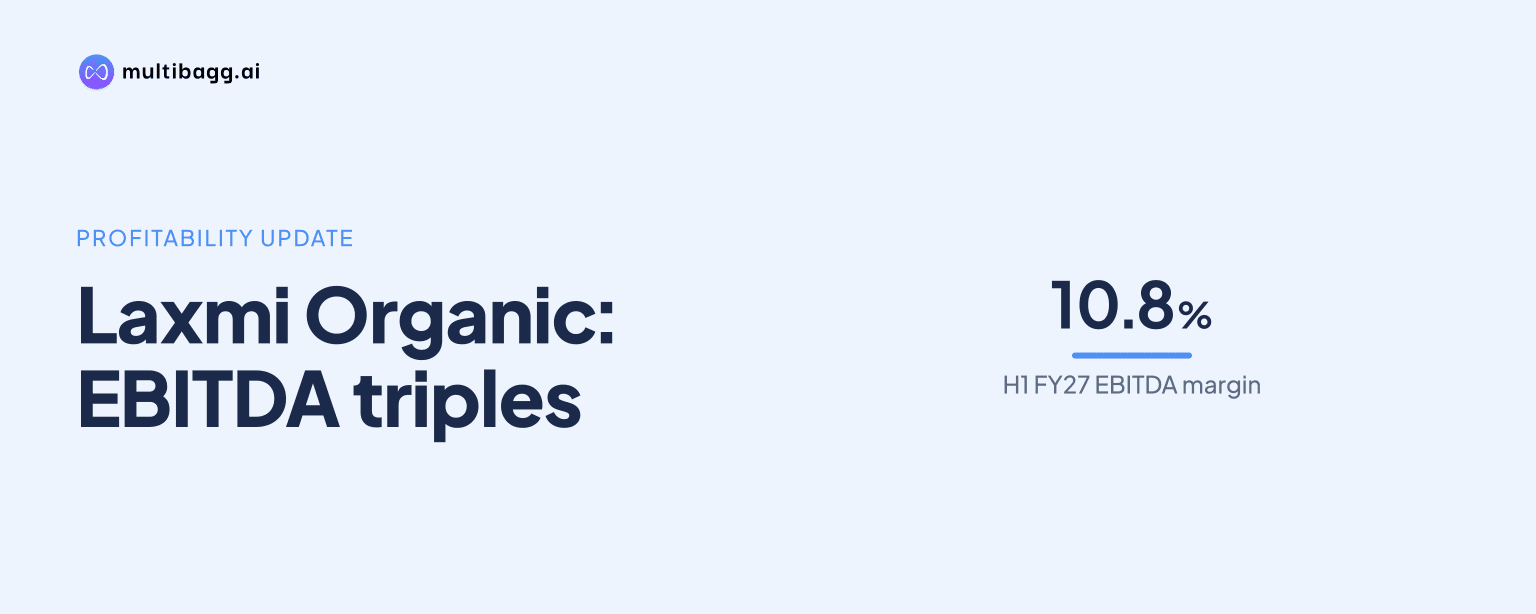
Laxmi Organic Industries Limited reported H1FY27 EBITDA of Rs 22.23 crore, up 227.8% year-on-year from Rs 6.78 crore, as EBITDA margin increased to 10.8% from 4.9%. The company attributed the improvement to higher realisations, cost pass-through and operating leverage, while Essentials supplied 74% of half-year EBITDA contribution.
Know Laxmi Organic Industries inside out
Results, valuation, peers and who's buying, in one view.
How much did Laxmi Organic’s H1FY27 earnings improve?
Laxmi Organic’s H1FY27 EBITDA more than tripled to Rs 22.23 crore from Rs 6.78 crore in H1FY26, while revenue from operations rose 47.3% to Rs 205.11 crore from Rs 139.27 crore. Profit after tax, or PAT, increased 284.9% to Rs 12.47 crore from Rs 3.24 crore. The presentation identifies both H1FY27 revenue and EBITDA as the company’s highest half-yearly figures.
The rise in profit exceeded sales growth because gross profit grew 63.1% to Rs 72.65 crore while total expenses increased 34% to Rs 50.42 crore. Gross margin rose 340 basis points, or bps, to 35.4% from 32.0%. EBITDA margin expanded 600 bps to 10.8%, and PAT margin increased 380 bps to 6.1% from 2.3%.
What drove Laxmi Organic’s H1FY27 margin expansion?
Laxmi Organic said higher realisations, timely cost pass-through and operating leverage aided margin growth despite higher energy and freight costs. Cost of goods sold, or COGS, rose to Rs 132.45 crore in H1FY27 from Rs 94.73 crore in H1FY26, an increase below the 47.3% revenue growth. That difference helped lift gross margin to 35.4%.
Costs below gross profit rose more slowly than gross profit in H1FY27. Employee cost was Rs 9.31 crore versus Rs 8.70 crore a year earlier, power and fuel was Rs 16.04 crore versus Rs 12.16 crore, and other expenses were Rs 25.07 crore versus Rs 16.90 crore. These expenses totalled Rs 50.42 crore, up 34%, compared with the 63.1% gain in gross profit.
The H1FY26 comparison includes a one-time supply-chain redesign project expense of Rs 1.02 crore at the EBITDA level and Rs 76 lakh at the PAT level. Laxmi Organic reported H1FY26 EBITDA of Rs 6.78 crore and PAT of Rs 3.24 crore including that item. Its disclosed year-on-year growth rates of 227.8% for EBITDA and 284.9% for PAT use the reported comparison.
Which business contributed most to Laxmi Organic’s turnaround?
Laxmi Organic’s Essentials business accounted for 74% of H1FY27 EBITDA contribution, compared with 28% in H1FY26, while Specialties’ share declined to 26% from 72%. The 46-percentage-point movement toward Essentials coincided with commissioning of ethyl acetate, or ETAC, capacity at Lote and better price realisations from timely cost-inflation pass-through, according to the presentation.
Essentials revenue increased 56% to Rs 156.06 crore in H1FY27 from Rs 100.24 crore in H1FY26. Specialties revenue rose 26% to Rs 49.04 crore from Rs 39.03 crore. Essentials therefore added Rs 55.82 crore of revenue year-on-year, compared with Rs 10.01 crore added by Specialties.
Specialties delivered positive volumes and strong double-digit revenue and reported margin growth, Laxmi Organic said. However, the company stated that feedstock price increases could not be immediately passed on to contract customers in that business. It also said the Dahej ramp-up is expected to provide operating leverage, making progress at the site relevant to the segment mix.
Got a follow-up? Ask IRIS
Did Laxmi Organic maintain momentum in Q2FY27?
Laxmi Organic reported Q2FY27 revenue of Rs 108.27 crore, up 54.7% from Rs 69.97 crore in Q2FY26 and 11.8% from Rs 96.83 crore in Q1FY27. Q2FY27 EBITDA was Rs 10.80 crore, up 191.3% year-on-year from Rs 3.71 crore. PAT reached Rs 5.70 crore, compared with Rs 1.10 crore a year earlier.
Sequential profitability moderated in Q2FY27. EBITDA declined 5.5% from Rs 11.43 crore in Q1FY27, and EBITDA margin fell 180 bps to 10.0% from 11.8%. Q2 gross margin declined 380 bps sequentially to 33.6% from 37.5%, although it was 50 bps above the 33.1% reported in Q2FY26.
Q2FY27 COGS was Rs 71.88 crore, power and fuel cost was Rs 8.39 crore, and other expenses were Rs 11.87 crore. Laxmi Organic said geopolitical disturbances affected feedstock prices and supply chains, but it managed material availability. The company also reported that ETAC capacity at Lote had stabilised and new Diketene capacity at Dahej had been commissioned.
What should readers watch in Laxmi Organic’s next phase?
Laxmi Organic’s disclosed priorities include stabilisation and ramp-up of Dahej Phase II, commissioning of Project Vaayu and expansion of its green-energy base. Its Dahej update schedules chemical charging in Q2FY27, stabilisation and customer qualification in Q3FY27, and ramp-up in Q4FY27. The site had received consent to operate for first-phase production, with commercial delivery starting in Q3FY26.
The company also flagged continued volatility in the broader operating environment. Exports represented 35% of revenue in H1FY27 and domestic business 65%, compared with 32% and 68%, respectively, in FY26. Revenue from the top 10 customers was 23% in H1FY27, up from 20% in FY26.
Conclusion
Laxmi Organic’s H1FY27 result combined revenue growth of 47.3% with EBITDA growth of 227.8%, taking EBITDA margin to 10.8%. The improvement reflected a 340-bps gain in gross margin, operating expenses growing more slowly than gross profit, and a substantial shift in EBITDA contribution toward Essentials, whose revenue increased 56%.
The next disclosed milestones are Dahej Phase II stabilisation and customer qualification in Q3FY27, followed by planned ramp-up in Q4FY27, as well as Project Vaayu commissioning. Laxmi Organic also identified feedstock, energy, freight and geopolitical volatility as unresolved operating factors to monitor alongside its cost pass-through and capacity-ramp plans.