










Surya Roshni adds spiral capacity as API EBITDA declines
Key highlights
- Surya Roshni commissioned a Rs 50 crore Malanpur spiral-pipe project with about 24,000 tonnes of annual capacity.
- API and spiral-pipe EBITDA declined to Rs 5,600 per tonne in FY 25-26 from Rs 9,300 in FY 24-25.
- API and spiral pipes represented 16% of FY 25-26 volume, compared with 18% in FY 21-22.
- Value-added products accounted for 43% of Surya Roshni’s steel pipes and strips revenue.
powered by IRIS
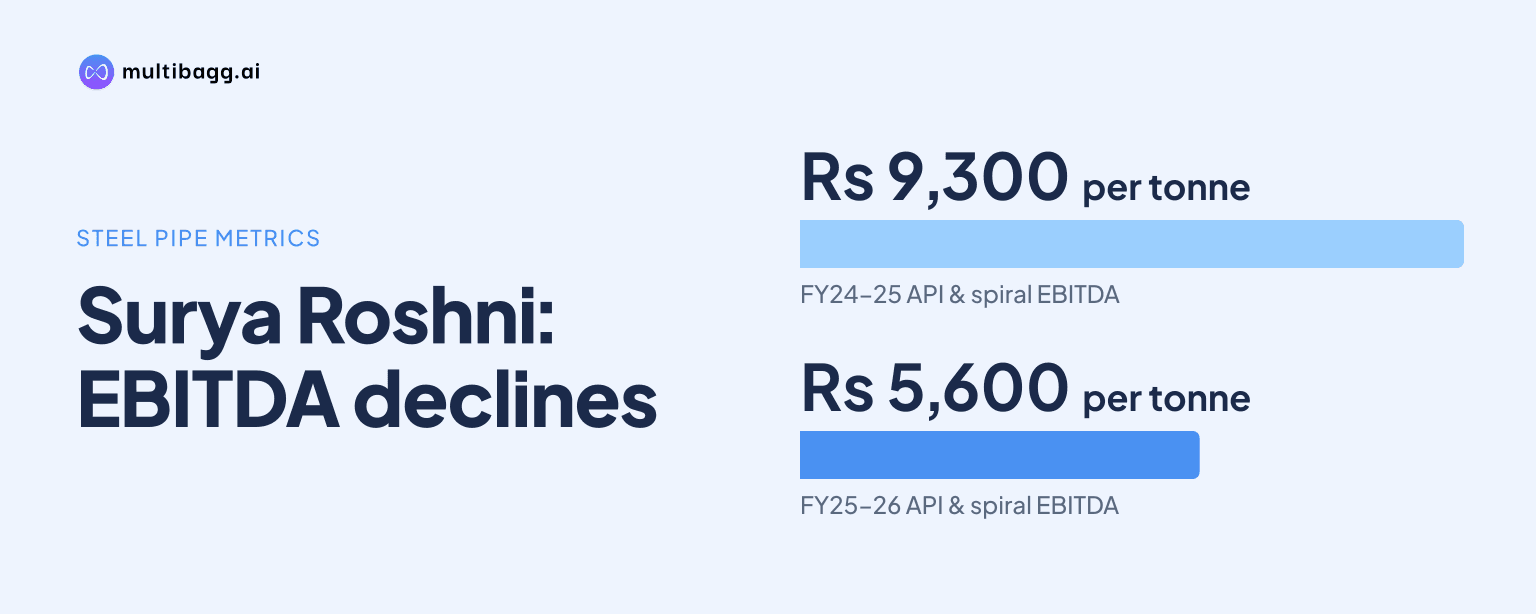
Surya Roshni Limited commissioned a Rs 50 crore Malanpur spiral-pipe project with about 24,000 tonnes of annual capacity for water projects, while its API and spiral-pipe EBITDA per tonne fell to Rs 5,600 in FY 25-26 from Rs 9,300 in FY 24-25.
Know Surya Roshni inside out
Results, valuation, peers and who's buying, in one view.
How is Surya Roshni changing its pipe mix?
Surya Roshni is building its presence in value-added pipe categories, which accounted for 43% of steel pipes and strips revenue, while API and spiral pipes represented 16% of volume in FY 25-26. Its range includes GI pipes, API and 3LPE-coated spiral pipes, black pipes, hollow-section pipes and CR strips. The presentation describes the portfolio strategy as a transition towards products with higher earnings before interest, tax, depreciation and amortisation, or EBITDA, per tonne.
The volume mix shows differing movements across categories from FY 21-22 to FY 25-26. API and spiral pipes declined to 16% from 18%, while section pipes rose to 17% from 13%. GI pipes fell to 27% from 33%, black pipes increased to 28% from 24%, and CR strips remained at 12%. Black pipes were therefore the largest category by FY 25-26 volume, ahead of GI pipes at 27%.
Surya Roshni reports annual steel-pipe and strips capacity of 14.21 lakh metric tonnes, including 10.21 lakh metric tonnes of ERW pipes, 2.60 lakh metric tonnes of spiral pipes and 1.40 lakh metric tonnes of CR sheets. It also lists external 3LPE coating capacity of 27.50 lakh square metres and four manufacturing locations in Haryana, Madhya Pradesh, Gujarat and Andhra Pradesh. API and 3LPE-coated spiral pipes serve oil and gas, water transportation and city gas distribution, while section pipes serve infrastructure applications including airports, metros, railways and warehouses.
What do Surya Roshni’s latest product economics show?
Surya Roshni’s FY 25-26 figures show GI pipes generated the highest listed EBITDA per tonne at Rs 6,133, followed by API and spiral pipes at Rs 5,600. API and spiral-pipe EBITDA per tonne declined by Rs 3,700 from Rs 9,300 in FY 24-25. This reverses the presentation’s broader description of API and spiral pipes as products that enjoy higher EBITDA per tonne than other offerings in the latest reported year.
The change across products was mixed. CR strips were the only listed category to increase, rising by Rs 211 per tonne to Rs 2,522 in FY 25-26. GI pipes declined by Rs 332 per tonne, black pipes by Rs 167 per tonne and section pipes by Rs 337 per tonne. Total EBITDA per tonne fell by Rs 839 to Rs 4,553.
The longer series shows sustained moderation in API and spiral-pipe unit profitability after Rs 12,134 per tonne in FY 22-23. It declined to Rs 10,495 in FY 23-24, Rs 9,300 in FY 24-25 and Rs 5,600 in FY 25-26. Over the same five financial years, the category’s volume share stayed within a relatively narrow 16% to 18% range, rather than expanding with the earlier higher per-tonne EBITDA.
Got a follow-up? Ask IRIS
What does the Malanpur project contribute?
Surya Roshni has commissioned the Malanpur, Madhya Pradesh project to manufacture spiral pipes for water projects. The project has an outlay of Rs 50 crore and capacity of about 24,000 tonnes per annum. The company says the facility will cater to markets in Rajasthan, Madhya Pradesh and Uttar Pradesh.
The 24,000-tonne annual capacity is equivalent to roughly 9% of the 2.60 lakh metric tonnes of spiral-pipe capacity listed for the steel pipes and strips business. The project focus aligns with the presentation’s statement that water transmission provides higher growth opportunities for API and 3LPE-coated pipes. The presentation does not disclose expected utilisation, revenue, return on the Rs 50 crore outlay or EBITDA per tonne from Malanpur.
Where is Surya Roshni targeting API and spiral-pipe demand?
Surya Roshni is targeting oil and gas transmission, city gas distribution and water transmission through its API and 3LPE-coated spiral-pipe offering. The company says it has gained market share to about 10% of oil and gas transmission pipes, covering cross-country land pipes and city gas distribution. It also says it has a strong API-pipe order book, but provides neither its value nor its execution schedule.
The company lists accreditations from project-management consultancies including EIL and Mecon. It says its 3LPE coating machinery was procured from Selmers in the Netherlands, with installed external coating capacity of 27.50 lakh square metres. These capabilities sit alongside the 2.60 lakh metric tonnes of disclosed spiral-pipe capacity and support the company’s oil, gas and water-transmission product range.
Management identifies API and spiral pipes as one of Surya Roshni’s fastest-growing product areas and says the category contributes significantly to profitability. However, FY 25-26 data place API and spiral EBITDA per tonne below GI pipes by Rs 533 per tonne, despite API and spiral pipes holding 16% of volume. The presentation does not give a reason for the change in relative profitability.
Conclusion
Surya Roshni’s strategy combines a broad pipe portfolio, 43% revenue from value-added products and a new Rs 50 crore spiral-pipe facility focused on water projects. The company retains meaningful exposure to black pipes at 28% of FY 25-26 volume and GI pipes at 27%, while API and spiral pipes accounted for 16% and experienced a substantial decline in EBITDA per tonne.
The next disclosures to watch concern execution of the Malanpur plan in Rajasthan, Madhya Pradesh and Uttar Pradesh, along with the company’s stated API-pipe order book. Management has identified water transmission as a higher-growth opportunity, but has not disclosed a utilisation target, order-book value, revenue forecast or return expectation for the 24,000-tonne project.