










Surya Roshni Limited Revenue Rose 33% as EBITDA Margin Fell to 5.8%
Key highlights
- Surya Roshni’s Q2FY27 consolidated revenue rose 33% year on year to ₹2,448 crore.
- Surya Roshni’s Q2FY27 EBITDA margin was 5.8%, down from 7.6% in Q2FY26.
- Steel Pipes & Strips volume reached 2.67 lakh tonnes in Q2FY27, up 23% year on year.
- Surya Roshni reported H1FY27 revenue of ₹4,495 crore and PAT of ₹136 crore.
powered by IRIS
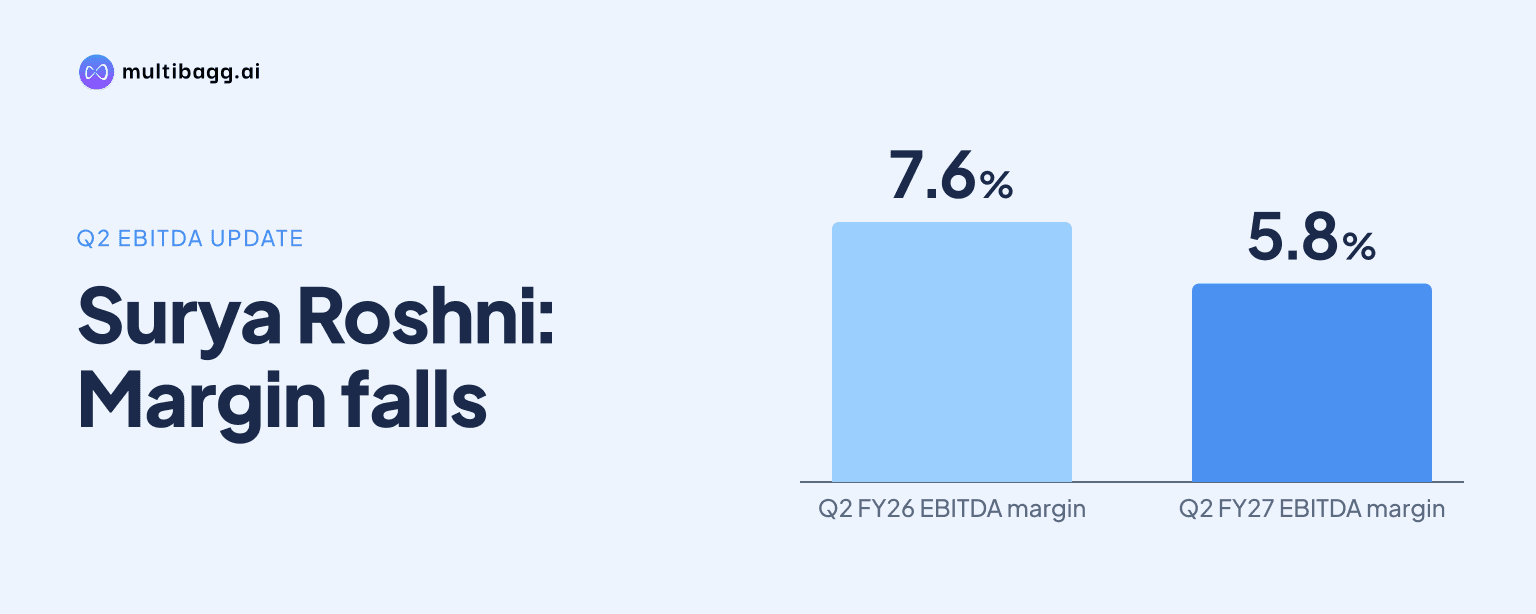
In Q2FY27, Surya Roshni Limited recorded 33% year-on-year consolidated revenue growth to ₹2,448 crore, but earnings before interest, tax, depreciation and amortisation (EBITDA) rose 1% to ₹143 crore and EBITDA margin fell to 5.8% from 7.6%, amid higher input costs, Extended Producer Responsibility (EPR) payments and planned brand investment.
Know Surya Roshni inside out
Results, valuation, peers and who's buying, in one view.
How did Surya Roshni’s Q2FY27 revenue and profit compare?
Surya Roshni’s Q2FY27 revenue increased faster than operating profit and net profit. Revenue rose by ₹603 crore from ₹1,845 crore in Q2FY26 to ₹2,448 crore in Q2FY27, while EBITDA increased by ₹2 crore from ₹141 crore to ₹143 crore. Profit before tax (PBT) rose 4% to ₹103 crore and profit after tax (PAT) increased 3% to ₹77 crore.
The sequential comparison showed higher absolute earnings in Q2FY27 than in Q1FY27. Revenue rose 20% from ₹2,046 crore, EBITDA increased 19% from ₹120 crore and PAT grew 29% from ₹60 crore. EBITDA margin nevertheless stayed at 5.8% in both quarters, meaning the higher sales did not change the sequential operating-margin rate.
For the first half of FY27 (H1FY27), revenue grew 30% year on year to ₹4,495 crore from ₹3,450 crore. EBITDA increased 18% to ₹263 crore from ₹223 crore, while PAT rose 26% to ₹136 crore from ₹108 crore. The 30% revenue increase exceeded the 18% EBITDA increase during the half year.
Why did Surya Roshni’s EBITDA margin decline?
Surya Roshni attributed the year-on-year margin decline to higher input costs, EPR payments and a planned increase in brand investment. EBITDA margin was 5.8% in Q2FY27, down 180 basis points from 7.6% in Q2FY26; one basis point equals one-hundredth of a percentage point. The margin was unchanged from Q1FY27 at 5.8%.
The Q2FY26 comparison also included a Steel Pipes & Strips demand effect that did not recur in Q2FY27. The company said European and Canadian customers had made one-time pre-buys before implementation of the Carbon Border Adjustment Mechanism and quotas, benefiting the prior-year quarter. This made the 7.6% margin base partly affected by exceptional customer purchasing.
Both principal segments posted revenue growth substantially ahead of EBITDA growth in Q2FY27. Lighting & Consumer Durables revenue rose 17% to ₹507 crore while EBITDA rose 1% to ₹40 crore. Steel Pipes & Strips revenue increased 38% to ₹1,941 crore, whereas EBITDA increased 1% to ₹103 crore.
Got a follow-up? Ask IRIS
Which businesses drove Surya Roshni’s sales growth?
Surya Roshni’s Steel Pipes & Strips segment supplied most of the Q2FY27 revenue increase. Its revenue increased by ₹530 crore to ₹1,941 crore from ₹1,411 crore in Q2FY26, compared with a ₹73 crore increase in Lighting & Consumer Durables revenue to ₹507 crore from ₹434 crore. Steel Pipes & Strips represented ₹1,941 crore of the consolidated ₹2,448 crore quarterly revenue.
Steel Pipes & Strips quarterly sales volume reached a record 2.67 lakh tonnes, up 23% year on year and 17% sequentially, exceeding the company’s guidance of 2.60 lakh tonnes. Export volume rose 64% year on year to 64,408 tonnes, contributing about 24% of segment volume, while capacity utilisation rose to 84% from 82% in Q1FY27.
Volume growth did not prevent a lower year-on-year EBITDA per tonne in Steel Pipes & Strips. EBITDA per tonne fell 18% to ₹4,105 from ₹5,013 in Q2FY26, although it improved 2% from ₹4,006 in Q1FY27. Value-added products accounted for about 48% of segment volume in Q2FY27.
Lighting & Consumer Durables reported its highest-ever Q2 revenue of ₹507 crore, despite Diwali falling in Q3 this year. Ceiling fans and water heaters each recorded 26% volume growth, mixer grinders grew 20%, and light-emitting diode bulbs increased 11%. Its EBITDA margin was 7.8%, unchanged sequentially but 120 basis points below 9.0% in Q2FY26.
Did Surya Roshni disclose negative H1FY27 operating cash flow?
Surya Roshni did not disclose an H1FY27 operating cash-flow figure in the supplied presentation. The material reports H1FY27 EBITDA of ₹263 crore, PBT of ₹184 crore and PAT of ₹136 crore, but provides no cash-flow statement or cash generated from operations measure. It therefore does not establish whether first-half operating cash flow was negative.
The supplied presentation also does not quantify receivables, inventory, payables or any other working-capital movement for H1FY27. It identifies input costs, EPR payments and brand investment as margin factors, but does not state the cash effect of those items. Reported profit growth can therefore be assessed from the disclosed figures, while operating-cash-flow conversion cannot.
The presentation does disclose orders for execution in H2FY27, without associated payment or collection terms. Steel Pipes & Strips had an order book of about ₹1,200 crore, including export orders of about ₹850 crore, while Professional Lighting had an order book of more than ₹200 crore. These order books indicate planned activity, not a disclosed cash-flow outcome.
Conclusion
Surya Roshni’s Q2FY27 results show sales growth outpacing operating-profit growth: revenue rose 33% to ₹2,448 crore while EBITDA rose 1% to ₹143 crore and margin declined 180 basis points to 5.8%. Steel Pipes & Strips delivered ₹530 crore of the ₹603 crore year-on-year revenue increase, but its EBITDA per tonne declined 18% to ₹4,105.
The next disclosed execution point is H2FY27, when Surya Roshni plans to execute about ₹1,200 crore of Steel Pipes & Strips orders, including about ₹850 crore of export orders, and more than ₹200 crore of Professional Lighting orders. Management also expects the value-added product share in Steel Pipes & Strips to rise from about 48% as export and domestic oil-and-gas orders are executed, while the supplied material gives no margin or cash-flow target.