










Surya Roshni targets 16.5 lakh tonnes by March 2027
Key highlights
- Surya Roshni targets about 16.5 lakh tonnes of steel-pipe capacity by March 2027.
- Surya Roshni plans about ₹150 crore of capital expenditure in each of FY27 and FY28 through internal accruals.
- Steel Pipes & Strips volume reached a record 2.67 lakh tonnes in Q2FY27, up 23% year on year.
- Surya Roshni targets about 20 lakh tonnes of steel-pipe volume by FY30 on about 22 lakh tonnes of capacity.
powered by IRIS
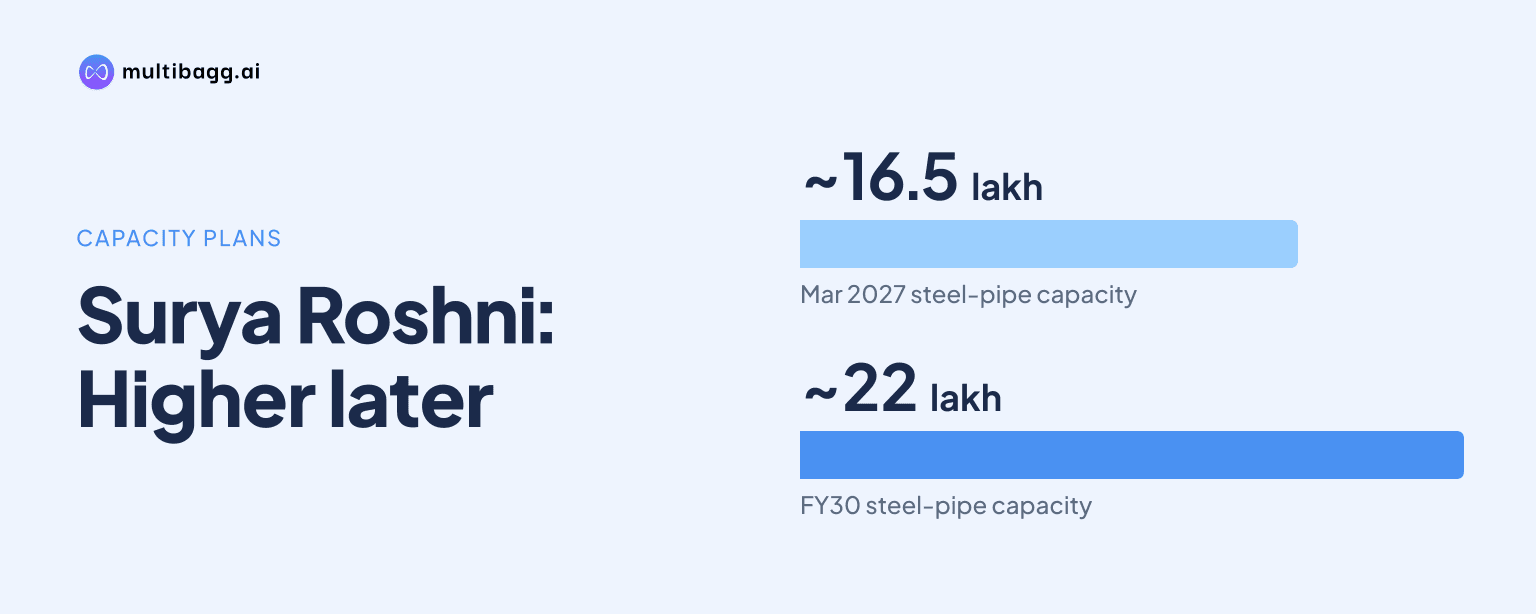
Surya Roshni Limited plans to raise installed Steel Pipes & Strips capacity to about 16.5 lakh tonnes by March 2027, led by three Direct Forming Technology mills and Hindupur’s first 60,000-tonnes-per-annum line. Management has earmarked about ₹150 crore of capital expenditure in each of FY27 and FY28, funded through internal accruals.
Know Surya Roshni inside out
Results, valuation, peers and who's buying, in one view.
How will Surya Roshni reach 16.5 lakh tonnes of capacity?
Surya Roshni plans to reach about 16.5 lakh tonnes of installed capacity by March 2027 through new Direct Forming Technology, or DFT, mills and the first Hindupur mill. Its Anjar, Gujarat DFT mill was commissioned in October 2026 and had shipped about 1,500 tonnes to export customers. The Malanpur, Gwalior mill is scheduled for December 2026 and the Bahadurgarh mill for January 2027, with both expected to add volumes from Q4FY27.
Surya Roshni has widened its DFT range to 80x80 millimetres from 150x150 millimetres earlier, extending to 200x200 millimetres. Management said this expands its addressable hollow-section market, which it expects to be the fastest-growing pipe category over the next two to three years because of infrastructure and construction demand. Hindupur’s first 60,000-tonnes-per-annum mill is due to be operational by March 2027.
How is Surya Roshni funding the steel-pipe expansion?
Surya Roshni plans capital expenditure of about ₹150 crore in FY27 and ₹150 crore in FY28, funded through internal accruals. The company reported zero debt and a cash surplus of ₹75 crore as of September 30, 2026, while its net working-capital cycle was 63 days in the second quarter of financial year 2027, or Q2FY27.
Surya Roshni’s Hindupur programme extends beyond the March 2027 line. Management said two further mills will be added during FY28, contributing about 1.2 lakh tonnes and strengthening its presence in southern India. These additions underpin management’s longer-term target of about 22 lakh tonnes of installed capacity by FY30.
What volume and product-mix targets has Surya Roshni set?
Surya Roshni targets steel-pipe volumes of about 11 lakh tonnes in FY27, 14 lakh tonnes in FY28 and 20 lakh tonnes by FY30. Management also targets earnings before interest, tax, depreciation and amortisation, or EBITDA, per tonne of about ₹4,500 to ₹4,600 in FY28; these are management targets rather than reported results.
Value-added products accounted for about 48% of Steel Pipes & Strips volume in Q2FY27, compared with about 47% in Q1FY27. Surya Roshni aims to take that share above 50% within two years. It began producing 13⅜-inch American Petroleum Institute, or API, casing pipes during the quarter and launched 0.6-millimetre and 0.8-millimetre cold-rolled full-hard pipes from its Bahadurgarh cold-rolling mill.
The FY27 volume plan requires an increase from about 5 lakh tonnes in the first half of FY27 to about 6 lakh tonnes in the second half. Management expects API export and domestic oil-and-gas orders to support this increase, and said it had added hot-rolled coil suppliers and increased purchases from existing suppliers to secure raw-material availability.
Got a follow-up? Ask IRIS
What does Surya Roshni’s recent pipe performance show?
Surya Roshni reported record Steel Pipes & Strips volume of 2.67 lakh tonnes in Q2FY27, up 23% from Q2FY26 and 17% from Q1FY27, exceeding its guidance of 2.60 lakh tonnes. Revenue rose 38% from a year earlier to ₹1,941 crore, while capacity utilisation increased to about 84% from 82% in Q1FY27. First-half FY27 volume rose 22% to 4.96 lakh tonnes and revenue grew 35% to ₹3,531 crore.
EBITDA per tonne improved sequentially to ₹4,105 in Q2FY27 from ₹4,006 in Q1FY27, but was below ₹5,013 in Q2FY26. Management attributed the prior-year quarter’s higher figure to one-time European and Canadian pre-buying ahead of carbon-border and quota measures. Segment EBITDA was ₹103 crore, up 1% year on year, while profit before tax was ₹75 crore, up 7%.
Export volume rose 64% year on year to about 64,408 tonnes, representing about 24% of Q2FY27 segment volume compared with about 18% in Q1FY27. The segment order book was about ₹1,200 crore, including roughly 1 lakh tonnes of export orders worth about ₹850 crore for execution in the second half. About 80,000 tonnes of export orders, worth about ₹700 crore, were API pipes, while domestic API orders had reached about 20,000 tonnes.
What cost measures support Surya Roshni’s expansion plan?
Surya Roshni said manpower, fuel and energy measures had saved about ₹500 per tonne in absolute terms, and management is targeting a ₹1,100-per-tonne reduction on a full-year basis through operating leverage. Another 1 megawatt of rooftop solar at Bahadurgarh by mid-January 2027 is expected to take steel-business solar capacity to about 4 megawatts and save about ₹2.5 crore annually.
Management also plans 1 megawatt of rooftop solar at Hindupur. During Q2FY27, Surya Roshni prioritised scarce hot-rolled coil for higher-margin products over fixed-price spiral orders; spiral volumes were 26,004 tonnes. Cold-rolled pipe supply was constrained by a coil shortage, which the new Bahadurgarh mill is intended to address.
Exports are part of the planned product mix, with management targeting 22% to 25% of FY27 volume, or about 2.5 lakh tonnes, including about 1.2 lakh tonnes for the United States. Management said all legacy export orders had been executed, current orders reflected prevailing freight rates, and about 70,000 tonnes of fully hedged imported raw material would benefit Q3FY27 and Q4FY27.
Conclusion
The March 2027 capacity target combines three DFT mills with Hindupur’s first line, while the FY28 Hindupur additions support management’s FY30 plan for about 20 lakh tonnes of volume on roughly 22 lakh tonnes of capacity. Record Q2FY27 volume of 2.67 lakh tonnes and 84% utilisation provide the reported operating base for that expansion, although EBITDA per tonne remained below the unusually elevated Q2FY26 comparison.
The next disclosed milestones are Malanpur’s DFT commissioning in December 2026, Bahadurgarh’s commissioning in January 2027 and Hindupur’s first mill by March 2027. Management’s second-half FY27 target of about 6 lakh tonnes, the planned rise in value-added products above 50% of volume within two years and the ₹1,100-per-tonne cost-reduction target are the further disclosed measures to track.