










Surya Roshni Reports Record Q2 FY27 Steel Volume at 2.67 Lakh Tonnes
Key highlights
- Surya Roshni's Q2 FY27 steel pipes and strips sales volume rose 23% year on year to a record 2.67 lakh tonnes.
- Surya Roshni's H1 FY27 steel pipes and strips volume increased 22% year on year to 4.95 lakh tonnes from 4.07 lakh tonnes.
- Surya Roshni reported Q1 FY27 consolidated sales of ₹2,046 crore, up 27.5% year on year.
- Surya Roshni will report Q2 FY27 financial results on November 7, 2026, with an earnings call at 3:30 PM IST.
powered by IRIS
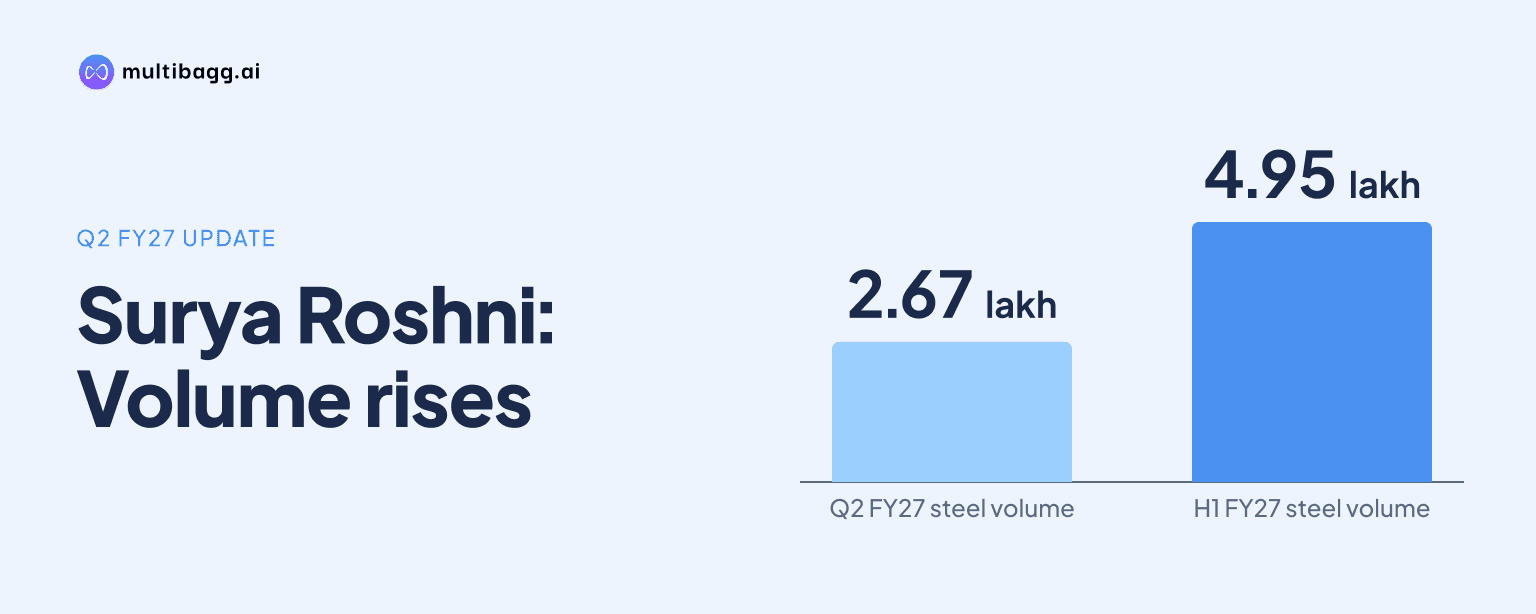
Surya Roshni Limited reported record steel pipes and strips sales volume of 2.67 lakh tonnes in Q2 FY27, up 23% year on year, ahead of its scheduled financial-results announcement on November 7, 2026. The operational update indicates higher throughput in its core steel business, although revenue, margin and profit figures for the quarter had not been filed at the time of the update.
Know Surya Roshni inside out
Results, valuation, peers and who's buying, in one view.
What did Surya Roshni report for Q2 FY27?
Surya Roshni reported that steel pipes and strips sales volume reached approximately 2.67 lakh tonnes during the July-September 2026 quarter. The company described this as its highest-ever quarterly sales volume in the segment. The volume was 23% above the level recorded in the corresponding quarter of the previous financial year.
For the first half of FY27, steel pipes and strips volume rose 22% year on year to around 4.95 lakh tonnes. The comparable H1 FY26 volume was 4.07 lakh tonnes. The company also said its Lighting and Consumer Durables segment delivered its highest-ever Q2 volume performance.
The update was released on October 1, 2026. It covered operating volumes rather than a complete quarterly financial statement. Therefore, the disclosure does not establish the quarter's revenue, operating profitability or net profit, which can be influenced by steel prices, product mix, raw-material costs and other expenses.
When will Surya Roshni release its Q2 FY27 financial results?
Surya Roshni is scheduled to report Q2 FY27 results on November 7, 2026, at 9:08 AM IST. The company has also scheduled a Q2 FY27 earnings call for 3:30 PM IST on the same day, according to its investor-meet intimation filed on October 29.
The pending results are important because the business update only confirms physical sales volumes. Investors will look for reported consolidated revenue, expenses, operating margin and profit, as well as any segment-level disclosures on the steel and lighting businesses.
The company had not filed Q2 FY27 figures when the business update was published. As a result, volume growth should not be treated as a direct measure of financial growth. Realisations and the movement in input costs can materially affect revenue and earnings even when volumes increase.
How did Surya Roshni perform in the previous quarter?
Surya Roshni last reported consolidated sales of ₹2,046 crore for the quarter ended June 2026, representing growth of 27.5% from ₹1,605 crore a year earlier. Net profit was ₹60 crore, up 76.5% year on year. The company separately reported revenue of ₹2,046.48 crore and net profit of ₹59.60 crore in its Q1 FY27 financial update.
Operating profit for the June 2026 quarter was ₹112 crore, compared with ₹70 crore in the June 2025 quarter. However, operating margin was 5%, versus 4.3% in the year-earlier period. The figures show that profit growth in Q1 FY27 exceeded sales growth, while the reported margin remained below the 7% achieved in the March 2026 quarter.
Got a follow-up? Ask IRIS
Why does the volume update matter for investors?
The record Q2 steel volume matters because steel pipes and strips are a core activity for Surya Roshni, which manufactures and sells steel pipes, steel strips, lighting products and consumer durables in India. A 23% increase in quarterly volume and a 22% rise for the first half point to higher sales activity in that business.
The update also provides an early operational signal before the formal results. But the market will need the November 7 release to assess whether the stronger volumes translated into higher revenue and earnings. Financial performance will depend on selling prices, input costs, product mix, demand conditions and operating expenses, none of which were quantified in the volume update.
The lighting segment's highest-ever Q2 volume performance adds a second operating indicator. The company linked the performance to activity ahead of the festive season. It did not provide a segment revenue figure, earnings contribution or year-on-year percentage change for lighting in the Q2 FY27 business update.
What is the recent financial and dividend context?
In Q2 FY26, Surya Roshni had reported consolidated revenue of ₹1,845 crore, up 21% year on year, and profit after tax of ₹74 crore, up 117%. EBITDA was ₹141 crore, a 69% increase, according to the supplied results summary. The steel pipe segment recorded 24% revenue growth in that period, while lighting revenue grew 10%.
The company declared an interim dividend of ₹2.50 per share with its Q2 FY26 results and revised its full-year steel-volume guidance to 10 lakh tonnes. That prior-year dividend is relevant context, but the Q2 FY27 business update did not announce a dividend, revised guidance or a financial target.
Industry comparison data in the supplied material estimates Surya Roshni's revenue growth at an average of 10% a year over the next two years, compared with an 11% forecast for India's Metals and Mining industry. These are forecasts rather than reported results and should be viewed separately from the company's disclosed Q2 FY27 volume figures.
Conclusion
Surya Roshni's Q2 FY27 business update confirms record quarterly steel pipes and strips volume of 2.67 lakh tonnes, alongside 4.95 lakh tonnes of H1 volume and a record Q2 performance in lighting. The update provides evidence of stronger operating activity, while leaving revenue, margins and profit for the quarter unreported.
The next item to watch is the November 7, 2026 results release and the scheduled 3:30 PM IST earnings call. Those disclosures can clarify whether the higher volumes were supported by realisations and costs, and whether the company provides updated volume guidance, segment commentary or a capital-return decision.