










Laxmi Organic Q2 EBITDA Rises 191% on Pricing and Volumes
Key highlights
- Laxmi Organic reported Q2 FY27 revenue of Rs 1,082.7 crore, up 55% year on year.
- Laxmi Organic's Q2 FY27 EBITDA rose 191% year on year to Rs 108 crore.
- Essentials revenue increased 61% to Rs 834.1 crore, while Specialties revenue rose 36% to Rs 248.6 crore.
- Laxmi Organic reported term debt of about Rs 610 crore and net debt to equity of 0.28 times at September 30, 2026.
powered by IRIS
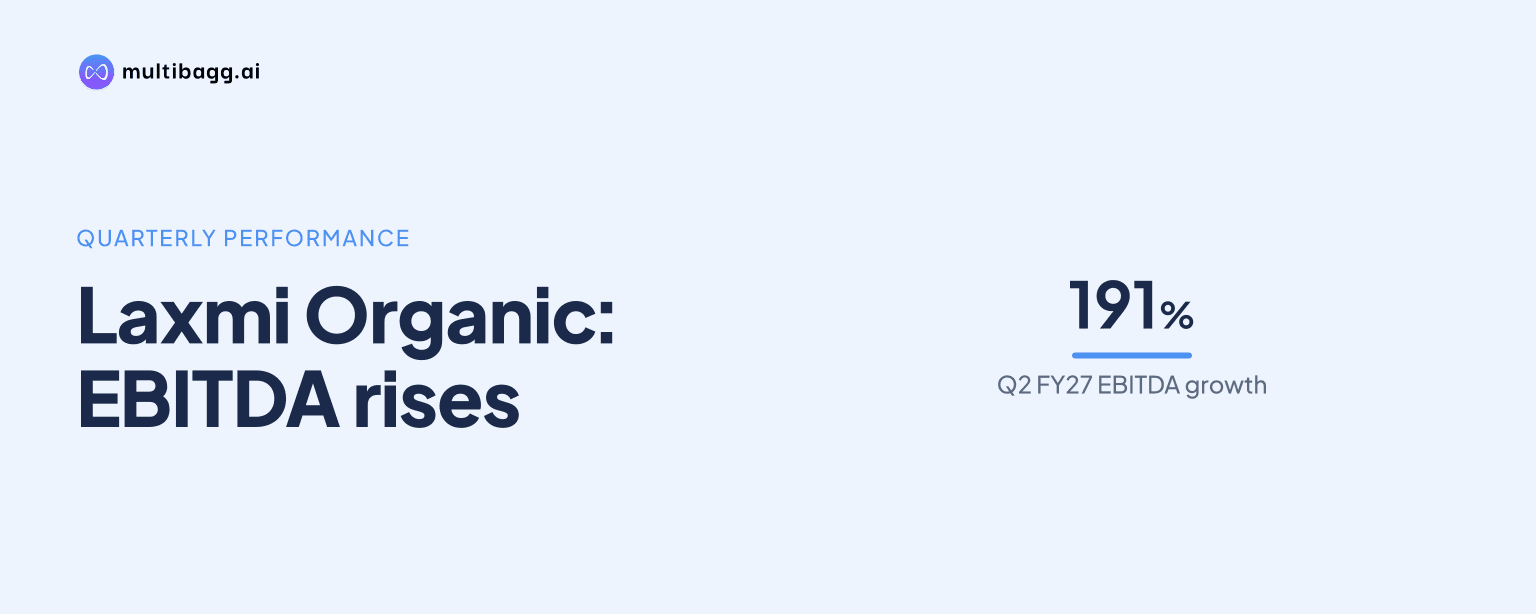
Laxmi Organic Industries Limited reported EBITDA of Rs 108 crore in Q2 FY27, up 191% year on year, as revenue rose 55% to Rs 1,082.7 crore through double-digit volume growth, price pass-throughs and procurement efficiencies. Management said these actions helped offset raw-material, energy, freight and vessel-availability disruption in the quarter ended September 30, 2026.
Know Laxmi Organic Industries inside out
Results, valuation, peers and who's buying, in one view.
How did Laxmi Organic's Q2 FY27 earnings change?
Laxmi Organic's Q2 FY27 earnings increased sharply, with earnings before interest, tax, depreciation and amortisation (EBITDA) reaching Rs 108 crore, 191% above the prior-year quarter. Revenue rose 55% year on year to Rs 1,082.7 crore, which management attributed to higher price realisations, double-digit volume growth and timely pass-through of raw-material, energy and freight-cost increases.
Management said Laxmi Organic recorded its highest revenue volume and EBITDA for an H1, or first half, although it did not disclose H1 amounts during the call. The Q2 outcome followed a movement in raw-material prices that started with a decline and then rebounded above Q1 levels amid Middle East tensions, typhoons in Southeast Asia and a force majeure event in Europe.
Which Laxmi Organic business drove Q2 revenue growth?
Laxmi Organic's Essentials business drove the larger share of Q2 revenue, reporting Rs 834.1 crore, up 61% year on year, compared with Rs 248.6 crore in Specialties, up 36%. Management attributed Essentials growth to double-digit volume gains and agile pricing actions that passed inflation in input costs to customers.
Management later said Essentials volume growth was almost 18% to 20% year on year in Q2. It also described demand as mixed: industrial customers showed growth around Diwali, while pharmaceutical and agro markets remained uneven. Essentials therefore expanded faster in reported revenue, while Specialties contended with new-asset costs and slower contract-price adjustments.
Specialties delivered double-digit revenue and EBITDA growth, but management said Dahej startup fixed costs and some contracts unable to immediately absorb higher raw-material and shipping costs affected profitability. Specialties contracts generally run for six months to one year, and management said price effects can pass through when those contracts renew. An agrochemical intermediate that had been phased out was absent from both Q2 FY27 and the comparable quarter, according to management.
How did Laxmi Organic respond to supply-chain volatility?
Laxmi Organic said pricing, procurement efficiencies and supply-chain agility supported Q2 operating profitability despite raw-material shortages, increased freight and energy costs. To secure timely availability of key raw materials and maintain business continuity, management said net working capital remained elevated and is expected to normalise over time.
The disruption affected inbound materials and outbound shipments, particularly routes west of India. Management said ships were not always berthing as scheduled or had limited available capacity, while vessel availability and shipping delays added to uncertainty. It said the company must continue to operate agilely because it does not expect the disrupted shipping environment to change soon.
Laxmi Organic also cited its end-to-end supply-chain digitisation programme, introduced in the prior financial year, as an operational focus area. The pricing mechanism differs by business: Essentials used agile price actions in Q2, while Specialties can face a lag until contracts of up to one year are renewed. This timing difference coincided with 61% Essentials revenue growth and 36% Specialties revenue growth.
Got a follow-up? Ask IRIS
What is Laxmi Organic's capacity and margin plan?
Laxmi Organic partially commissioned Dahej Project Phase II at the start of Q2 FY27, and management expects the remaining facilities to commission in the coming quarter. Its stated priorities are to stabilise the plant, complete customer qualifications and ramp volumes, with stabilisation expected in Q3 and volume ramp-up expected from Q4 after qualifications.
Management said the core Dahej blocks have started and most products are already made for existing customers, but the new plant requires customer qualification. It expects FY28 to be the first full revenue year from Dahej and uses a three-year path to full scale in its business plan, while aiming to improve on that timeline. Management said higher Dahej volumes should help absorb fixed costs currently affecting Specialties profitability.
Management's stated ambition is for Specialties EBITDA margins to return to the mid- to high-teens, rather than the roughly 12% H1 FY27 level cited by an analyst. Laxmi Organic also commissioned ethyl acetate assets at Lote during Q2. Project Vaayu, linked to its partnership with Hitachi, remained on track for Q3 commissioning, with volume ramp-up expected in subsequent quarters.
Laxmi Organic reported term debt of about Rs 610 crore at September 30, 2026, as its capital-expenditure cycle neared completion. Net debt to equity stood at 0.28 times, while return on capital employed on a trailing 12-month basis improved to 10.3% in September 2026 from 4.9% a year earlier. Management also said its fluorination platform had qualified with multiple customers across multiple countries and applications, without providing a utilisation percentage.
Conclusion
Laxmi Organic's Q2 FY27 result combined 55% revenue growth to Rs 1,082.7 crore with a 191% increase in EBITDA to Rs 108 crore. Essentials benefited from volume growth and agile pricing, while Specialties grew more slowly and absorbed Dahej fixed costs plus the temporary effect of contract-price lags amid input and shipping volatility.
The next milestones are the remaining Dahej Phase II commissioning in the coming quarter, Project Vaayu's planned Q3 commissioning and Dahej volume ramp-up from Q4 following customer qualification. Management's expectation of FY28 as Dahej's first full revenue year, its three-year full-scale planning baseline and its mid- to high-teens Specialties margin ambition are the disclosed measures to track.