










LCC Projects reports Rs 116 crore H1 operating cash outflow
Key highlights
- LCC Projects used Rs 116 crore in net operating cash during H1FY27 despite reporting Rs 142.7 crore in profit after tax.
- Working-capital changes consumed Rs 340.2 crore in H1FY27, exceeding Rs 263 crore of operating profit before working-capital changes.
- LCC’s order book stood at Rs 8,154 crore at September 30, 2026, up from Rs 7,953.2 crore at March 31.
- Financing activities generated Rs 218 crore in H1FY27, lifting cash and cash equivalents by Rs 66.3 crore to Rs 238.4 crore.
powered by IRIS
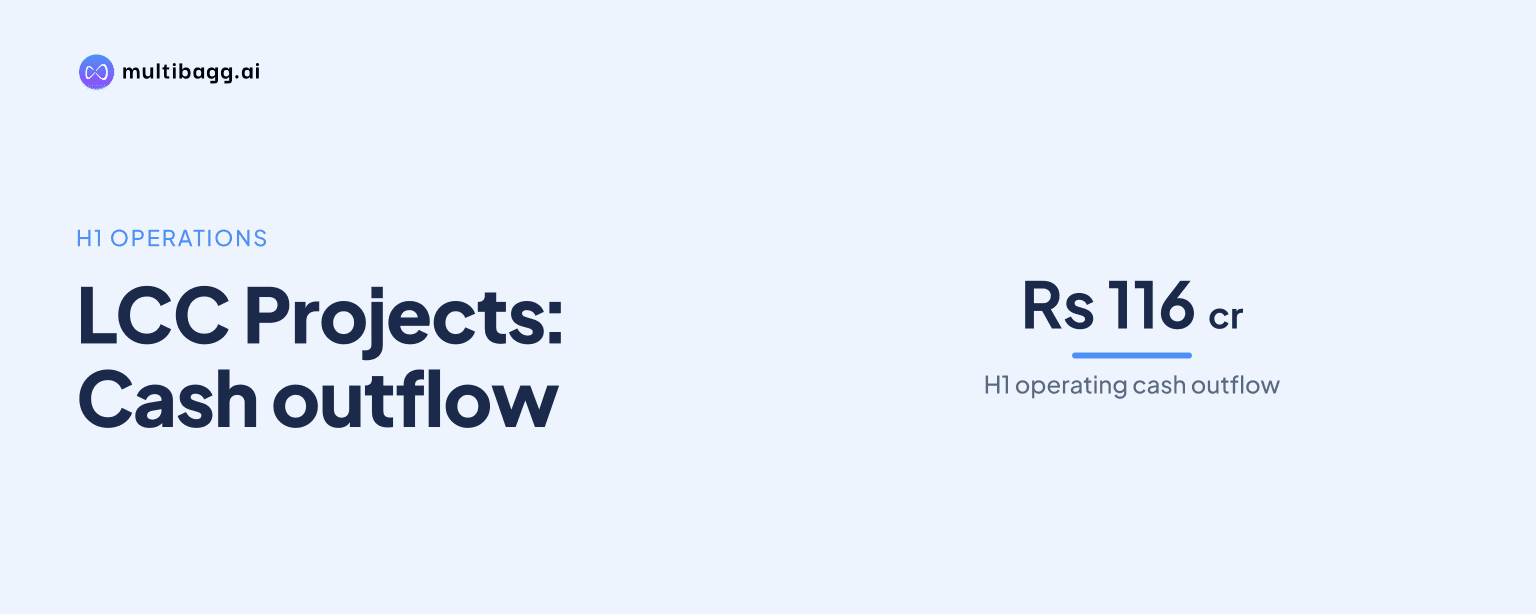
LCC Projects reported net cash used in operating activities of Rs 116 crore in H1FY27, even as profit after tax rose 13% year on year to Rs 142.7 crore. The cash deficit followed a Rs 340.2 crore working-capital outflow and Rs 38.8 crore of net direct taxes paid, while financing activities added Rs 218 crore.
Know LCC Projects inside out
Results, valuation, peers and who's buying, in one view.
Why did LCC’s operating cash flow turn negative in H1FY27?
LCC’s operating cash flow turned negative because changes in working capital consumed Rs 340.2 crore, exceeding its Rs 263 crore operating profit before working-capital changes. This resulted in cash generated from operations of negative Rs 77.2 crore in H1FY27, before net direct taxes paid of Rs 38.8 crore took net cash used in operating activities to Rs 116 crore.
The H1FY27 outcome contrasts with the two full financial years shown in the presentation. LCC reported Rs 158.4 crore of net cash from operating activities in FY26 and Rs 23.6 crore in FY25, although those 12-month figures are not directly comparable with a six-month period. The working-capital outflow was also Rs 103.2 crore larger than FY26’s Rs 237 crore outflow.
Which balance-sheet changes coincided with the working-capital outflow?
The working-capital outflow coincided with a Rs 217.9 crore increase in trade receivables, which rose to Rs 673.7 crore at September 30, 2026, from Rs 455.8 crore at March 31, 2026. Other current assets increased by Rs 256.2 crore to Rs 892 crore, while other current financial assets rose by Rs 77.8 crore to Rs 371.8 crore.
Some balance-sheet movements went in the opposite direction. Inventories fell by Rs 159 crore to Rs 88.9 crore, while trade payables increased by Rs 127.7 crore to Rs 388.2 crore between March and September 2026. The cash-flow statement does not provide a line-by-line reconciliation of the Rs 340.2 crore working-capital movement, so it does not identify how much each receivables, inventory, payable or other-current-account change contributed.
LCC’s total current assets rose by Rs 467.5 crore over the six months to Rs 2,561.6 crore, compared with a Rs 98.5 crore rise in current liabilities to Rs 1,533.3 crore. Cash and cash equivalents accounted for Rs 238.4 crore of current assets at September 30, up Rs 66.2 crore from March 31, so the balance-sheet changes should not be treated as a substitute for the cash-flow working-capital calculation.
How did LCC’s cash generation compare with reported earnings?
LCC reported higher earnings in H1FY27 despite the negative operating cash flow. Revenue from operations increased 5% year on year to Rs 1,688.3 crore, profit before tax rose 15% to Rs 194.2 crore, and profit after tax increased 13% to Rs 142.7 crore from Rs 126.4 crore in H1FY26.
Profitability margins also increased in the consolidated financial highlights. Earnings before interest, tax, depreciation and amortisation, or EBITDA, margin rose to 15.2% in H1FY27 from 13.8% in H1FY26; earnings before interest and tax margin increased to 14.5% from 12.9%; and profit-after-tax margin reached 8.4% from 7.8%.
The presentation contains two H1FY27 EBITDA figures. Its performance-update page reports EBITDA of Rs 255.4 crore, while the consolidated financial-highlights table reports Rs 256.4 crore; both show a 15.2% margin, compared with Rs 221.5 crore and 13.8% in H1FY26. The cash-flow statement reports Rs 263 crore of operating profit before working-capital changes, a separate cash-flow measure that includes Rs 68.8 crore of adjustments to Rs 194.2 crore profit before tax.
Got a follow-up? Ask IRIS
How was LCC’s H1FY27 cash deficit offset?
LCC offset the operating and investing cash uses through Rs 218 crore of net cash generated from financing activities in H1FY27. Operating activities used Rs 116 crore and investing activities used Rs 35.7 crore, producing aggregate outflows of Rs 151.7 crore before financing.
The result was a Rs 66.3 crore net increase in cash and cash equivalents during H1FY27, from an opening balance of Rs 172.2 crore to a closing balance of Rs 238.4 crore. That H1 cash increase was close to the Rs 69.3 crore increase reported for FY26, when financing activities supplied Rs 17.7 crore and operating activities generated Rs 158.4 crore.
Current borrowings rose by Rs 38.7 crore from March 31, 2026, to Rs 833.1 crore at September 30, while non-current borrowings declined by Rs 14.8 crore to Rs 51.5 crore. The presentation does not break down the Rs 218 crore financing inflow by borrowing, equity or other financing source, even though total equity increased to Rs 1,276.2 crore from Rs 893.2 crore over the same six months.
What does LCC say about its working-capital management?
LCC says working-capital days improved to 40 days at September 30, 2026, from 45 days at March 31, 2026, attributing the change to enhanced working-capital management and operational efficiency. That company-reported operating metric declined even as the cash-flow statement recorded a Rs 340.2 crore working-capital outflow during H1FY27.
The distinction matters because the presentation supplies no definition or calculation for working-capital days, while its cash-flow statement is prepared from period movements and adjustments. Receivables were Rs 673.7 crore at September 30 and inventories were Rs 88.9 crore, compared with Rs 455.8 crore and Rs 247.9 crore, respectively, at March 31.
LCC also reported more than 35% of its non-fund-based limits remained unutilised and said this headroom supports bidding for larger projects. Its order book was Rs 8,154 crore at September 30, 2026, up from Rs 7,953.2 crore at March 31, while H1FY27 order booking was Rs 1,641.3 crore and projects worth Rs 1,582.8 crore were in L1 position.
Conclusion
LCC’s H1FY27 figures show a difference between accounting profit and cash conversion. Profit after tax rose to Rs 142.7 crore and operating margins increased, but the Rs 340.2 crore working-capital outflow and Rs 38.8 crore of taxes paid produced Rs 116 crore of net operating cash use. Financing inflows of Rs 218 crore nevertheless lifted closing cash by Rs 66.3 crore.
The next issue to watch is whether LCC can maintain the 40 working-capital days it reported at September 30 while executing its Rs 8,154 crore order book. Management’s stated plan to use more than 35% unutilised non-fund-based limits for larger bids, alongside its Rs 1,582.8 crore L1 pipeline, makes cash conversion and the source of future financing inflows relevant measures in subsequent disclosures.