










LCC Projects expects 123-day cycle to return to normal
Key highlights
- LCC Projects reported a 123-day working-capital cycle at September 2026, versus its historical 90-100-day range.
- Management said most of approximately Rs 675 crore of September receivables were realised in October.
- Nearly Rs 290 crore of cash and bank balances was earmarked as margin for bank guarantees and fixed deposits.
- Management targets Rs 4,300 crore to Rs 4,400 crore of financial year 2027 revenue and about Rs 60 crore of capital expenditure.
powered by IRIS
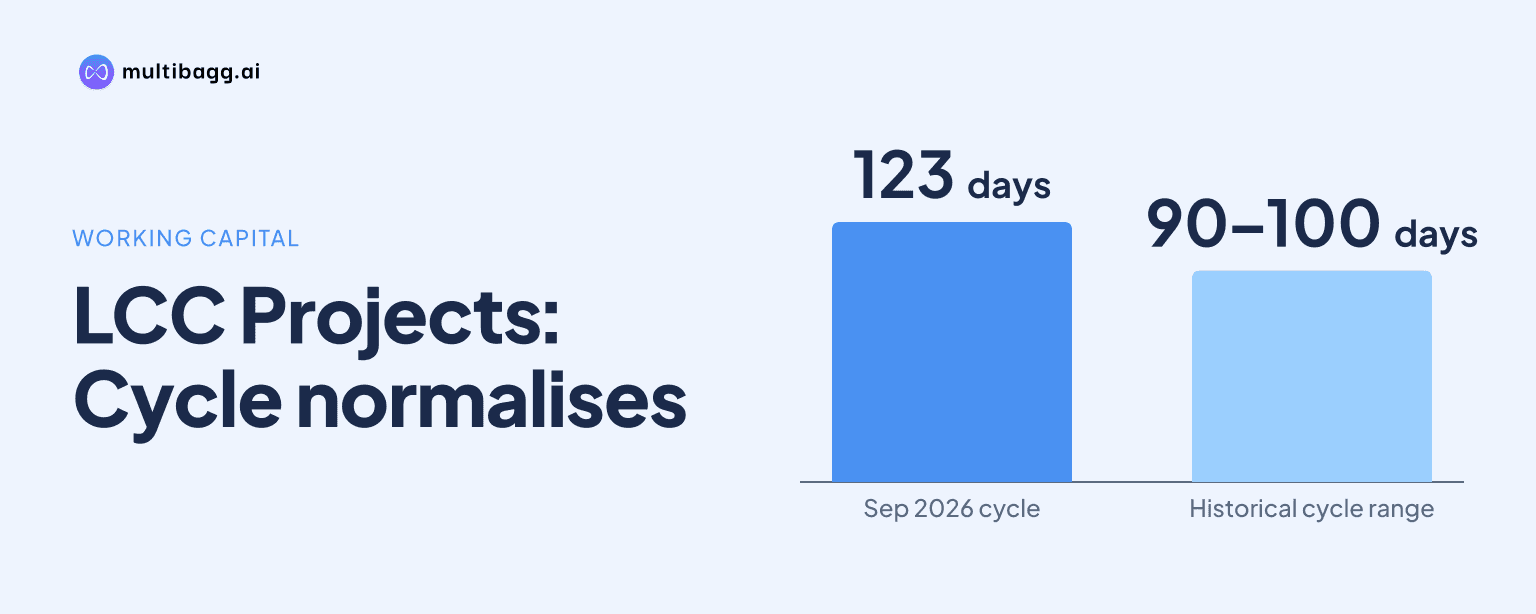
LCC Projects Limited said its working-capital cycle rose to 123 days at September 2026 from its historical 90-100-day range, chiefly because trade receivables of about Rs 675 crore and unbilled revenue were elevated at month-end. Management said most of those receivables were realised in October and expects the cycle to return to 90-100 days by the financial year-end.
Know LCC Projects inside out
Results, valuation, peers and who's buying, in one view.
Why did LCC Projects’ working-capital cycle reach 123 days?
LCC Projects said the 123-day working-capital cycle at September 2026 resulted from higher trade receivables and unbilled revenue at a particular reporting date, rather than a change in its usual collection process. Chief Financial Officer Artiba Narpatsinh Jadeja said the company generally executes work for 28-30 days, raises a bill at month-end, obtains certification from the customer or department, and then recognises the amount as a receivable.
Management said payment is generally received 30-45 days after certification. Consequently, bills certified towards the end of September can remain in receivables at the reporting date while still being within the stated collection process. LCC Projects described the roughly Rs 675 crore receivables amount as exceptionally high, and separately referred to trade receivables of around Rs 670 crore when discussing the September working-capital position.
The September cycle was 23 days above the top of LCC Projects’ historical range and 33 days above its lower end. The company did not disclose a March 2026 receivables balance or an earlier working-capital figure on the call, so the precise change across reporting periods cannot be calculated from the information provided.
How much of LCC Projects’ September receivables were collected in October?
LCC Projects said most of the Rs 675 crore receivables discussed for September 2026 were realised in October. In a later response, management said a “very good amount” of the approximately Rs 670 crore trade-receivables balance had already been collected, but it did not disclose an exact October collection value, the remaining balance, or a completion date for collections.
Management’s case for normalisation therefore depends on billing timing and the usual 30-45-day collection period after certification. The company said it was in a comfortable position within one month and was very sure that working capital would return to 90-100 days by the end of the financial year, which is management’s expectation rather than a reported subsequent cash-flow result.
LCC Projects differentiated the aggregate September balance from its Jal Jeevan Mission payment experience. Management said it had received Jal Jeevan Mission payments in 45-55 days over the past three years. It also said Jal Jeevan Mission represented about 20% of its water-sector irrigation exposure, while water-sector irrigation accounted for about 80% of the relevant order mix cited on the call.
What is LCC Projects’ normal working-capital level?
LCC Projects said its normal working-capital cycle is 90-100 days, a range management said had prevailed for the previous three to four years. The September 2026 figure of 123 days was attributed to the combined effect of trade receivables and unbilled revenue, with certified month-end bills awaiting payment in the next month.
The company did not provide interim milestones for reducing the cycle from 123 days. Its stated mechanism is the conversion of September billing into cash, particularly after the October collections it described. The difference between September’s 123 days and the stated upper end of the normal range is 23 days.
Working-capital execution also overlaps with a seasonally larger second half. Management said the first half has accounted for around 40% of annual revenue and the second half for around 60% over the last three to four years. For financial year 2027, LCC Projects is targeting revenue of Rs 4,300 crore to Rs 4,400 crore, representing approximately 20% growth according to management.
Got a follow-up? Ask IRIS
How do LCC Projects’ cash and banking facilities affect funding?
LCC Projects said cash and bank balances of more than Rs 500 crore at September 2026 were not entirely free cash. Management said initial public offering proceeds were being used according to their stated objectives in October, and nearly Rs 290 crore was earmarked as margin for bank guarantees and fixed deposits.
Management said a 10% margin is required when a bank guarantee is issued. It also said existing non-fund-based banking limits were sufficient for further guarantee requirements. In response to an analyst’s reference to 38% of limits being unutilised, management agreed that the available limit was adequate for anticipated growth and said bank guarantees were also being released from utilised limits.
Mobilisation advances were Rs 29 crore as of September 30, 2026, according to LCC Projects. Management said most of this amount was interest-free and that it only accepts mobilisation advances when departments provide them without interest, rather than using interest-bearing advances.
How could project execution affect LCC Projects’ working capital?
LCC Projects said it invested around Rs 30 crore in capital expenditure in the first half and expects a further Rs 30 crore in the second half. Management said its usual annual capital expenditure is Rs 50 crore to Rs 60 crore, mainly for machinery and plant, as it described the company as asset light.
The company said it had around 12,000 labourers on site, matching its stated requirement of 10,000-12,000. To reduce dependence on labour, management said LCC Projects had started a precast factory in Ahmedabad and installed precast facilities at project sites. Timely execution matters because it supports work completion, billing and the collection cycle described for September.
LCC Projects also said all contracts were protected by price-escalation clauses. Management said most clauses are linked to the Wholesale Price Index, while some use a direct “belt star rate.” The call did not disclose the timing of escalation receipts or quantify the share of September unbilled revenue related to escalation claims.
Conclusion
LCC Projects attributes its September 2026 working-capital increase to month-end billing, certified receivables and unbilled revenue, rather than a disclosed revision in payment terms. The 123-day cycle was above the company’s historical 90-100-day range, while management said most of the approximately Rs 675 crore receivables balance had been realised in October.
The next disclosure to watch is whether LCC Projects returns to its 90-100-day working-capital range by the financial year-end while executing a second half that management says typically generates 60% of annual revenue. Management is targeting Rs 4,300 crore to Rs 4,400 crore of financial year 2027 revenue and expects about Rs 60 crore of capital expenditure for the year.