










Lord's Mark reports Rs 68.29 crore H1 operating cash outflow
Key highlights
- Lord's Mark reported a Rs 68.29 crore net operating cash outflow for the half year ended September 30, 2026.
- Short-term loans and advances rose Rs 294.61 crore to Rs 402.63 crore at September 30, 2026.
- Long-term borrowings increased Rs 78.40 crore to Rs 224.24 crore, while short-term borrowings fell Rs 54.72 crore.
- Lord's Mark reported Rs 69.43 crore of H1 profit before tax and Rs 50.44 crore of net profit.
powered by IRIS
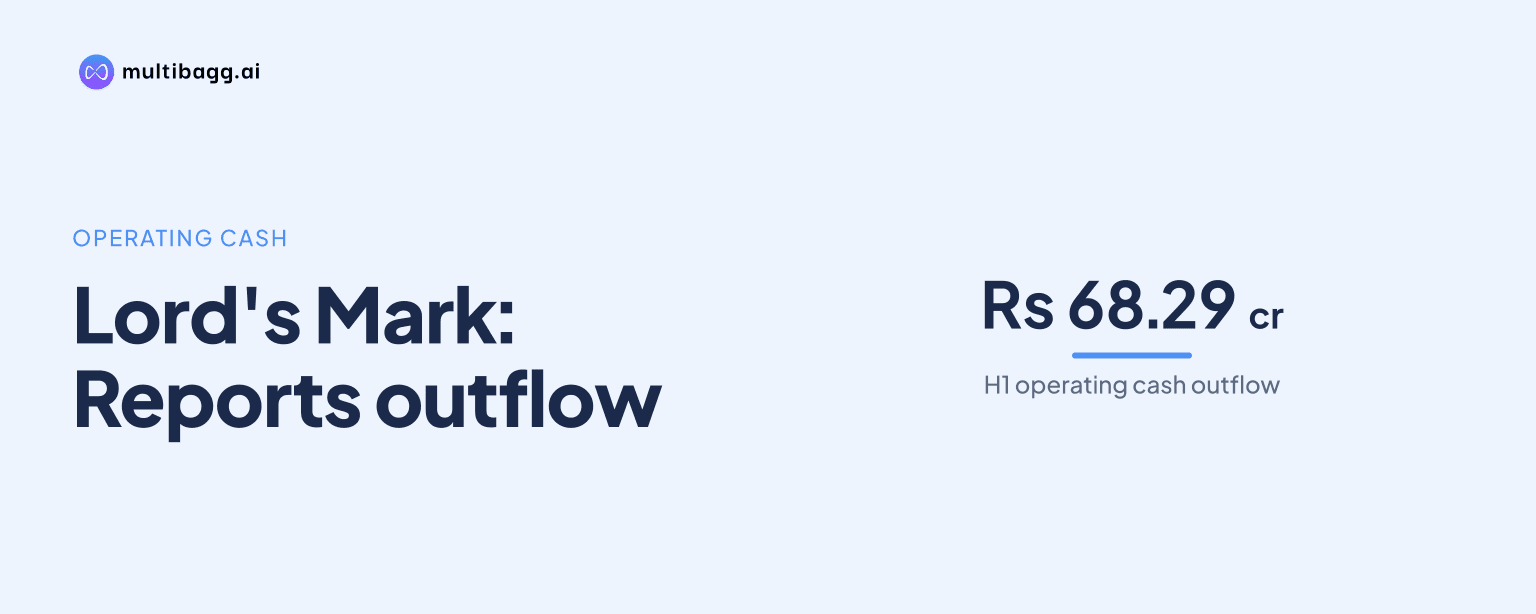
Lord's Mark Industries Limited reported a Rs 68.29 crore net cash outflow from operating activities for the half year ended September 30, 2026, despite Rs 69.43 crore of profit before tax. The cash-flow statement shows Rs 294.61 crore deployed in short-term loans and advances and other current assets, exceeding cash generated before tax.
Know Lords Mark Industries inside out
Results, valuation, peers and who's buying, in one view.
Why did Lord's Mark report an operating cash outflow?
Lord's Mark reported the Rs 68.29 crore operating cash outflow because working-capital movements turned Rs 91.55 crore of cash flow before working-capital changes into Rs 49.29 crore of cash used before tax. The company then recorded Rs 18.99 crore as income tax paid or provided, taking the net operating outflow to the reported level for the period ended September 30, 2026.
The starting point in the cash-flow statement was Rs 69.43 crore of net profit before extraordinary items, the same amount presented as half-year profit before tax in the consolidated results. Lord's Mark added back Rs 4.99 crore of depreciation, Rs 13.97 crore of interest paid on borrowings and Rs 3.15 crore of changes in reserve and surplus, producing the Rs 91.55 crore pre-working-capital figure.
This shows that the reported profit did not translate into operating cash over the six-month period. The source does not give a management explanation for the increase in loans and advances, identify counterparties, or set out repayment terms, so the filing supports the quantified movement but not a conclusion on its commercial purpose.
How did working capital change at Lord's Mark?
The largest working-capital movement was a Rs 294.61 crore increase in short-term loans and advances and other current assets, recorded as a cash outflow in the September 30, 2026 cash-flow statement. That movement was more than three times the Rs 91.55 crore cash flow before working-capital changes and was the principal identified use of operating cash.
The balance sheet records short-term loans and advances of Rs 402.63 crore at September 30, 2026, up from Rs 108.02 crore at March 31, 2026. The balance-sheet increase of Rs 294.61 crore corresponds closely to the cash-flow line, although that line also refers to other current assets. The filing does not provide a note-level split of that cash-flow movement.
Other working-capital items partly offset the advance-related outflow. Trade receivables fell by Rs 183.92 crore in the cash-flow statement, while short-term borrowings fell by Rs 54.72 crore, trade payables increased by Rs 3.39 crore and short-term provisions increased by Rs 20.99 crore. Inventories changed by Rs 0.19 crore, with the balance sheet showing inventory at Rs 149.54 crore at September 30 versus Rs 149.74 crore at March 31.
Got a follow-up? Ask IRIS
What changed in Lord's Mark borrowings?
Lord's Mark's long-term borrowings increased by Rs 78.40 crore to Rs 224.24 crore at September 30, 2026, from Rs 145.84 crore at March 31, 2026. The cash-flow statement likewise lists a Rs 78.40 crore increase in long-term loans during the half year, making this the largest stated financing inflow.
Short-term borrowings moved in the opposite direction, falling to Rs 183.62 crore from Rs 238.34 crore over the same dates. The Rs 54.72 crore reduction appears in operating cash flow as a working-capital movement, while the balance-sheet presentation classifies it as a current financial liability. Together, the two borrowing categories were Rs 407.86 crore at September 30, compared with Rs 384.18 crore at March 31.
Lord's Mark reported Rs 13.97 crore of interest paid on borrowings in both the operating cash-flow reconciliation and financing cash flow. Financing activities generated a net Rs 84.46 crore, including Rs 1.73 crore from share capital, Rs 16.54 crore from share premium and Rs 3.01 crore from share application or warrants, offset by the interest payment and a Rs 1.25 crore minority-interest movement.
How did Lord's Mark's H1 earnings compare with cash flow?
Lord's Mark reported Rs 683.41 crore of income from operations for the six months ended September 30, 2026, compared with Rs 12.64 crore in the corresponding six months of 2025. Total income was Rs 692.07 crore, including Rs 8.66 crore of other income, while total expenses were Rs 622.63 crore.
Profit before tax was Rs 69.43 crore, compared with a Rs 2.14 crore loss before tax in the corresponding prior-year half. After Rs 18.99 crore of tax expense, net profit was Rs 50.44 crore, against a Rs 2.14 crore loss a year earlier. Basic and diluted earnings per share, not annualised, were Rs 1.18 for the half year.
The comparison between profit and cash flow is therefore material: Lord's Mark earned Rs 69.43 crore before tax but reported a Rs 68.29 crore operating cash outflow. Revenue and profit describe performance for April to September 2026, whereas the balance sheet gives positions at September 30, 2026, and the cash-flow statement tracks changes from the March 31, 2026 opening balances.
The consolidated results cover four subsidiaries: Lords Mark Tech Next Private Limited, Lords Green Energy Private Limited, Renalyx Health Systems Private Limited and Lords Mark Micro Biotech Private Limited. The independent auditor's review report dated November 14, 2026 says the reviewer did not audit the interim financial statements and did not express an audit opinion, while stating that nothing had come to its attention suggesting a material misstatement.
Conclusion
Lord's Mark's half-year filing combines a sharp increase in reported revenue and a shift to Rs 69.43 crore of pre-tax profit with a Rs 68.29 crore operating cash outflow. The immediate accounting bridge is the Rs 294.61 crore increase in short-term loans and advances and other current assets, only partly offset by a Rs 183.92 crore reduction in trade receivables and other working-capital changes.
The next point to watch is whether short-term loans and advances, which stood at Rs 402.63 crore on September 30, are recovered or otherwise reduced, and how that affects cash generation. Investors can also track long-term borrowings, which rose Rs 78.40 crore in the half year to Rs 224.24 crore, alongside the company's next reported financial results and cash-flow statement.