










Lords Mark Industries Ltd Q2 Profit Reaches ₹17.26 Crore
Key highlights
- Lords Mark reported Q2 FY27 consolidated total income of ₹379.40 crore and net profit of ₹17.26 crore.
- Consolidated revenue from operations was ₹375.73 crore, while other income was ₹3.67 crore in Q2 FY27.
- Standalone Q2 FY27 total income was ₹343.23 crore and net profit was ₹15.83 crore.
- Lords Mark reported H1 FY27 consolidated total income of ₹692.07 crore and net profit of ₹48.59 crore.
powered by IRIS
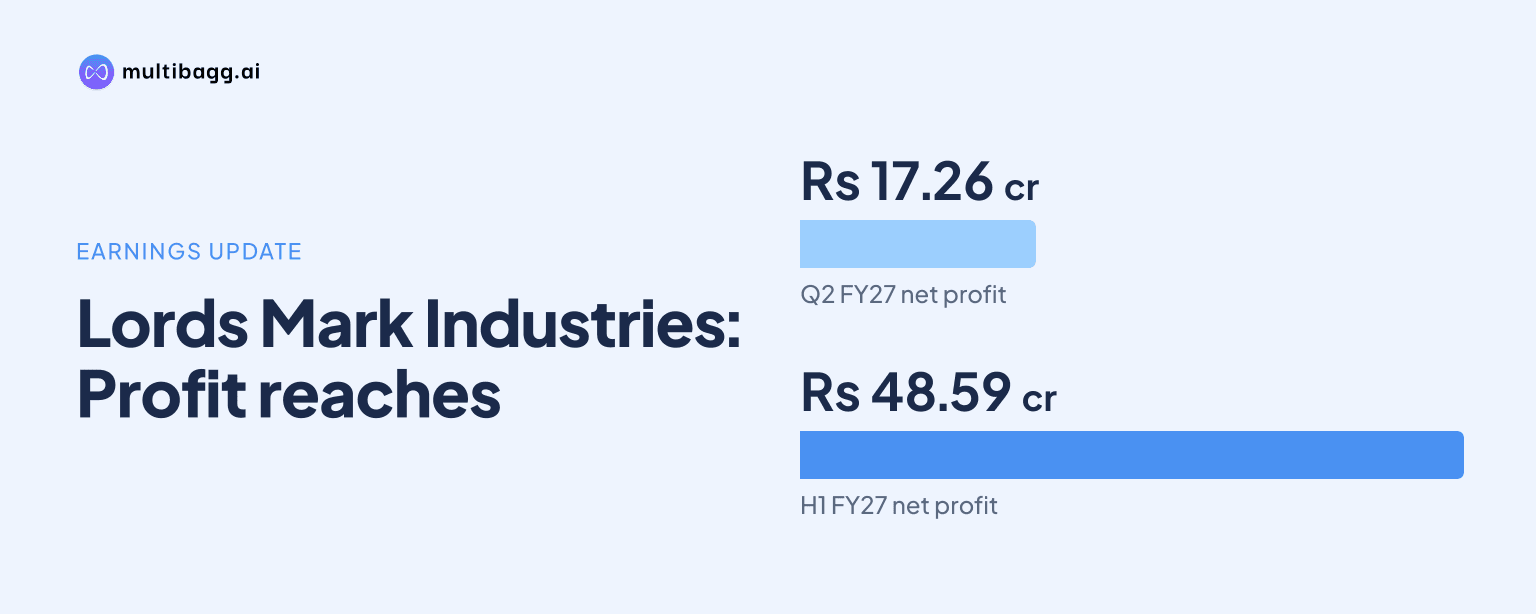
For the quarter ended 30 September 2026, Lords Mark Industries Ltd reported consolidated net profit of ₹17.26 crore on total income of ₹379.40 crore. The result marks a turnaround from a consolidated loss of ₹2.11 crore in the corresponding quarter a year earlier, although comparability is affected by the company’s amalgamation.
Know Lords Mark Industries inside out
Results, valuation, peers and who's buying, in one view.
What did Lords Mark report for Q2 FY27?
Lords Mark reported consolidated revenue from operations of ₹375.73 crore, other income of ₹3.67 crore and total income of ₹379.40 crore for Q2 FY27. Profit before tax was ₹23.96 crore, while net profit stood at ₹17.26 crore. Basic earnings per share were ₹0.40.
The board approved the unaudited standalone and consolidated financial results for the quarter and half year ended 30 September 2026 in a filing dated 14 November 2026. The quarterly numbers show a substantial change in the reported scale of the business compared with Q2 FY26, when consolidated total income was ₹13.37 crore and the company reported a ₹2.11 crore net loss.
The contribution from other income was limited. At ₹3.67 crore, it represented a small portion of consolidated total income, indicating that the reported quarterly income was primarily generated from operations rather than non-operating income.
How did the standalone business perform in the September quarter?
Lords Mark’s standalone business reported total income of ₹343.23 crore and net profit of ₹15.83 crore for Q2 FY27. Standalone revenue from operations was ₹339.59 crore, supplemented by other income of ₹3.65 crore, while profit before tax was ₹21.61 crore. Basic EPS was ₹0.37.
In the year-earlier quarter, standalone total income was ₹10.21 crore and the company reported a net loss of ₹2.42 crore. The move into profit is therefore clear in reported terms, but the scale of the comparison must be viewed alongside the restructuring disclosed by the company.
Other income accounted for about 1.1% of standalone total income. This suggests that the standalone result, like the consolidated outcome, was mainly linked to operating revenue. The difference between consolidated and standalone income also reflects the presence of subsidiaries in the consolidated financial statements.
Why are the year-on-year comparisons not directly comparable?
Lords Mark said its financial results reflect an amalgamation, with consolidated figures including four private companies. This has changed the composition and reported scale of the consolidated business relative to the corresponding quarter of the previous financial year.
As a result, the increase from ₹13.37 crore of consolidated total income in Q2 FY26 to ₹379.40 crore in Q2 FY27 should not be treated as a comparison of an unchanged business structure. Similarly, the swing from a loss to a profit occurred against a low base in the prior-year period.
The company’s reported Q2 revenue from operations of ₹375.73 crore was described as being 2,872% higher year on year. That percentage reflects the very small revenue base in the comparable period, as well as the effect of the amalgamation. Investors assessing the result would need to distinguish between expansion from the combined entity and growth generated by a like-for-like operating base.
Got a follow-up? Ask IRIS
What do the half-year figures show about the business?
Lords Mark reported consolidated total income of ₹692.07 crore and consolidated net profit of ₹48.59 crore for the half year ended 30 September 2026. The disclosed half-year figures include the September-quarter result and provide a broader view of the company’s reported performance during the first six months of FY27.
On a standalone basis, half-year total income was ₹628.46 crore and net profit was ₹48.00 crore. The company had earlier indicated an FY27 revenue target of ₹1,550 crore. The half-year figures provide a reference point for tracking performance against that stated target, though the filing does not provide a revised target or a forecast for the remaining quarters.
How could the Q2 result matter to investors and operations?
Lords Mark’s Q2 filing establishes a profitable consolidated quarter, with net profit of ₹17.26 crore and profit before tax of ₹23.96 crore. It also shows that most of the quarter’s income came from operations, rather than other income. These are relevant data points for investors examining the quality and composition of the reported result.
At the same time, the amalgamation limits a simple year-on-year reading of growth, revenue scale and profitability. The prior-year quarter was considerably smaller and loss-making, while the current consolidated accounts include additional entities. Future filings will be important for establishing a longer comparable record under the current structure.
For industry participants and customers, the results indicate that Lords Mark is reporting operations at a materially larger consolidated scale than in the corresponding period last year. The filing does not provide segment-level revenue, customer concentration, order-book details or a breakdown of the contribution from each amalgamated entity.
Conclusion
Lords Mark reported Q2 FY27 consolidated total income of ₹379.40 crore and net profit of ₹17.26 crore, compared with a ₹2.11 crore loss in Q2 FY26. The standalone business contributed ₹343.23 crore of total income and ₹15.83 crore of net profit. The quarter confirms a return to reported profitability, while the amalgamation makes direct comparisons with the prior-year period less straightforward.
The next point to watch is progress toward the company’s stated FY27 revenue target of ₹1,550 crore. Subsequent quarterly results, along with disclosures on the performance of the combined entities, will help clarify the sustainability of revenue, margins and profits under the post-amalgamation structure.