








L&T wins Rs 1,000-2,500 crore 300 MW Khavda BESS order

Find your next multibaggerBe a Pro Investor
Research stocks and track your picks on the go. Download the app.
Key highlights
- L&T jointly won a 300 MW/900 MWh BESS development order at Khavda, Gujarat, announced on November 25, 2026.
- L&T classifies the Khavda order as Significant, representing a disclosed range of Rs 1,000 crore to Rs 2,500 crore.
- The 900 MWh system is designed as a three-hour BESS with 300 MW of power capacity.
- The Khavda BESS will use liquid-cooling technology, according to L&T.
powered by IRIS
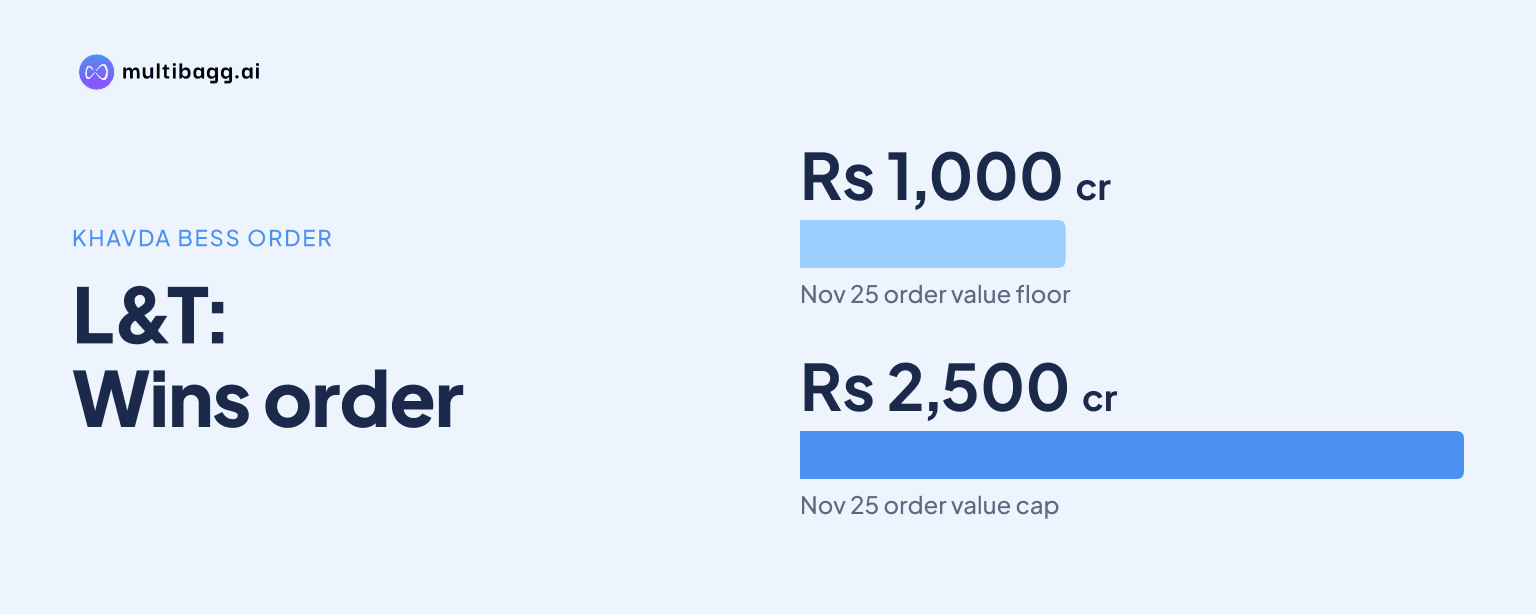
Larsen & Toubro Limited has jointly won a 300 megawatt (MW) and 900 megawatt-hour (MWh) Battery Energy Storage System (BESS) order at Khavda, Gujarat, classified in the Rs 1,000 crore to Rs 2,500 crore Significant band on November 25, 2026. The three-hour project will store surplus renewable energy and release it during peak demand.
Know Larsen & Toubro inside out
Results, valuation, peers and who's buying, in one view.
What order has L&T won at Khavda?
L&T has won a Significant-category order to develop a 300 MW/900 MWh BESS at Khavda in Gujarat, according to its November 25, 2026 announcement. The company did not disclose the customer, exact contract value, construction schedule, commissioning date or commercial terms in the filing.
The Significant classification covers orders valued from Rs 1,000 crore to Rs 2,500 crore under L&T's stated classification table. This is a disclosed value band rather than an announced contract price, so neither Rs 1,000 crore nor Rs 2,500 crore is confirmed as the value of the Khavda award.
L&T said its Renewables business and L&T Electronic Products & Systems (LTEPS) jointly won the 300 MW/900 MWh work. The announcement identifies the scope as development of the BESS project, but does not allocate engineering, equipment supply, construction or services between the Renewables business and LTEPS.
The project is located at Khavda in Gujarat and combines 300 MW of power capacity with 900 MWh of energy-storage capacity. L&T describes this configuration as a three-hour BESS, linking the facility's energy capacity and power capacity in the announced design.
How large is L&T's Khavda battery-storage project?
L&T's Khavda project is rated at 300 MW of power capacity and 900 MWh of energy-storage capacity, making it a three-hour BESS. The November 25, 2026 filing states both capacity measures and the three-hour duration.
The 300 MW and 900 MWh specifications set out two dimensions of the Khavda installation: power capacity and stored-energy capacity. L&T does not disclose the number of battery containers, individual battery units, site footprint, round-trip efficiency or availability target for the 900 MWh system.
The three-hour configuration follows L&T's stated operating purpose for the facility. The company said the BESS will store surplus renewable energy when generation is high and release it during periods of peak demand.
L&T said the 300 MW/900 MWh operating cycle will help maximise clean-energy utilisation, strengthen grid stability, and enhance the flexibility and reliability of power supply. These are the company's stated intended outcomes for a project announced as an order win, not operating results from the facility.
How will the Khavda BESS use renewable power?
The Khavda BESS is intended to absorb surplus renewable power during high-generation periods and supply stored electricity during peak demand. L&T links this mechanism for the 300 MW/900 MWh facility to greater use of clean energy and improved grid stability.
The announced three-hour duration is central to that mechanism, with 900 MWh of energy-storage capacity paired with 300 MW of power capacity. The filing does not identify the renewable generation source, grid connection, offtake arrangement, dispatch authority or expected number of daily charge-discharge cycles.
L&T also said the Khavda facility will improve grid flexibility and enable greater integration of renewable energy into India's power network. The release does not quantify the amount of renewable electricity expected to be shifted by the 900 MWh system or any effect on peak demand.
No revenue, availability, degradation or operating-life estimate was disclosed for the 300 MW project. L&T's November 25, 2026 announcement instead describes the BESS's role as managing the timing difference between surplus renewable generation and periods of peak power demand.
Got a follow-up? Ask IRIS
What technology will L&T deploy at Khavda?
L&T said the 900 MWh BESS will incorporate liquid-cooling technology intended to provide higher power density, enhanced safety and a longer operating life. The filing does not identify the battery chemistry, battery supplier, inverter supplier, cooling-system supplier or technology partner.
Liquid cooling is the specific technical feature disclosed for the 300 MW project. L&T describes its expected benefits in qualitative terms and does not provide a thermal-performance measure, temperature range, warranty period or availability commitment.
LTEPS is one of the two L&T verticals that jointly won the 300 MW/900 MWh order, alongside the Renewables business. The announcement does not state which of those two verticals will supply or integrate the liquid-cooling system and other BESS components.
L&T also does not disclose whether the Khavda facility will be delivered in phases or as one installation. The confirmed technical details are therefore the 300 MW power rating, 900 MWh energy-storage capacity, three-hour duration and liquid-cooling technology.
What does L&T's Significant order classification mean?
L&T's Significant classification means the Khavda order falls in a value range of Rs 1,000 crore to Rs 2,500 crore. The company places this below the Large classification, which starts at Rs 2,500 crore, while withholding the exact contract consideration.
The disclosed classification rises from Significant to Large at Rs 2,500 crore, then to Major at Rs 5,000 crore. Because L&T labels the Khavda contract Significant, the filing supports only the Rs 1,000 crore to Rs 2,500 crore band and not an exact award value.
L&T said the 300 MW order further strengthens its position in energy storage and reflects clients' confidence in its ability to deliver complex projects at scale. This is L&T's assessment; the release provides no order-book addition, margin expectation, execution timeline or financial-period effect.
The project combines the Renewables business and LTEPS in a 900 MWh storage development at Khavda. L&T's filing does not connect the order with a separate segment revenue figure, backlog figure or expected contribution from either of the two verticals.
Conclusion
The Khavda order adds a 300 MW/900 MWh, three-hour BESS development to L&T's announced work, within a disclosed Significant value band of Rs 1,000 crore to Rs 2,500 crore. Its liquid-cooled design is intended to store surplus renewable energy and make it available when electricity demand peaks.
The next matters to watch are the undisclosed execution details in L&T's November 25, 2026 announcement, including the customer, exact contract value, delivery plan and commissioning date. Further disclosures may also establish how the Renewables business and LTEPS will divide work on the 900 MWh project.

